
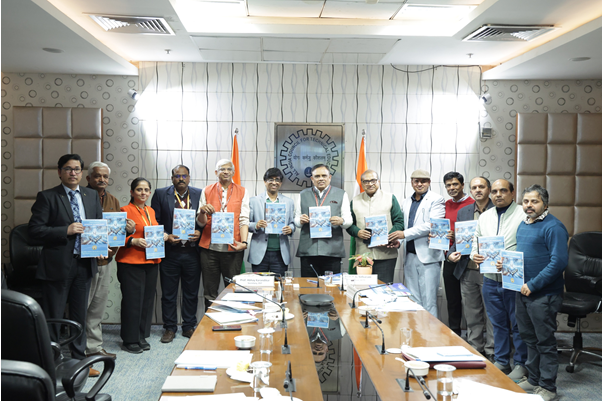
The Department of Science and Technology (DST) in collaboration with All India Council for Technical Education (AICTE) announced a dedicated curriculum at the undergraduate level, to create a thriving quantum-trained ecosystem in India as part of the National Quantum Mission.
Professor Ajay K Sood, Principal Scientific Advisor to Govt. of India said that the curriculum will integrate theoretical knowledge with hands-on lab experience, aiming to deepen graduates' understanding of quantum technologies through a minor program in the subject at undergraduate level. Highlighting the progress made in the National Quantum Mission, Prof. Sood emphasised the importance of this initiative to align with the goals of the Mission in order to create a quantum-ready workforce for the country’s technological advancement and global leadership.
The National Quantum Mission from the Government of India is a decisive step in accelerating the nation’s research and technology development in this field. Such research and technology development will require a highly skilled workforce through immediate initiatives in teaching and training.
The curriculum will help impart training for developing this workforce to enable them to reach global standards, and simultaneously address the multi-disciplinary needs of quantum technology development -- from basic to applied research.
Professor Abhay Karandikar, Secretary Department of Science and Technology said that the announcement of this curriculum marks a significant step in building a quantum-ready workforce. ‘It is designed for undergraduate students to establish a strong foundational and advanced knowledge base keeping in mind the diversity in the institutions, and will enable all engineering students irrespective of their disciplines to undertake UG minor in quantum technologies from their third or fourth semester.” he added.
“For the success of the program, training of teachers and basic lab infrastructure will also be required. National Quantum Mission will support creation of teaching labs in some select institutions and will work with AICTE for faculty development,” Prof. Karandikar pointed out.
Prof. Karandikar urged institutes to adopt the curriculum proactively and also students to recognize the importance of integrating quantum technologies into research, education, and innovation strategies.
Dr. Ajai Chowdhry Chairman MGB, NQM said that while this course will help in developing manpower in quantum technology in the country, internships should also be started in parallel to create more value for the students.
Professor T G Sitharam, Chairman All India Council for Technical Education (AICTE) highlighted that this is a new beginning in quantum revolution to leverage the potential of quantum technology to create impact in society. “Our curriculum is ready and hopefully it will be included from next July session in all top institutions,” he added.
While institutes of national importance have begun programs to this end, expanding such training to a larger pool of institutes across the country can enable the nation to tap into the vast resource of students who can then participate in the mission to accelerate its progress towards its goals. The course would be taken up for implementation by AICTE approved institutions across the country.
The course structure includes all four verticals of Quantum Technology -- Quantum Computing, Quantum communications, Quantum sensing and metrology, Quantum materials and devices. The proposed curriculum constitutes a minimum of 18 credits with both theory and lab courses. Each course amounts to 3 credits (1 credit translating to 1 in-class contact hour per week for a theory course or 1 session of lab for 3 hours for a lab course), thereby making the minor program span a minimum of 6 courses.
Faculty Development Programs in the areas of Quantum Technologies are also proposed to be carried out to enable them to do justice to the goals of the minor program. Such sustained teacher training efforts will also enhance the quality of the training imparted to students over the years leading to long-term benefits and enable India to become a world leader in this field.
Apart from this course, National Quantum Mission in collaboration with AICTE is also planning to support creation of labs to aid teaching in the areas of quantum technologies, writing of books for the course and quantum awareness programmes.
Proposed structure of the program:
Minimum credits to fulfil – 18
A 3.0.0 course has 3 theory lectures per week and considering an average length of 14 weeks for a semester,
A 3:0 course amounts to at least 36 hours of lectures (considering holidays, exam days etc).
A n:m lab course has n hours of lectures and m sessions (3 hours each) of lab per week.
Source: https://dst.gov.in/dst-along-aicte-announces-undergraduate-courses-quantum
Comments
Post a Comment
Have a Say?..Note it down below.