
Through this assessment, for the first time, tech education council will test students while they're studying instead of after graduation, to identify lacunae and redress them.
KRITIKA SHARMA 22 September, 2021 8:57 am IST
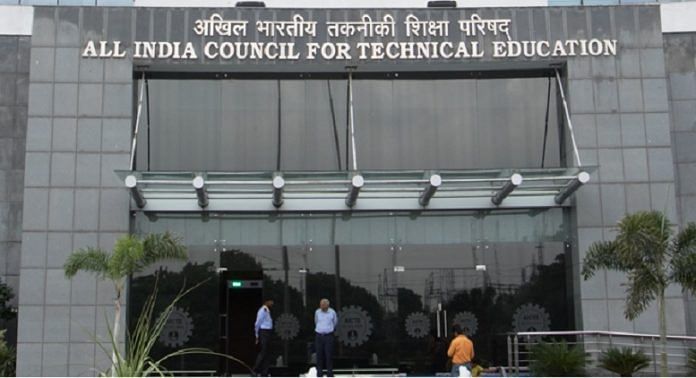
New Delhi: For the first time, the All India Council for Technical Education (AICTE) is set to measure the learning levels of engineering as well as management students during the course of their studies, ThePrint has learnt.
The move is the result of earlier findings of skill assessment reports, which have shown, among other things, that Indian engineers lack new-age tech skills.
The AICTE’s Student Learning Assessment project will test management students on skills like ability in planning and organising human, financial and physical resources. For engineering, the skills tested will be in emerging areas like blockchain technology and artificial intelligence, core engineering knowledge, and basic knowledge of maths, physics and chemistry. Mental and social abilities of both sets of students will also be measured.
The assessment will be conducted online for all branches of engineering and management across all AICTE-affiliated colleges in India and is set to begin soon, officials at the council told ThePrint.
Through this assessment, the council plans to gauge the learning level of a student during the course, identify lacunae, and redress them. The assessment will also help judge the employability of students, officials said, adding that students will be assessed through questionnaires according to their year of study.
AICTE member Secretary Rajive Kumar told ThePrint: “We want to identify the learning gaps among students at various stages, and take corrective measures. This assessment is not just open to students, but we are asking institutes to extend it to teachers as well, so that they know how to improve the teaching quality.”
Shocking employability statistics
Though there have been employability assessments in the past like the ‘India Skills Report’ released annually, in association with the AICTE, Confederation of Indian Industries (CII) and other private agencies, an assessment while students are still enrolled has not been undertaken yet.
Over the years, the India Skills Report has highlighted shocking employability statistics on Indian graduates. The 2021 report, for example, shows that the employability of B.E./B.Tech. graduates has declined over the years. According to the 2015 report, 54 per cent of graduates were employable, but the number came down to 46.8 per cent in 2021.
The idea of conducting a pan-India assessment on engineering and management students came after a study on a small number of institutions was undertaken by Stanford University two years ago under a World Bank-funded project, the Technical Education Quality Improvement Programme (TEQIP). The study focused on students from 167 institutions from India and compared their learning levels to those in China, Russia, and other nations.
While the complete report of the Stanford study is still awaited, sources said the preliminary findings show that Indian students fare better than their counterparts from China and Russia in terms of their learning abilities when they reach senior classes.
“After the Stanford University study, an internal committee suggested that we should do a larger study for our institutes by ourselves. It will not just help us assess students but the institutes can also take corrective measures, like appointing a new faculty member if students are facing problems with a subject, try a different teaching approach among other measures,” an AICTE official added.
(Edited by Paramita Ghosh)
KRITIKA SHARMA 22 September, 2021 8:57 am IST
New Delhi: For the first time, the All India Council for Technical Education (AICTE) is set to measure the learning levels of engineering as well as management students during the course of their studies, ThePrint has learnt.
The move is the result of earlier findings of skill assessment reports, which have shown, among other things, that Indian engineers lack new-age tech skills.
The AICTE’s Student Learning Assessment project will test management students on skills like ability in planning and organising human, financial and physical resources. For engineering, the skills tested will be in emerging areas like blockchain technology and artificial intelligence, core engineering knowledge, and basic knowledge of maths, physics and chemistry. Mental and social abilities of both sets of students will also be measured.
The assessment will be conducted online for all branches of engineering and management across all AICTE-affiliated colleges in India and is set to begin soon, officials at the council told ThePrint.
Through this assessment, the council plans to gauge the learning level of a student during the course, identify lacunae, and redress them. The assessment will also help judge the employability of students, officials said, adding that students will be assessed through questionnaires according to their year of study.
AICTE member Secretary Rajive Kumar told ThePrint: “We want to identify the learning gaps among students at various stages, and take corrective measures. This assessment is not just open to students, but we are asking institutes to extend it to teachers as well, so that they know how to improve the teaching quality.”
Shocking employability statistics
Though there have been employability assessments in the past like the ‘India Skills Report’ released annually, in association with the AICTE, Confederation of Indian Industries (CII) and other private agencies, an assessment while students are still enrolled has not been undertaken yet.
Over the years, the India Skills Report has highlighted shocking employability statistics on Indian graduates. The 2021 report, for example, shows that the employability of B.E./B.Tech. graduates has declined over the years. According to the 2015 report, 54 per cent of graduates were employable, but the number came down to 46.8 per cent in 2021.
The idea of conducting a pan-India assessment on engineering and management students came after a study on a small number of institutions was undertaken by Stanford University two years ago under a World Bank-funded project, the Technical Education Quality Improvement Programme (TEQIP). The study focused on students from 167 institutions from India and compared their learning levels to those in China, Russia, and other nations.
While the complete report of the Stanford study is still awaited, sources said the preliminary findings show that Indian students fare better than their counterparts from China and Russia in terms of their learning abilities when they reach senior classes.
“After the Stanford University study, an internal committee suggested that we should do a larger study for our institutes by ourselves. It will not just help us assess students but the institutes can also take corrective measures, like appointing a new faculty member if students are facing problems with a subject, try a different teaching approach among other measures,” an AICTE official added.
(Edited by Paramita Ghosh)
Comments
Post a Comment
Have a Say?..Note it down below.