
The biggest concern remains the manuscripts — nearly 300 had been digitised recently, but the computer that stored the records was washed away.
Written by Ajay Jadhav |Sangli |Updated: September 6, 2019 8:30:22 am
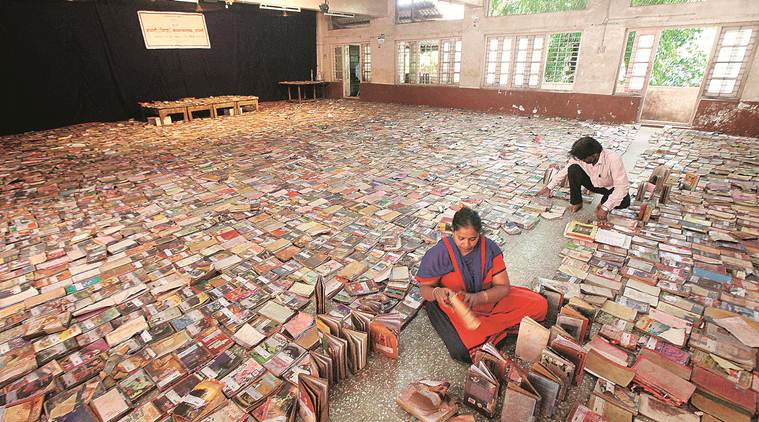 At the Sangli District Nagar Vachnalaya, one of the oldest public libraries. (Express photo by Pavan Khengre)
GROUPS OF students in shifts, staff, well-wishers — and three heaters plus six hair dryers.
Advertising
For nearly a fortnight now, this combination has been hard at work at the Sangli Nagar Vachanalaya to save whatever is possible from the thousands of books and rare manuscripts damaged in the recent floods in southwestern Maharashtra.
The 150-year-old three-storey facility, with 2,500 members, is one of the oldest public libraries in the country. It houses over 1.8 lakh books and documents, including over 600 rare manuscripts from 400 years ago. Of these, officials estimate that nearly 75,000 books and at least 100 manuscripts were damaged in the floods that submerged parts of Sangli, Satara and Kolhapur in August.
“Most of the books were on the ground floor to enable easy access. We tried to save them as the water started entering, but had to finally leave to save our own lives,” says librarian Surekha Naik.
Advertising
Today, many of the damaged books are beyond repair. Some have also started showing signs of fungal growth. The others have been spread on the floor across the building, from the staircase to the passage and the cultural hall. Naik is among the six fulltime staff busy arranging the books to dry under the ceiling fans. Then, there are the hair dryers. “We gave priority to the manuscripts and began to dry them with a hair dryer as there was no other way. We had one dryer at the beginning. Our appeal to members resulted in five more being used. They are effective,” says Naik. The library is also using three heaters, two of them donated by members. “We were also fortunate to get additional hands from Pune and Sangli colleges. Three teams of ten students each came down and stayed with us for two days in rotation to help us prepare a list of damaged books,” she says.
The biggest concern remains the manuscripts — nearly 300 had been digitised recently, but the computer that stored the records was washed away. “Fortunately, the person who had carried out the digitisation had saved another copy,” says Naik.
“I have gone through about 10,000 manuscripts in libraries across the state but those in Sangli Vachanalaya were in the best condition,” says Priyanka Mujumdar, who digitised the manuscripts in Sangli under the National Mission for Manuscripts of the Centre.
”The manuscripts relate to ancient texts, including the Vedas, Puranas, Dharmashastra, Ayurveda, Jyotishshastra, etc. It would require a miracle to save them now, considering that the paper and ink were so old,” says Mujumdar, who is a post-graduate in Sanskrit and diploma-holder in Manuscripts.
At the library, staff say financial assistance is required to replace damaged furniture and computers. Once operations resume, possibly within the next six months, the library also plans to prepare a list of books lost and issue an appeal for copies to be donated.
”We are also reaching out to experts for preservation of the books. We will take the help of social organisations to fund our efforts,” says Atul Gijre, secretary of the governing body of Sangli Vachanalaya.
According to Ujjwala Londhe, district library officer, 17 public libraries in Sangli were affected by the floods, with three small libraries getting completely damaged. The district library office has estimated a loss of Rs 63.7 lakh, including Rs 39.95 lakh in Sangli Vachanalaya alone.
Written by Ajay Jadhav |Sangli |Updated: September 6, 2019 8:30:22 am
At the Sangli District Nagar Vachnalaya, one of the oldest public libraries. (Express photo by Pavan Khengre)GROUPS OF students in shifts, staff, well-wishers — and three heaters plus six hair dryers.
Advertising
For nearly a fortnight now, this combination has been hard at work at the Sangli Nagar Vachanalaya to save whatever is possible from the thousands of books and rare manuscripts damaged in the recent floods in southwestern Maharashtra.
The 150-year-old three-storey facility, with 2,500 members, is one of the oldest public libraries in the country. It houses over 1.8 lakh books and documents, including over 600 rare manuscripts from 400 years ago. Of these, officials estimate that nearly 75,000 books and at least 100 manuscripts were damaged in the floods that submerged parts of Sangli, Satara and Kolhapur in August.
“Most of the books were on the ground floor to enable easy access. We tried to save them as the water started entering, but had to finally leave to save our own lives,” says librarian Surekha Naik.
Advertising
Today, many of the damaged books are beyond repair. Some have also started showing signs of fungal growth. The others have been spread on the floor across the building, from the staircase to the passage and the cultural hall. Naik is among the six fulltime staff busy arranging the books to dry under the ceiling fans. Then, there are the hair dryers. “We gave priority to the manuscripts and began to dry them with a hair dryer as there was no other way. We had one dryer at the beginning. Our appeal to members resulted in five more being used. They are effective,” says Naik. The library is also using three heaters, two of them donated by members. “We were also fortunate to get additional hands from Pune and Sangli colleges. Three teams of ten students each came down and stayed with us for two days in rotation to help us prepare a list of damaged books,” she says.
The biggest concern remains the manuscripts — nearly 300 had been digitised recently, but the computer that stored the records was washed away. “Fortunately, the person who had carried out the digitisation had saved another copy,” says Naik.
“I have gone through about 10,000 manuscripts in libraries across the state but those in Sangli Vachanalaya were in the best condition,” says Priyanka Mujumdar, who digitised the manuscripts in Sangli under the National Mission for Manuscripts of the Centre.
”The manuscripts relate to ancient texts, including the Vedas, Puranas, Dharmashastra, Ayurveda, Jyotishshastra, etc. It would require a miracle to save them now, considering that the paper and ink were so old,” says Mujumdar, who is a post-graduate in Sanskrit and diploma-holder in Manuscripts.
At the library, staff say financial assistance is required to replace damaged furniture and computers. Once operations resume, possibly within the next six months, the library also plans to prepare a list of books lost and issue an appeal for copies to be donated.
”We are also reaching out to experts for preservation of the books. We will take the help of social organisations to fund our efforts,” says Atul Gijre, secretary of the governing body of Sangli Vachanalaya.
According to Ujjwala Londhe, district library officer, 17 public libraries in Sangli were affected by the floods, with three small libraries getting completely damaged. The district library office has estimated a loss of Rs 63.7 lakh, including Rs 39.95 lakh in Sangli Vachanalaya alone.
Comments
Post a Comment
Have a Say?..Note it down below.