VIKRAM SARABHAI'S 100TH: WORDS FROM THE AWARD-WINNING LEADER'S 1971 SPEECH REMAIN IMPORTANT FOR INDIA TODAY

Editor's Note: On 10 April 1971, at the Silver Jubilee Celebration of the Tata Institute of Fundamental Research, the father of India's Space program Dr Vikram Sarabhai was invited to take the stage and share a few words as the Guest of honor. He spoke of the role Tata Institute of Fundamental Research plays in the country's biggest atomic energy program (the Atomic Energy Commission, of which Sarabhai was the President 1966–1971) and the importance of institutes of national import to freely-interact in clusters with others important institutions to address the needs of a developing nation like India.
Your Excellency, Mr Tata, Prof Menon and friends,
I speak here on behalf of the Atomic Energy Commission of India with admiration, gratitude, pride, and expectation as Panditji said, "This Institution has been the cradle of Atomic Energy in India", and it is through the agency of one single person: Homi Bhabha, that we saw during the early part of the fifties and right to the middle of the sixties a creation and the development of 3 major institutions — not only the Atomic Energy Commission itself but the Tata Institute of Fundamental Research and the Atomic Energy Establishment, of all three of which Bhabha was the guiding spirit.
But when in 1966 Bhabha met his tragic death, it was considered appropriate to separate the directing responsibility of each one of these three units, and we have in Professor Menon a most distinguished successor to Bhabha in the role of the Director of the Tata Institute of Fundamental Research. It is necessary for creative work to be able to see squirrels and birds. It is not a physicist's remark and I feel that Professor Menon has not only maintained the excellence of this Institute but has kept up the core 0f the culture which was created so admirably by Bhabha for the type of creative work which was to be done here.
Vikram Sarabhai (left), Chairman of ISRO, and NASA administrator Thomas Paine sign an agreement in September 1969. Image: NASA
But one of the most important aspects which I would like to deal with you here is this aspect of the relationship of the culture of fundamental research, the culture of research and development and the culture of industry; for the main task of Atomic Energy Commission in this county is to provide the benefits of Atomic Energy for the development of the nation. And I think it is necessary to understand that the main task is related to the completion of this entire innovative change from fundamental research to the industry, if we are to succeed.
I would suggest that the primary task of fundamental research is to discover; of research and development is to optimise, and of the industry to produce. One of the main problems that are faced in the organisation of innovative institutions or establishments is to make the link between these three cultures and to provide for a basis by which transfer of knowledge, of men, of technology can proceed from one step to another interacting freely and also benefitting one from the other. Margarate Mead has talked of the interacting clusters which are necessary if development and change are to take place. The clusters which are in each one of these three cultures require their transfer men who shared each other's trust above all and who share a common commitment to a profession, to science, to excellence, to certain common ideals. In electrical engineering, it is well known that energy from one loop to another can only be transferred if there are matched impedances.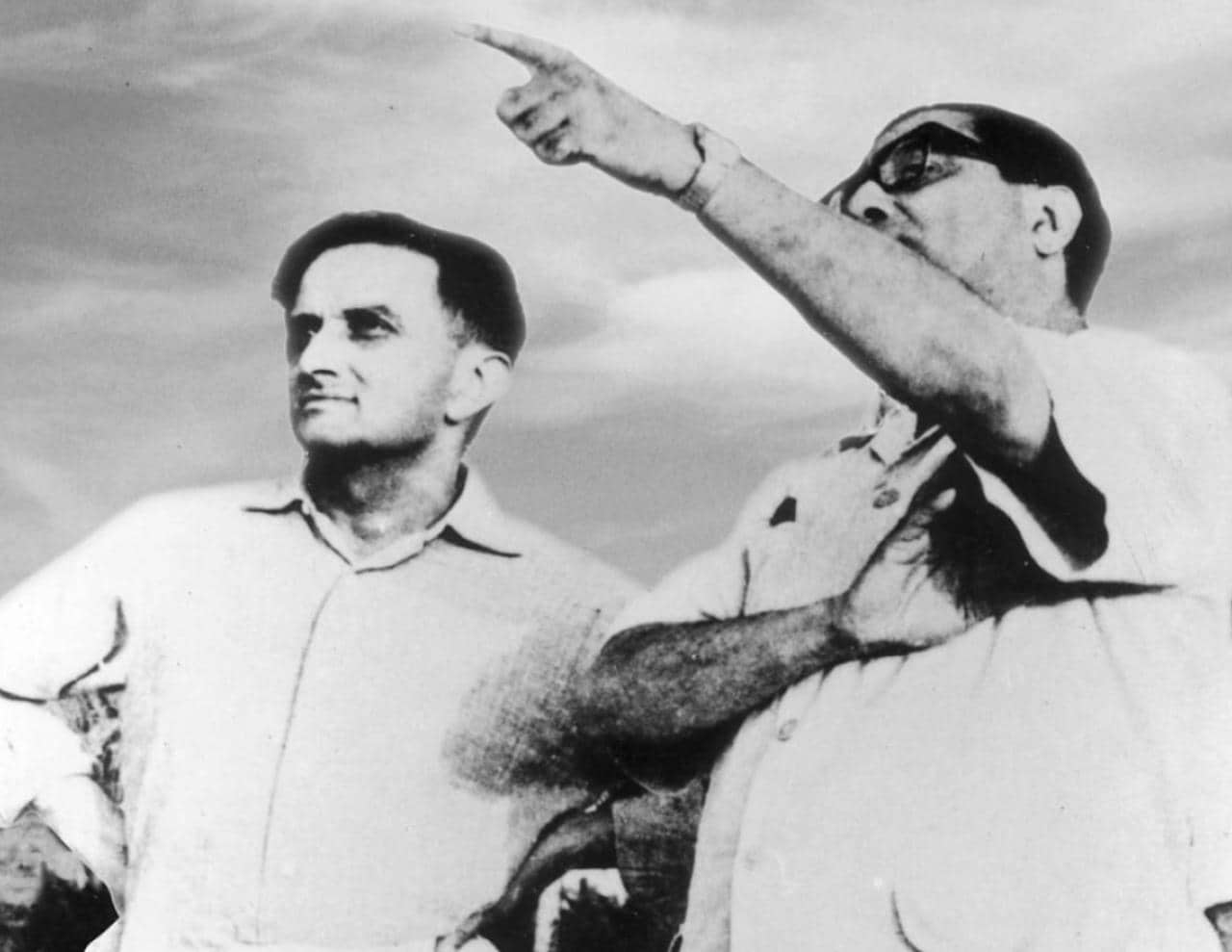
Dr Vikram Sarabhai with Dr Homi Bhabha. Image courtesy: Darpana Archives
It is these common matching transformers at which the point of transfer takes place and it is through the men who are occupying positions of trust in these different clusters that it is possible to make the most important transfers which are involved in the innovative change. I would like to suggest that one of Bhabha's greatest accomplishments was that when he died suddenly, he left the state of affairs in the hands of people who shared a common trust and a common culture and could manage to develop these institutions further as a joint group or a family.
Dr Menon has already remarked about the role that the Tata Institute of Fundamental Research is playing in transferring electronics technology to the Electronics Corporation of India, of the big role that today they will be playing in the development of the computer industry in this country, and in the development of radars for the Space Research or the Variable Energy Cyclotron. There are a number of projects which TIFR continues to share with the other members of the family of Atomic Energy. In the years to come, we have a very challenging task before us. The 10-year profile of Atomic Energy and Space Research requires the best from our bright and talented scholars.
Comments
Post a Comment
Have a Say?..Note it down below.