Kashaf Shaikh is one of the most renowned entrepreneurs in the country and all across the globe. With her innovative set of skills, mindfulness, and determination, she founded one of the most famous websites in the country which is called Dealivore. It is an authentic website which is full of various kinds of coupons which are valid and real and can be used across a lot of stores all over the country. Also, if you are a purchaser of online products from various e-commerce websites then you have to check her website because all the coupons, she puts on the website are pure deals which will surely make your experience on the shopping portals better and fascinating.
However, she is a computer engineer basically. She completed her graduation......
AI-based project management tools can eventually reduce the dependency on project managers - istock.com
AI increasingly taking over the role of project managers in software firms
Mid-level IT employees in the software services sector could be staring at another round of job losses as Artificial Intelligence (AI) takes over their roles, especially in the area of project management.
In the $167-billion Indian IT industry, project managers constitute 5-7 per cent of the 3.8-million workforce. Though all of them may not be rendered redundant, a large chunk of them might struggle to retain their jobs because of the increasing role played by AI.
Role of project managers
Project managers play a key role as they are in charge of a specific project or projects within an organisation. Typically, their job entails ensuring that projects are completed on time, carrying out analyses across a range of projects from maintenance to application development, giving updates on the status of projects, and sharing insights on the number of people required for the project and other factors such as kind of expertise needed, explained AV Sridhar, CEO and co-founder of Digité, Inc, an application lifecycle management company.
All that can change quickly. Project management tools, which have been gathering data over decades and now have an AI layer as well, may eventually reduce the dependency on project managers, making many of their roles redundant.
“In effect, what this means is that the machines will do a majority of our tasks,” said Syed M, a project manager with one of the top 10 outsourcing companies in Bengaluru.
Most project management products show a rear-view mirror image of projects. Companies now look for technology to predict and enhance employee productivity, said Kris Lakshmikanth, CEO, Headhunters India.
The top five software majors — TCS, Infosys, HCL Tech, Wipro and Cognizant — work on 9,000–12,000 projects. While companies do not provide granular data on how many project mangers are deployed for each of these projects, industry watchers believe a project typically requires between three and seven such managers depending on the complexity and the value.
Cost-saving tech
AI’s benefits can be gauged from a Deloitte case study, which said that with technology, a bank can expect to save $40 million in three years as the use of automation is directly linked to margin improvements, 70 per cent cost reduction (against employing people), and higher productivity.
According to Vasumathi, President of Forum for IT Employees (FITE), Chennai chapter, the association does back the use of technology as the nature of jobs changes rapidly. “However, we believe that the benefits (which companies accrue from technology) are not shared with employees,” she said.
According to FITE data, around 60,000 employees in the technology sector were forcibly asked to leave in 2017.
But according to industry body Nasscom, around 1.8 lakh jobs were added in 2018, which opens up the debate of whether employees made redundant by technological advancement should be allowed to go or retained because of their age profile.
NEW DELHI: Industrial growth slipped in January, failing to build on modest recovery in the
month before while consumer inflation inched up in February though remaining well below the
central bank’s target, strengthening the case for another rate cut in the next monetary policy
review.
Inflation, as measured by the Consumer Price Index (CPI), rose to a four-month high of 2.57%
from 1.97% in January, data released by the statistics office on Tuesday showed.
The simultaneously released Index of Industrial Production (IIP) showed a 1.7% rise in
industrial output in January. Industrial growth was 2.6% in December, revised upward from
2.4% estimated initially.
Retail inflation has stayed below the Reserve Bank of India’s (RBI) medium-term target of 4%
for the seventh straight month and has opened up the possibility of more rate cuts as
industrial growth remains tepid.
“With inflation remaining below RBI’s target, inflationary expectations declining and growth
profile weakening, RBI may frontload its monetary easing in the beginning of FY20,” said Devendra Kumar Pant, chief economist, India
Ratings. The RBI last month lowered the benchmark repo rate by 25 basis points, its first rate cut in 17 months.
Poor Start to the Fourth Quarter
One basis point is one-hundredth of a percentage point......
Teach India’s
volunteers feel rewarded when they see the difference they have made to their
students’ lives
TIMES NEWS NETWORK
‘He who can, does. He who can’t,
teaches,’’ is a saying often used to dismiss those in the teaching profession.
Yet Teach India initiative proves that even author George Bernard Shaw could be
wrong sometimes. Among the illustrious list of people who volunteer their time
for teaching in the programme are corporate executives, homemakers and
entrepreneurs who have never taught before.
Like Gurugram-based Pooja Widhani who
works in a garment-buying house and has more than 20 years of experience
working with international brands. “I had held meetings, travelled the world
but never taught. My son said ‘Mom give it a shot’, and I did,’’ she recalls.
That was 2014. From training a batch of 20 students Pooja has moved on to
training and mentoring teachers for the Gurgaon and south Delhi region.
Despite long years in the corporate
sector, the fact that 20 lives were in her hands was a responsibility that made
her nervous. The turning point came when 80% got a job. One student touched her
feet and said that she had changed his life. “That changed my life. It
motivated me so much and has made me feel better about myself than all those
fancy jobs I have held over the years.’’ The Teach India campaign this year is
in partnership with the American Express and will impact the lives of 1,400
learners who will be given training in communication and English to improve
their employability.
Launched in 2010, the programme has had
significant success. It has so far trained 80,000 learners over the last eight
years. Of these, 52,800 learners have secured jobs. The programme aims to reach
100,000 learners by 2020.
This has been due to the earnestness of
people like Pooja Widhani and Pradeep Jain. Jain, 58, spent more than three
decades working in operations as a senior VP. After a hectic career, he was
looking for a change. “I started working with Teach India in 2014. My thinking
has changed a lot since then. I started working with an NGO for differently
abled children near Bhikaji Cama Place, as well as an NGO in Mehrauli in a
Muslim-dominated area,” he says. He hadn’t seen that kind of poverty before.
“You read about it, but it’s a completely different experience to see the
reality of it.”
He convinced his wife Jyotsna to join
Teach India as well. “My husband would tell me how much he enjoys it, and how
content he feels doing this work. I was inspired by him and decided to become a
part of it,” says the 63-year-old homemaker-turned- teacher. “Recently, I’ve
been working with a Gurugram-based NGO that teaches women who are homemakers. The
experience has changed my life.’’ Pradeep Jain adds, “Seeing the willingness of
these children to learn and make something of themselves against all odds has
been an inspiration.”
More recent volunteers include
Gurugram-based designer Aakriti Verma, who joined Teach India in 2016, soon
after completing her graduation in apparel export in the UK. “I had just set up
my brand and was struggling to establish it,” says Verma, 26. “It was busy but
I thought the starting point of my career was the right time to volunteer and
it could help me bring a fresh energy to what I did.”
Since then, Verma has worked with NGO
Sahyog, Gurugram Traffic Police and Indian Army jawans’ wives. She says the
sessions have also helped her become more confident in her professional life.
“I have to talk to a lot of people as part of my work, and when you talk to so
many people on stage, you become fearless,” says Verma.
She also forged a personal bond with
students, and says the programme offered her an opportunity to interact with people
she would’ve otherwise never met. “For example, we don’t really interact with
the police,” she says. She continues to be in touch with many of her students,
such as a Gurugram policeman who tells her how learning spoken English has
helped him figure out when people are making fun of him. “Many still call to
wish me on my birthday. Even if I’ve made a small difference to someone, it’s
been worth it,” she says.
LEARNING CURVE: Volunteers
from diverse backgrounds ranging from corporate executives to homemakers are
part of the Teach India initiative
It will include tracks on segments such as healthcare, manufacturing, telecom, smart cities and agriculture
The Internet of Things (IoT) India Congress, an event which will see digital technology leaders converge to discuss and explore business opportunities in mainstreaming IoT, will be held in Bengaluru on August 22-23, 2019.
The IoT India Congress 2019 will include tracks on segments such as healthcare, manufacturing, telecom, smart cities, energy, retail, cyber security, skills and development, IoT Standards, legal and regulatory, and agriculture.
Tata Consultancy Services has launched a new version of the Metadata Registrv and Transformation (MRT) Platform that helps life sciences companies streamline their clinical data management by automating clinical study design and set up and conversion of clinical data into standard formats for greater interoperability across the clinical trial phases.
The MRT platform is part of TCS' Advanced Drus Development (ADD) suite of cloud-based clinical platforms, which are powered by a cognitive engine.
Powered by Capital Market - Live News
(This story has not been edited by Business Standard staff and is auto-generated from a syndicated feed.)
New York: Accenture (NYSE: ACN) has been recognized by IBM as a top-performing global partner at the 2019 IBM Beacon Awards ceremony, held recently in San Francisco. For the second year in a row, Accenture Interactive was recognized as the IBM Watson Customer Engagement Partner of the Year.
The Assistive Technology Accelerator focusses on startups building tech-based solutions for the differently abled
See a problem, solve it – that’s the mantra that most startups set out with. And in doing so, they come up with solutions that makes things easier for a wide audience. The same goes for startups working in assisted technologies. However, most often, these startups can find it difficult to reach out to the intended market and target audience.
“In fact, people with disabilities are one section of the society that are the least exposed to technology when the fact is that they would be able to make the most from it,” says Prateek Madhav, CEO of Assistive Technology Accelerator (ATA).
This was the genesis for starting the ATA, which focusses on startups that are building assistive technology for the disabled. For close to two decades now, Prateek has straddled the two worlds of corporate and non-profit organisations. Having worked with Accenture, he was earlier an advisor with the Samarthanam Trust for the Disabled before he joined full-time.
Why an accelerator for assistive technology
Prateek says technology and startups can transform the lives of the differently abled. However, the primary problem for startups looking to create and develop technologies to help these people is taking them to the market.
“This is the problem we set out to address with the Assistive Technology Accelerator,” says Prateek. Quoting a WHO report, he says that by 2030, close to 2 billion people in the world will need at least one assistive technology product. He adds,
“There are 70 million people with disability in India, and over 1 billion, or close to 15 percent of the world’s population, lives with some form of disability. It is important that we start using our advanced technology and products to make life easier for them.”
He joined hands with Ravi Narayan, who is well-known in the venture capital and startup accelerator space. For over two decades, Ravi has mentored startups, helping them build, grow, and scale. He was the global director at Microsoft Accelerators, and is the CEO of T-Hub today.
“When I first came to India two decades back, there wasn’t much of a startup ecosystem - hardly any mentors or investors. In over a decade, the ecosystem has grown and evolved. After years of building for-profit startups, I felt it was time to look at startups in the assistive technology space,” he says.
The ATA is housed in the premises of the Samarthanam Trust, and is actively supported by Mahantesh G.K., Founder and Chairman of the trust. Prateek says the trust helps give startups access to the target market, space, and allows them to test their products.
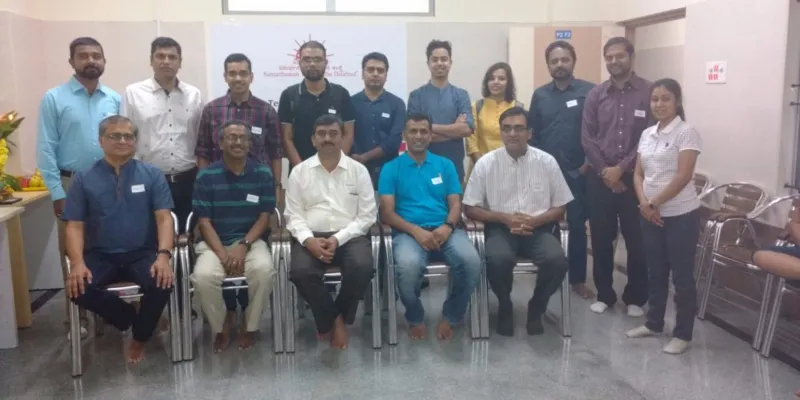
The team at the soft launch of the Assistive Technology Accelerator
What it offers
“In addition to all the facilities that an accelerator provides such as mentorship and funding, the ATA also offers a ready ‘market’ right here for assisted technology startups. Any technology or product they develop can be immediately tested and applied,” says Ravi.
The accelerator had a soft launch in November 2018 and applications are now open for startups to apply. Once the cohort is formed, the chosen startups will receive guidance and mentorship for six months with respect to product-market fit and in setting up a business model.
The focus of the accelerator is to help existing assistive technology startups scale their business across India and find a global audience and also assist them in funding as well. Ravi says they are now looking for startups that have a basic minimum viable product in place, and have had few tests in the market. He adds,
“In the next phase, we will also look to incubate early-stage ideas and finally, we also aim to help startups solve larger disability issues through collaboration among startups.”
The accelerator will also provide mentorship in terms of growth, investment strategy, product design and management. It will conduct workshops, sessions from industry leaders and disability experts. ATA will also give startups access to beneficiaries, NGOs, and experts, and help them with distribution channels for assistive technology solutions.
The ATA also provides a subsidised seating space for startups and hosts other startup workshops.
“Today, there are many college and university projects and assignments that are simply lying waste. And the primary reason for that is lack of market access or lack of building a solution that can actually be utilised by people. At ATA, we want to change that,” says Prateek.
In addition, it analysed the companies using over 100 other criteria and 34 in-depth customer interviews spanning 11 countries and 10 industries.
Published: 11th March 2019 02:10 PM | Last Updated: 11th March 2019 02:10 PM
| A+A A-
File Photo of Wipro Company. | File Photo
By ANI
BENGALURU: IT major Wipro Limited has been recognised as a leader in the IDC MarketScape, which evaluated 16 service providers on their services and delivery capabilities across DevOps disciplines.
In addition, it analysed the companies using over 100 other criteria and 34 in-depth customer interviews spanning 11 countries and 10 industries.
“In IDC's evaluation, Wipro demonstrated strong capabilities in terms of its DevOps services offerings, delivery model and scalability,” said the report.
Phil Dunmore, Vice President and Global Head, Consulting, Wipro Limited said findings of the report show that a large number of companies are embracing DevOps on a large scale, and increasingly rely on companies like Wipro to drive digital transformation with DevOps as a critical enabler.
"In the face of aggressive competition, the big asks from our clients are how to strengthen customer loyalty, create new sources of value, drive organisational efficiency, and disrupt the market with new business models," he said.
Qyresearchreports include new market research report “Global Emerging Biometric Technologies Market Size, Status and Forecast 2025” to its huge collection of research reports.
This report studies the global Emerging Biometric Technologies market size, industry status and forecast, competition landscape and growth opportunity. This research report categorizes the global Emerging Biometric Technologies market by companies, region, type and end-use industry.
The report here assembles the various perspectives to be considered as to the global Emerging Biometric Technologies market which depicts the recent data and upcoming expectations with reference to the advancing powers at play. The prime reason behind the investigation is to offer the perusers with an expansive details and make accessible the required materials and records. The quantifiable and examined clarifications for the investigation, other than illustrating data on factors, for example, drivers, limitations, and projections so as guess the total outcome of the global Emerging Biometric Technologies market over the said period in the report. It furthermore gives a brief and top to bottom examination of the predefined showcase, which gathers some present scenario of the business which are at risk to trigger an adjustment in the market or may cause any negative after-effect.
Get Research Summary of the Report: https://www.qyresearchreports.com/sample/sample.php?rep_id=1865304&type=S
Biometrics is the assessment of physical and behavioral characteristics such as fingerprints, voice, facial patterns, movement of hands, odor, iris, etc.
The biggest market application for emerging biometric technologies will most likely be in document verification and authorization. In 2017, the global Emerging Biometric Technologies market size was xx million US$ and it is expected to reach xx million US$ by the end of 2025, with a CAGR of xx% during 2018-2025.
This report focuses on the global top players, covered 3M Cogent Aware Bio-Key International Cognitec Systems Cross Match Technologies Daon Facebanx Fujitsu Fulcrum Biometrics NEC Precise Biometrics Safran Secunet Security Networks Thales
Market segment by Regions/Countries, this report covers United States Europe China Japan Southeast Asia India
Market segment by Type, the product can be split into Fingerprint Recognition Technologies Automated Fingerprint Identification System (Afis)/Live-Scan Technologies Facial Recognition Technology Iris Recognition Technology Vein Recognition Technology Voice/Speech Recognition Technology Hand Geometry Technology Signature Recognition Technology
Market segment by Application, split into Mobile Biometrics Market Payment Using Mobile Biometrics Banking Using Mobile Biometrics Physical Access Control Using Mobile Biometrics Law Enforcement Using Mobile Biometrics Disaster Response Using Mobile Biometrics
The study objectives of this report are:
To study and forecast the market size of Emerging Biometric Technologies in global market. To analyze the global key players, SWOT analysis, value and global market share for top players. To define, describe and forecast the market by type, end use and region. To analyze and compare the market status and forecast between China and major regions, namely, United States, Europe, China, Japan, Southeast Asia, India and Rest of World. To analyze the global key regions market potential and advantage, opportunity and challenge, restraints and risks. To identify significant trends and factors driving or inhibiting the market growth. To analyze the opportunities in the market for stakeholders by identifying the high growth segments. To strategically analyze each submarket with respect to individual growth trend and their contribution to the market To analyze competitive developments such as expansions, agreements, new product launches, and acquisitions in the market To strategically profile the key players and comprehensively analyze their growth strategies.
In this study, the years considered to estimate the market size of Emerging Biometric Technologies are as follows: History Year: 2013-2017 Base Year: 2017 Estimated Year: 2018 Forecast Year 2018 to 2025
For the data information by region, company, type and application, 2017 is considered as the base year. Whenever data information was unavailable for the base year, the prior year has been considered.
Key Stakeholders
Emerging Biometric Technologies Manufacturers Emerging Biometric Technologies Distributors/Traders/Wholesalers Emerging Biometric Technologies Subcomponent Manufacturers Industry Association Downstream Vendors
Regional and country-level analysis of the Emerging Biometric Technologies market, by end-use. Detailed analysis and profiles of additional market players.
Although the current working population is tech-savvy and comprises quick learners, they still require indepth training to develop new skill-sets and, thus, adapt to be prepared for the work culture of tomorrow
The future of work or the jobs of tomorrow is one of the most common topics of discussion among today’s crowd. The traditional working culture is rapidly reshaping with automation taking charge. No doubt, these innovations will enhance the key processes of a business, and thus deliver customer satisfaction; these advances also raise an interesting question: is our workforce geared up for that shift? Organisations, therefore, must go for an agile approach to learning, which is the need of the hour in today’s job scenario.
MINT/FILE■ Automation may be the future but human presence will still be required in some jobs
Although the current working population is tech-savvy and comprises quick learners, they still require in-depth training to develop new skill-sets and, thus, adapt to the evolving work culture. Today, when we hear innovations like AI, big data or analytics, we do not fear about job losses but instead feel proud to use them, mostly for entertainment purposes. What we are witnessing today, especially through our smartphones, are the smallest forms of innovations. The “big” is still lying around the corner.
We are not aware of how these advances will dominate the future jobs, and those who fail to adapt will see their own fall. However, instead of considering it a threat, companies should nurture the existing skills of their employees and help them become masters of using these technologies. That’s how companies can make the best use of groundbreaking technologies and help their employees deliver better results.
CHALLENGES
If we think a tad deeper, it will be much easier to understand the root cause of the problem. Yes, it originates from the good old education system, which unfortunately has become obsolete, and urgently needs an overhaul. The gap between the industry requirements and offerings made by academic institutions has further widened. While 43 per cent of businesses annually revise/ update their learning models, 71 per cent of Higher Education Institutions (HEIS) work at the speed of a snail. They update their curriculum in every two to six years. Also, inadequate preparation of students in the job area combined with insufficient industry-academia interactions has significantly added to the skill gap. These initiatives are crucial in the current scenario to help students in understanding future jobs, and the skills required to excel.
INCREASING UNEMPLOYMENT RATE
A report by Accenture titled ‘Fuelling India’s Skill Revolution’ says that India,over the next decade, could have secured a $1.97 trillion worth of GDP growth by investing in intelligent technologies. But currently, 65-75% of the country’s youth entering the workforce are jobless due to the paucity of talent. This needs urgent attention. Both companies and educational institutions should go for predictive and agile approaches to identify skills and introduce curricula changes, respectively. They should understand that the current workforce needs to switch from “what to learn” to “how to learn”.
HARSH REALITY
A large number of IT professionals who signed up for higher studies or skill-augmentation courses were found to leave in the mid ofthese courses in between. And, when it comes to employees, many were put back on the same team, doing the same work, which they were already doing. If the skill upgrades are not utilised properly, how are we even expecting better results?
Besides, intelligent workforce strategies for upskilling existing employees fail if there is a largescale misalignment. Companies, in such case, should seriously identify the right fits that suit the evolving demands of the market.
AI AND JOBS
It’s a truism that AI will replace not only repetitive and low-end tasks but also some high-skilled white-collar jobs. There will be a time when such skills will also become irrelevant, and those who will fail to adopt these changes will turn jobless. However, in this replacement process, AI will also create newer jobs that will call for newer skills. Hence, companies should focus more on upskilling their existing employees through several training activities.
WHAT’S HAPPENING ELSEWHERE?
Many organisations are becoming successful in their endeavours as they are fearless in experimenting and taking newer measures to adopt innovations. With the utilisation of such advanced tools, they are changing their traditional methods of working and, thus, motivating employees to perform better in today’s fastmoving world.
It is crucial for businesses, educational institutions and governments to come together and develop a learning culture, where students, as well as employees, could feel curious to explore more and stay self-motivated to learn newer things in life. More importantly, companies will need “human-ness” as a crucial skill from employees. Other skills like self-motivation, resilience, empathy, flexibility, communication and creativity will play a critical role, too. All these factors will be considered important to work efficiently with the future intelligent systems and, hence, utilise their benefits.
To tackle the future uncertainty of jobs, the preparation should begin from school education itself, instead of being dependent on higher studies. The government should focus on helping students imbibe problem-solving skills, creativity and innovation through modifying the curricula and adding more interesting activities.
After passing senior secondary levels or class XII exams, as students enter colleges, the training modules should gradually advance with the introduction of workshops and academic interactions. This pragmatic approach will enrich students with practical insights into the industry and help them in deeply understanding the nature of real-time jobs.
THE WAY FORWARD
Automation and robots are the future, but humans need to stay beyond them in every aspect. They should perform things that robots cannot. After all, they are human creations and, thus, always require human control. The skills of today should modify, and candidates should be trained from the very core of school education. That’s how we can replace the skill mismatch with relevant skills. The future jobs will be more about exploring passion from the very beginning of childhood, and not only schools but parents will also have a vital role in this developmental journey.
Source: Hindustan Times (Jaipur Edition) dated 12 March, 2019
The global workforce
is facing a serious talent shortage. With the emergence of new and rapidly
evolving technology, workers at all levels need new skills to meet the
everchanging market demands.
■ AI will be an important skill in the future workforce (Image)
Rapid evolution of
technology in the last few years has dramatically altered the jobs scenario not
just in India but also globally. India is experiencing a challenging
environment of rapidly changing skills requirements from industry combined with
a higher education sector struggling to keep up.
Emerging technologies,
like AI and Machine Learning have put the industry on a fast track towards
automation.
There has been a lot
of concern around students, new employees and even experienced IT veterans on
losing jobs to machines, which I believe is an extreme view. Rather the nature
of jobs will change, some will become obsolete while new roles get created. This
has, after all, been the reality of the industry since the dawn of the
industrial age.
The World Economic
Forum’s ‘The Future of Jobs 2018’ report for instance, estimates that 75
million jobs could be made redundant by 2022 as machines start to do more of the
work done by humans, but at the same time 133 million new roles could emerge
due to this shift towards automation. This shows that automation will have a
positive impact on job creation. In fact, people will have many careers within
a career.
To get a sense of what
skills will be needed in an age of accelerated innovations, we need to take
cues from the direction of technology’s evolution. Emerging technology like
cloud and cognitive big data require not only new skills, but “liquid skills”
to keep pace with rapidlyevolving technology development.
Cloud-based
applications, AI and Blockchain are already transforming industries and they
will become more widespread in the future.
We have already seen
how cloud computing has made businesses leaner and more agile. But the
intersection of technologies like AI, Blockchain and Data Analytics with Cloud
is opening up new applications, like ability to launch new products faster and
test them better. Therefore, cloud developers, network engineers and architects
will be in great demand.
The lack of blockchain
skills is a top concern and significant inhibitor to blockchain adoption in
companies across a variety of industries.
Businesses have seen
the potential of Blockchain, especially when deployed in conjunction with other
technologies like AI, Internet of Things (IOT) and data analytics, in having an
immediate and positive impact on business bottom lines. Considering it is still
early days, the demand for people with skills in this transformative technology
will only go up.
Similarly, AI and
Machine Learning has proven its potential across sectors from human resources
to healthcare, and again with each new application, the underlying technology
is getting more advanced and it is opening up new avenues of innovation.
Data analytics
specialists, with skills in Python, R and Apache, among others, will continue
to find lucrative careers in technology.
We are aware of the
importance of security of our networks and the data it handles. Yet, research
puts the shortage of cybersecurity professionals at just below three million
and these roles will need to be filled quickly.
The ‘Design Thinking’
and ‘Agile’ methodologies are now well proven. By placing a premium on user
outcomes and constant reinvention in the case of the former and on adaptive
planning, evolutionary development and early delivery in the case of the
latter, companies can transform their business processes and outcomes rapidly
and with minimum disturbances.
AI is viewed as one of
the most pressing workplace skills necessary for success in the coming years.
Organisations and
educational institutions have created tailor made courses focused on imparting
such skills to students and to those who have already embarked on a career in
tech. So upskilling and reskilling are not as great a challenge as before. For
those with the right skills and for those willing to gain these skills the
future holds great promise of being in a position to drive the next generation
of new technology. Skilling in the future will be a continues process and will
focus on contextual learning.
Source: Hindustan Times (Jaipur Edition) dated 12 March, 2019