Friday, September 13, 2019

AI could improve police paperwork: MHA think tank

BPRD’s futuristic vision for law enforcement , especially in smart cities, Prime Minister Narendra Modi’s ambitious project, is part of a concept note the body has drafted.
In a recent interview with The Economist, author Malcolm Gladwell, too discusses the importance of AI in the criminal justice system.(HT image)


The use of Artificial Intelligence in police paperwork, including charge sheets could remove flaws and prejudices from creeping into investigations, India’s Bureau of Police Research & Development (BPRD), a think-tank of the ministry of home affairs (MHA), believes.

BPRD’s futuristic vision for law enforcement , especially in smart cities, Prime Minister Narendra Modi’s ambitious project, is part of a concept note the body has drafted.

“A machine-learning algorithm can generate chargesheets specific to an incident with complete legal validity without any exclusions or non-conformity. This allows minimal manual intervention; hence the scope for malicious intent is not there in any way and the ability of the legal system to prosecute to the fullest extent of the law is always available. In the charge sheet, references from other judgements as well as other outcomes can also be included to make it more effective,” reads the note, a copy of which has been seen by HT.

Asserting that AI based systems have outperformed lawyers as well as judges in some cases, the BPRD note adds: “A neural network based system over a period of time can also create sensor based inputs in order to predictively allow for the analysis of outcome of cases as well, helping speed up the judicial process. The consequent burden on the policing system goes down”.

In a recent interview with The Economist, author Malcolm Gladwell, too discusses the importance of AI in the criminal justice system. Citing an example of judges taking bail decisions, Gladwell says, “..Defendants stand in front of the judge, the judge has to decide whether I released this person until the trial or I put the person in jail. Are they likely to commit another crime in the interim? That’s an extremely difficult decision to make. And when we look at how effective judges are in predicting the dangerousness of the defendant, they are not very good at it. But look how the machine learning algorithm tends to do better, actually much better than the judge. So there is an instance where we have clear evidence that a disembodied computer can be more accurate in making a prediction about the human being than a judge.”

Gladwell, however, also argues that there is a need to combine both the decision making of humans and AI, a view that many proponents of AI have also advocated.

According to BPRD, AI models coupled with crime mapping can be developed “to analyse crime patterns and identify hotspots which act as a useful tool for predictive and preventive policing”.

The police can also use AI based on algorithmic software at a crime scene for immediate recognition of perpetrator (s) based on modus operandi, pattern of crime/criminals in the area, biometric data, forensic data etc, the note claims. The BPRD note cites the example of San Francisco based Deep Science AI which has developed AI Surveillance (AIS) platform which uses deep learning to identify real people concealing their faces/firearms of intruders.

AI can also be used to manage traffic in smart cities, BPRD has suggested in its note.

To be sure, all this needs integrated data on video surveillance of public places, a wide CCTV camera network, sensors just about everywhere, databases of criminals, information on public transport, real-time tracking of events, and other such, the note admits. It also adds that privacy concerns need to be factored in while using such technologies.

When asked how AI can help police smart cities, Tarun Wig, co-founder of Innefu, a data analytics and cyber security company which provides predictive intelligence systems to various government institutions said: “The AI based system will read the text on a particular case which has to be charge sheeted and extract data on similar charges and relevant law provisions. It can read the type of crimes and tell police how to use its resources”.

BPRD and MHA officials did not respond to queries seeking comment on the concept note.

Wednesday, September 11, 2019

'Make in India' push: ABB, NITTTR set up digital simulation lab in Chandigarh

Supporting the nation’s vision of becoming a global manufacturing hub, ABB partnered with NITTTR, for a digital simulation of a CoE lab for students and faculty
The funding for the project is part of ABB India's CSR initiative


New Delhi: Swiss power major ABB India on Tuesday announced the company and the National Institute of Technical Teachers Training and Research (NITTTR) have set up a digital simulation lab in Chandigarh.

The first-of-its-kind multi-physics 'Simulation Center of Excellence' (SCoE) in the country will enhance skill development for critical electro-mechanical equipment design and manufacturing, catalysing 'Make in India' for the students and the faculty members of the institute, according to a statement by ABB India.

The funding for the project is part of ABB India's corporate social responsibility (CSR) initiative.

The Center has added another feather in the cap of educational hub of Chandigarh and Mohali, having institutes of repute ranging from business schools to state-of-the-art research institutions. Chandigarh and its adjoining areas have also become a sought-after destination also for outsourcing industries.


Students from electrical and mechanical engineering departments of the institute have been working with ABB on online remote condition monitoring of motors and issues of motor casings.

Though the SCoE was established with focus on electromechanical systems, the high-performance computing feature of workstations in SCoE has also been used by students of the computer science department of the NITTTR for their postgraduate thesis work in the domain of machine learning.

"A combination of knowledge and expertise developed through the right skilling initiatives would be key to take the Indian economy to the next level of growth. ABB India over decades has been working on various initiatives to catalyse teaching, learning and skill development on best-in-class global technology and practices," said ABB India Managing Director Sanjeev Sharma in the statement.


"The upgraded computing, simulation and analysis facilities available in SCoE has brought opportunities for NITTTR students and faculty for research of complex industrial systems. With the availability of SCoE infrastructure, NITTTR faculty has been able to introduce new short-term courses in the domain of Finite Element Analysis for the technical teachers," said NITTTR Director Shyam Sundar Pattnaik.

In a bid to spur NAAC accreditation, UGC assigns Telangana i

Bill to merge AICTE, UGC in final stages

The HRD ministry’s five-year Education Quality Upgradation and Inclusion Programme (EQUIP), which was released in June, called for the need to set up a Higher Education Commission of India (HECI).

The official however, refused to share more details about the elements of the bill.(HT image)

A bill that aims to merge the University Grants Commission (UGC) and the All India Council for Technical Education (AICTE) to create a single regulator for higher education in the country is in the final stages of preparation and likely to come up before the cabinet next month, according to an official aware of the development.

Till now, the UGC regulated the functioning, accreditation and also fund disbursal to 40 central varsities while the AICTE played a similar role for technical institutions. The government has been considering setting up a single regulatory body that would focus on imparting quality education and learning outcomes. The function of fund disbursal would not be a role for such a body.

“The India Higher Education Commission Bill to replace the UGC and the AICTE has been prepared in consultation with the states. The ministry plans to take it to the cabinet next month,” the official said on condition of anonymity. The official added that the bill is in its final stages.

The official however, refused to share more details about the elements of the bill.

The HRD ministry’s five-year Education Quality Upgradation and Inclusion Programme (EQUIP), which was released in June, called for the need to set up a Higher Education Commission of India (HECI).

The plan envisaged the HECI as a regulatory body to promote the quality and standards of education by merging the UGC and AICTE.

According to the suggestion of the EQUIP report, the HECI will primarily focus on academic and quality matters related to ensuring learning outcomes, mentoring of institutions, training of teachers and administrators. It would also seek to promote education through Information and Communication Technology (ICT) initiatives.

According to the EQUIP report, which HRD officials terms as their five-year implementation plan, the HECI will grant autonomy to best performing higher educational institutions and award them powers to confer degrees.

The disbursal of funds that the UGC presently undertakes will be kept separate from the commission, according to the EQUIP report. “Disbursal of the funds shall be done through an SPV [Special Purpose Vehicle]. The HECI shall provide for comprehensive and holistic growth of higher education and research in a competitive global environment,” the report said.

A bill seeking the formation of a National Research Foundation (NRF) is also ready and expected to be placed before the Union cabinet for approval.

In her budget speech in July, finance minister Nirmala Sitharaman proposed to the formation of the NRF to fund, promote and coordinate research in the country. “The NRF will assimilate the research grants being given by various ministries independent of each other,” she had said.

“The need to create an umbrella body for the higher education sector has been felt for a long time. However, what kind of relations it has with other bodies including varsities and institutions would define its success. Its role vis-à-vis all other bodies will have to be carefully defined,” said former UGC member Prof Inder Mohan Kapahy.

New Arrivals: September 9-13, 2019


Accession Number 
Class No. 
Author/Editor 
Title 
Publisher 
Year 
No. of Copies
Branch / Subject 
27321-27330
343.7309 VIS 
VISWANATHAN/ SURESH T.  
BHARAT'S THE INDIAN CYBER LAW 
BHARAT LAW HOUSE
   
2015 
10
INFT/CMPN/ExTC/ Cyber Security and Laws
27331-27335
620.112 SUB 
SUBRAMANIAN/ R.  
STRENGTH OF MATERIALS 
 OXFORD UNIVERSITY PRESS

   2016 
5
 MECHANICAL/Strength of Materials
27336-27365
005.8 GOD/BEL 
GODBOLE/ NINA/ BELAPURE/ SUNIT  
CYBER SECURITY: UNDERSTANDING CYBER CRIMES, COMPUTER FORENSICS AND LEGAL PERSPECTIVES 
WILEY INDIA
2011
30
INFT/CMPN/ExTC/ Cyber Security and Laws
27366-27370
005.8 CHA/CHA 
CHATTERJEE/ MADHUMITA/ CHAUDHARY/ SANGITA/ SHARMA/ GAURAV  
CYBER SECURITY AND LAWS: AN INTRODUCTION 
STAREDU SOLUTIONS
   
2019 
5
CMPN/Cyber Security and Laws
27371-27440
621.4021 KHU/KHU 
KHURMI/ R.S./ KHURMI/ N.  
STEAM TABLES WITH MOLLIER DIAGRAM 
S. CHAND
   
2018 
70
MECHANICAL/Thermodynamics

The Top Programming Languages 2019

Python remains the big kahuna, but specialist languages hold their own
By Stephen Cass

Welcome to IEEE Spectrum’s sixth annual interactive ranking of the top programming languages. This year we’ve done a major overhaul, changing some of the underlying metrics and building a new streamlined interface. But our basic idea and methodology remains the same: combining data from multiple sources to rank the popularity of the programming languages that are used for the type of coding you are interested in.

We take this approach to get around the two fundamental obstacles to all attempts to determine the popularity of programming languages: (1) No one can actually look over the shoulder of every coder around the world as they tap away at the keyboard, and (2) a language that’s a cornerstone of one programming domain might be utterly irrelevant in another. Spectrum gets data for 11 metrics from 8 sources that we think are good proxies for popularity, and we combine the results in an app that lets you filter languages and adjust the weights given to each metric. The upshot is a ranking that’s right for you. (As part of our overhaul, we’ve retired two metrics that we used in previous years because we didn’t think they were yielding good quality data anymore, incorporated data from the IEEE Job Site, and added some new languages to the list, such as Dart.)

Of course, we’ve also got some preset weightings built in that are optimized for job seekers, for example, or folks interested in diving into an open-source side project. Our default weighting is optimized for the typical Spectrum reader, so let’s take a look at what it shows as the top 10 languages of 2019.

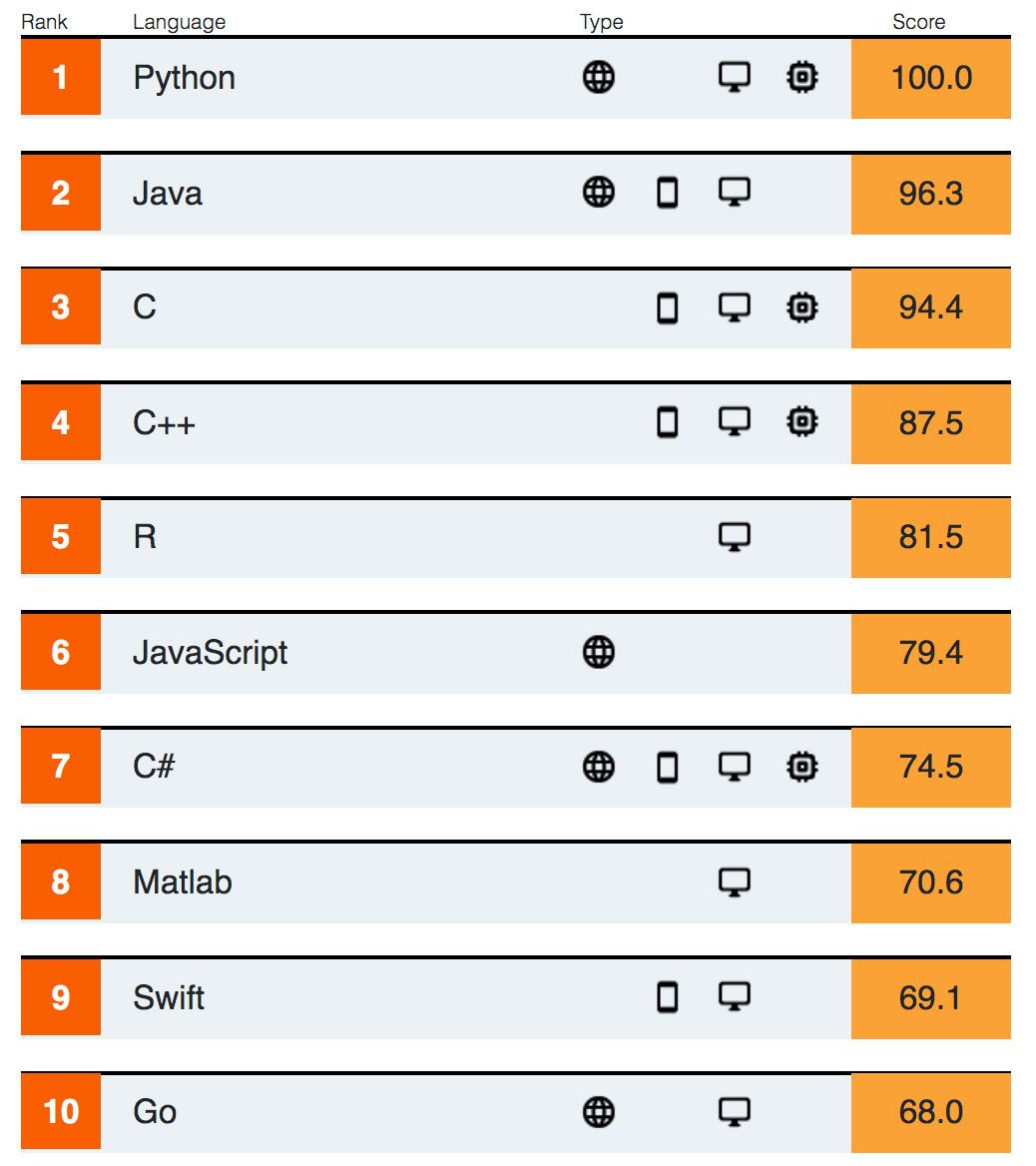
Although the changes in our underlying metrics mean that we have to be careful when directly comparing this year’s rankings to last year’s, the general outline of results remains similar, with Python firmly on top. Python’s popularity is driven in no small part by the vast number of specialized libraries available for it, particularly in the domain of artificial intelligence, where the Keras library is a heavyweight among deep-learning developers: Keras provides an interface to the TensorFlow, CNTK, and Theano deep-learning frameworks and tool kits. Deep learning isn’t the only field where Python is having an impact that could not have been anticipated when the language was first released in 1991. The dramatic increase in computing power found in microcontrollers means that embedded versions of Python, such as CircuitPython and MicroPython, are becoming increasingly popular among makers.

Next comes Java, C, and C++, a group whose members have long jostled with one another and with Python for the top spot, although with our adjusted metrics the distance between these contenders has widened, with C++ coming in with a score of 12.5 points below Python. (In any given ranking, the highest-ranked language is assigned a score of 100, and the scores of lower-ranked languages are scaled to that.) The number-crunching language R rounds out the top five. Despite being a much more specialized language than the others, it’s maintained its popularity in recent years due to the world being awash in an ever-growing pile of big data.

Moving further down the top 10, the presence of Matlab—a proprietary language developed by MathWorks and intended for numerical computing—may be a surprise to some, but it simply reflects the language’s prominence in hardware engineering, especially for those interested in running simulations or creating control systems via MathWorks’ graphical Simulink package.

Below the top 10, some items of note include Arduino at No. 11 and HTML/CSS at No. 12. In previous years, some readers have complained that neither should appear on a list of programming languages. In the case of Arduino, the argument is that there is no such language, that “Arduino” is actually the name of the family of hardware platforms on which the language runs, and that this language should be called Wiring (or sometimes C or C++ for historical reasons). In this, we are led by simple pragmatism: When faced with a programming question, the overwhelming majority of Arduino developers search Google using terms like “Arduino Code for…,” rather than any alternative. By choosing the de facto name, we avoid deeply discounting the popularity of programs written for the Arduino and similar microcontrollers.

Pragmatism is also the name of the game when it comes to HTML, with the objection here that it is not a real programming language because it doesn’t have branching or loop constructs. But given the huge popularity of HTML and CSS among developers, and the fact that they are used to instruct billions of computers to do things daily, we feel any academic arguments about Turing completeness and so on are beside the point. A markup language is still a language.

Finally, some older languages are still alive and kicking. In particular, despite being over 60 years old, Fortran still comes in at No. 38, likely due to the enormous legacy power of being the original scientific computing language. The language is still under active development, with the most recent Fortran standard released at the end of 2018, incorporating improved interoperability with C and better support for massive parallel computations.

The Online Test Centre

The Online Test Centre
Whether you are studying for a professional entrance exam—if you’re applying for a job at some of the best software companies—or even if you want to strengthen your problem-solving skills, then head to The Online Test Centre. Here you will find thousands of questions in numerical and verbal aptitude tests, logic and diagrammatic tests, reasoning tests, puzzles, general knowledge questions and GMAT test advice. You will even find a section dedicated to interview questions subdivided into categories like Typical Questions, Sudden Tests, Group Discussions, Tasks at Interviews, and Behavioral Questions. The Online Test Centre is a completely free resource with no login required; all the tests are free and available when you need them. www.theonlinetestcentre.com

Researcher: An App for Academicians

Researcher
Researcher is a valuable resource for college students and academics who want to keep abreast of research papers in disciplines such as Arts & Humanities, Business & Management, Earth Sciences & Geography, Engineering & Computer Science, Medicine & Health, and more. Each discipline consists of at least ten sub-categories: For instance, you can read papers on Gender Studies, Law and Urban Studies within the Social Sciences course. Using the app, you can bookmark technical papers, download them for free to your phone, share them with colleagues via email or messenger, and even read them later from a PC web browser. Once you create an account, you gain access to over 15,000 peer-reviewed journals. The app’s journals database is updated on a weekly basis.
Android, iOS Free

Source: The Times of India (Mumbai edition) dated 11/09/2019

IIM-Udaipur launches course on digital enterprise management

Small global cos on India hiring spree

Host of product firms have moved tech teams here to leverage cost arbitrage in last 8 months
Share

It is not just large banks and IT firms that are tapping into India’s technology talent pool. Over the past year or so, a growing number of small American and European product companies have started moving technology development work to India, as they face a battle for talent competing with large companies in their home markets.

Software as a Service (SaaS) firm Quolum, which started operations earlier this year, has hired three people in India out of its four-member tech team.

“Over the last seven to eight months, we have seen a lot of product companies move tech teams to India to leverage the cost arbitrage. These companies have proven business models and find it easy to attract talent by paying 1.3-1.5 times the prevailing salaries in India,” said Joseph Devasia, MD, Antal India, an executive recruitment firm.

Paying a marginally higher salary is not an issue for foreign firms as it is still one-fifth of what they would have to pay in their home markets. Ridecell, which provides amobility platform for shared vehicles, has a 50-member team in Pune.

“Having a tech office in India gives us the strategic advantage to address the huge market potential in India and the growing mobility markets across Europe, Asia and the Middle East. Additionally, India is the hub for world-class tech talent, so it made complete sense for us to set up a technology office here,” said Samyak Pandya, VP of business operations and finance, Ridecell.

There has been a spike in the number of small tech companies looking at India, said Gaurav Chattur, managing director-Asia Pacific, Catenon Group, a search firm that helps global firms recruit people for their India operations. “The US and European countries are inherently short on tech talent. The visa norms in these countries are also a challenge, which is why even early-stage firms are considering India,” he said.

A recent study by Cornell University found that foreign-born PhD students in the US were more likely to opt to work at a large tech firm over a startup or smaller product firm, simply because of visa issues.

Smaller firms typically do not have the resources to help procure an H-1B visa — essential for a non-US citizen to work in the US. As a result, many of the smaller firms are struggling to find the right talent locally. With large IT services firms also increasing hiring locally in the US, the talent supply pipeline has been choked for product firms.

Very often, these companies have been started by Indians, or have Indians on the core team. In these cases, the choice of where to set up the India operations depends on where the founder has a personal connection.

Switzerland-headquartered Loylogic started out by outsourcing its technology work, but when it decided to move it in-house for IP and knowledge management reasons, India was an obvious choice.

“India (and Pune) has a mature IT industry with access to large resource pool. There is still cost arbitrage compared to European salaries,” said Piyush Khandelwal, Chief Operations Officer, Loylogic Technologies India.

There may be challenges around getting people to work for an unknown entity, but often the lure of doing differentiated work and a higher paycheck are incentives enough.

From Tamil Nadu’s fields to space: Isro chief K Sivan’s journey

From tilling the family fields with his father in a remote Tamil Nadu village to heading the prestigious Indian Space Research Organisation (ISRO) in Bengaluru and launching India’s ambitious moon mission, Chandrayaan 2, K Sivan has come a long way.

Despite his family’s modest means, Sivan, now 62, pursued his studies, attending his classes and also helping his father in the fields.

He studied at a village government school in the Tamil medium, and did his BSc in mathematics from ST Hindu College in Kanyakumari district. Throughout his early student years, his wardrobe was minimalist (he used to wear a dhoti) and he would walk barefoot. The first time he wore slippers was in engineering college.

Even after all these years, Sivan remains a man of simple needs.

“He still wears plain clothes, even though he is quite fond of wearing white-coloured clothes,” said a colleague and friend of his, who did not wish to be named.

“Same goes for his eating habits. He is the ISRO chairman but during all our project meetings you will find him sitting with the rest of the team members and enjoying a meal of dal-chawal, rasam, papad and curd. He prefers south Indian cuisine,” said the colleague.

Sivan graduated from Madras Institute of Technology in aeronautical engineering in 1980, after which he pursued aerospace engineering from the Indian Institute of Science, Bangalore, in 1982. He also has a PhD in aerospace engineering from the Indian Institute of Technology, Bombay.

Sivan joined ISRO in 1982 in its Polar Satellite Launch Vehicle (PSLV) project and has contributed immensely towards end-to-end mission planning, mission design, mission integration and analysis for all the launch vehicle programmes. He is the chief mission architect for 104 satellites launched in a single mission of the PSLV (PSLV C37).


“He is a perfectionist, and doesn’t accept substandard work. Even the presentations need to be perfect; even if he finds a minor error in a presentation before it’s to be presented, he cancels the meeting until the corrections are made. Behind his benign appearance is a tough taskmaster. He is a workaholic and also expects his team to put in their 100%,” the colleague said.

Sivan evolved a cost-effective strategy for the 2014 launch of the Mangalyaan Mars Orbiter Mission (MOM) using the PSLV. In addition to this, he is the primary developer of 6D trajectory simulation software SITARA which is used for mission planning of ISRO launch vehicles. Sivan is also the primary developer of Day of Launch – a wind biasing strategy for launch vehicles that has enabled all-weather launches.

He is the chief architect of ISRO’s space transportation and technology roadmap for meeting future requirements as well as augmenting existing capabilities in a phased manner.


During his career at ISRO, he has held many responsibilities -- group director, mission simulations and synthesis group; project director, reusable launch vehicle—technology demonstration programme; and chief controller, Vikram Sarabhai Space Centre that he later also headed.

As part of his innovative approach to making space technologies useful in day-today life, Sivan also has had discussions with the medical fraternity for development of medical devices in key areas.

The proposals for development of advanced microprocessor controlled artificial limb and artificial heart pump called Left Ventricle Assist Device has now been taken up in association with industry partners for prototype development as well as field trials.

India's cyber security chief highlights security risks of 5G, IoT

NCSC Lt General Rajesh Pant said the government has to take decision on Huawei
By PTI September 06, 2019 22:05 IST
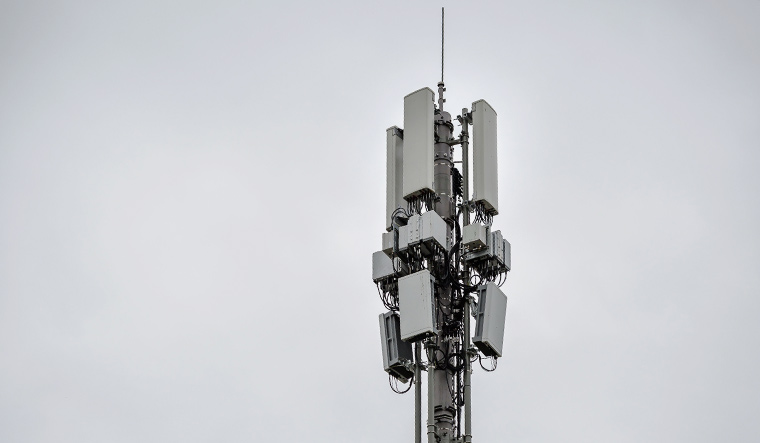
(Representational image) An antenna for the 5G mobile network service is pictured in Etoy, western Switzerland | AFP

Security is a big issue in 5G and the decision around participation of Chinese telecom gear major Huawei should be taken after proper consideration, the country's top cyber security officer said on Friday.

National Cyber Security Coordinator Lt General (Dr) Rajesh Pant also said that 5G will not be limited to telecom networks but will have an impact across all sectors.

Meanwhile, Huawei said security and privacy are its highest priority and the company strictly adheres to all local laws and regulations.

"Government has to decide on it (participation of Huawei). We can tell you from technology aspect. Thereafter, its economics and political part will be seen. Security is an issue, there is no doubt in it. 5G is not just a pure telecom network. It has many things that are connected to our lifestyle," Pant told reporters on the sidelines of CII Telecom Convergence Summit.

He was responding to a question on the views of his office over the participation of Huawei in 5G trials in India.

Pant said that 5G technology will be connected to the internet of things (IoT) that will be installed in homes and industrial IoT will be operational in electric vehicles, healthcare systems, agriculture and drones, among others.

"If someone wants to add malware in system, it will not only disturb telecom network but it can also disrupt health system, agriculture, industry. It is a big security issue. In this, we will have to take decision only after proper consideration. There has been no decision on it as of now," Pant said.

"We will have to see our national interest," he added.

The US has banned Huawei's 5G technology, saying the company's systems could be manipulated by Beijing to spy on other countries and disrupt critical communications.

When contacted, Huawei said it hopes the Indian government makes an "independent and informed decision" that provides a level playing field for all players for the country and not based on country of origin or speculative allegations lacking evidence.

Huawei India CEO Jay Chen said, "It is well known that Huawei is closely working with all governments, including the Indian Government on 5G technology, solutions and security issues. Beyond that, it is to be noted that Huawei has stepped up to advocate to the industry to sign the no backdoor' agreement with the Indian Government to secure network security. We share the same opinion as the Indian Government that network security is important and it depends upon the joint efforts of all stakeholders."

Huawei said it has subjected itself to the strictest reviews and screening by regulators and customers.

The company's 30-years of operational track record across 170 countries is proof of the security of its networks, it added.

Saturday, September 7, 2019

UK-born Indian teens bring out Ramayana audiobook


English narrative translated into Hindi, Telugu


At a time when teenagers are busy aping the western culture and almost ignoring the Indian epics, two British-born Indian descent teenagers stand out for not just trying to propagate the values espoused by the Ramayana but also their work now licensed by the British Airways.

The London-based brothers, Shreyas Pulle and Ayur Pulle, have created a one-hour audiobook “Ramayana: An Ancient Indian Epic” that introduces the compelling epic to non-Indians and also gives the Indian listeners a refreshing perspective.

It all started when Ayur’s Jewish dominated school in London asked him to perform in an Indian play in which he played the character of Hanuman. Ramayana’s characters struck him and coming from a traditional Indian family the growing interest was natural, reveals Ayur’s mother Neelima Penumarthy.

Flawless narration

His elder brother Shreyas then teamed up to create a simplified version of the complex classic and decided to go the audio way to reach out to people. The simple language added with flawless narration and smooth adoption of the characters makes it further interesting, even for those newly introduced to Ramayana.

The audiobook gained popularity in British circles and was judged one of the best in its segment. To their delight, the British Airways has licensed it to place it on its in-flight entertainment until 2028.

The English narrative is now translated into Hindi with the help of Hindi teacher and students at the Kendriya Vidyalaya, Uppal and also to Telugu by the maternal grandmother of the brothers.

Ms. Neelima explains that the Hindi version of the audiobook has been recorded with six students from 10th and 12th class of Kendriya Vidyalaya, Uppal No 1 where she studied.

A socially conscious Neelima is now making an effort to rope in visually challenged students to bring out the Telugu audiobook involving three students from the Devnar School for the Blind, Begumpet. “Braile version of the book is given to them and the visually challenged students have done a wonderful work. It should be out in a few days,” she says.

The narration of the epic by the blind students is challenging as they have to visualise something they have not seen. “Some of them have such mellifluous voice and their narration has made a difference,” she said.

Neelima, who runs a company, ‘Puranas’, that connects culture through stories has also produced a 15-minute puppet show based on the audiobook. It was performed in several schools in London and last year it was performed at the Diwali celebrations sponsored by Mayor of London at Trafalgar Square. “We will be doing the same this year as well,” she adds.

Friday, September 6, 2019

Damaged by floods in Sangli, library’s mission to save 75,000 books: Staff, students, 6 hair dryers

The biggest concern remains the manuscripts — nearly 300 had been digitised recently, but the computer that stored the records was washed away.

Written by Ajay Jadhav |Sangli |Updated: September 6, 2019 8:30:22 am


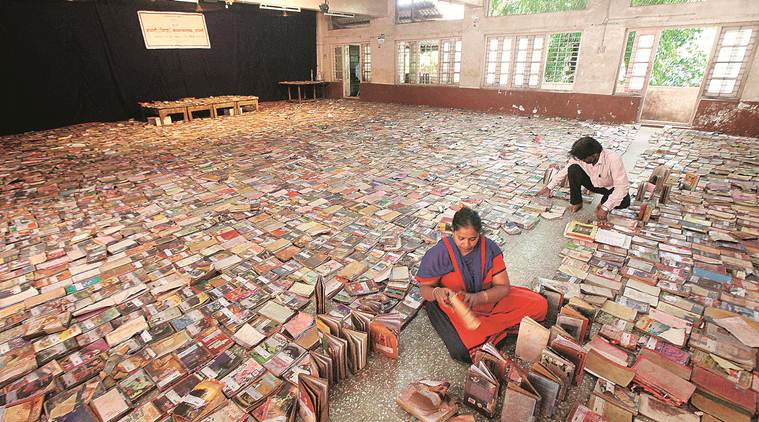
At the Sangli District Nagar Vachnalaya, one of the oldest public libraries. (Express photo by Pavan Khengre)

GROUPS OF students in shifts, staff, well-wishers — and three heaters plus six hair dryers.
Advertising

For nearly a fortnight now, this combination has been hard at work at the Sangli Nagar Vachanalaya to save whatever is possible from the thousands of books and rare manuscripts damaged in the recent floods in southwestern Maharashtra.

The 150-year-old three-storey facility, with 2,500 members, is one of the oldest public libraries in the country. It houses over 1.8 lakh books and documents, including over 600 rare manuscripts from 400 years ago. Of these, officials estimate that nearly 75,000 books and at least 100 manuscripts were damaged in the floods that submerged parts of Sangli, Satara and Kolhapur in August.

“Most of the books were on the ground floor to enable easy access. We tried to save them as the water started entering, but had to finally leave to save our own lives,” says librarian Surekha Naik.
Advertising


Today, many of the damaged books are beyond repair. Some have also started showing signs of fungal growth. The others have been spread on the floor across the building, from the staircase to the passage and the cultural hall. Naik is among the six fulltime staff busy arranging the books to dry under the ceiling fans. Then, there are the hair dryers. “We gave priority to the manuscripts and began to dry them with a hair dryer as there was no other way. We had one dryer at the beginning. Our appeal to members resulted in five more being used. They are effective,” says Naik. The library is also using three heaters, two of them donated by members. “We were also fortunate to get additional hands from Pune and Sangli colleges. Three teams of ten students each came down and stayed with us for two days in rotation to help us prepare a list of damaged books,” she says.

The biggest concern remains the manuscripts — nearly 300 had been digitised recently, but the computer that stored the records was washed away. “Fortunately, the person who had carried out the digitisation had saved another copy,” says Naik.

“I have gone through about 10,000 manuscripts in libraries across the state but those in Sangli Vachanalaya were in the best condition,” says Priyanka Mujumdar, who digitised the manuscripts in Sangli under the National Mission for Manuscripts of the Centre.

”The manuscripts relate to ancient texts, including the Vedas, Puranas, Dharmashastra, Ayurveda, Jyotishshastra, etc. It would require a miracle to save them now, considering that the paper and ink were so old,” says Mujumdar, who is a post-graduate in Sanskrit and diploma-holder in Manuscripts.

At the library, staff say financial assistance is required to replace damaged furniture and computers. Once operations resume, possibly within the next six months, the library also plans to prepare a list of books lost and issue an appeal for copies to be donated.

”We are also reaching out to experts for preservation of the books. We will take the help of social organisations to fund our efforts,” says Atul Gijre, secretary of the governing body of Sangli Vachanalaya.

According to Ujjwala Londhe, district library officer, 17 public libraries in Sangli were affected by the floods, with three small libraries getting completely damaged. The district library office has estimated a loss of Rs 63.7 lakh, including Rs 39.95 lakh in Sangli Vachanalaya alone.

Saturday, August 31, 2019

Active Users of the LIRC - August 1-31, 2019

Sr. No. Member No. of Transactions
1 SAHU MADHUSHREE DAMBARUDHAR SONALI 37
2 PHILIP FRANCIS FERNANDES 25
3 DSOUZA NELSON NORBERT PAUL DSOUZA ALICE DSOUZA 25
4 BHATT PARTH CHYAVAN VAISHALI 25
5 ANDHALE SHREYA VILAS URMILA 25
6 OJHA ANOOP PARASNATH SHANTIDEVI 24
7 LOBO ANDREA KARLTON ALICE 23
8 AHUJA RISHIKA SANDEEP DIPALI 23
9 MELVIN YOHANNAN MARIAMMA YOHANNAN 23
10 CHAUHAN DEEPAK DINANATH SHEELA 22

All the above "Active Users" are eligible for one extra book from the Library for the following month i.e. September 2019.

LIRC @ A GLANCE: AUGUST 2019

-->
LIRC AT A GLANCE AS ON 31/08/2019
Name of Library Software: LibSuite 6.5
U.G. BOOKS
Total Titles: 10448
Total Volumes: 27320
Editions : 341

Ref.Books : 3472(UG= 3181 PG=291 )
P.G. BOOKS
Total Titles: 292
Total Volumes: 1187
Editions : 02
Books in the BOOK BANK: 1459Faculty Publications: 305
E-Books : 55
Doctoral Theses : 11
Project Reports: 1800
CDs: 3135
VIDEO DVD: 64
PERIODICALS

Total Journals for UG = 39
UG Courses: 37 (National)
UG Courses: 02 (International)

Total Journals for PG = 10
PG Courses: 10 (National)

Total Subscribed Magazines: 19
Technical : 07
Non-Technical Magazines: 12

Total Gratis Magazines: 8

Technical : 02
Non-Technical Magazines: 06
E-PACKAGE :

IEEE/IET Electronic Library (IEL)The full-text of IEEE content published since 1988 with select content published since 1872 from:
IEEE journals, transactions, and magazines, including early access documents IEEE conferences IET journals IET conferences IEEE published standards IEEE Standards Dictionary Online
Membership of: IIT Bombay Library National Digital Library
Area: 482.39 Sq. metersSeating Capacity: 260

ALL
Total Members Visited Members % Unique Members %
1976 3240 163.97 967 48.94
STAFF
Total Members Visited Members % Unique Members %
164 55 33.54 37 22.56
STUDENTS
Total Members Visited Members % Unique Members %
1812 3185 175.77 930 51.32
INFT
Total Members Visited Members % Unique Members %
546 941 172.34 272 49.82
CMPN
Total Members Visited Members % Unique Members %
553 961 173.78 294 53.16
EXTC
Total Members Visited Members % Unique Members %
518 883 170.46 275 53.09
ELEC
Total Members Visited Members % Unique Members %
83 253 304.82 44 53.01
MECH
Total Members Visited Members % Unique Members %
112 134 119.64 40 35.71

Friday, August 30, 2019

UGC urges colleges, varsities to join PM’s Fit India Movement, create fitness plan

In an attempt to bring focus to fitness among the youth, the University Grants Commission (UGC) recently shared a circular on its website, urging affiliated colleges and universities to participate in the ‘Fit India Movement’, which Prime Minister Narendra Modi launched yesterday.

As part of the movement, universities and colleges have been asked to make efforts to improve the health and wellbeing of students as well as teaching and non-teaching staff, in order to achieve physical fitness, mental strength and emotional equanimity.

“The Fit India Movement helps take the nation forward on the path of fitness and wellness and it provides a unique and exciting opportunity to work towards a healthier India,” said the circular released by UGC.

“Every person should pledge and attempt to walk 10,000 steps… and follow it up in his/her daily routine,” states the circular. It further requests institutes to implement an institutional fitness plan to incorporate exercise into the daily routine of staff and students.

HRD directs UGC to set up committee to probe 'sale of fake degrees

Thursday, August 29, 2019

Microsoft and ISB partner to advance AI skilling in India

The two will collaborate in research which will use AI and Machine Learning to study issues relevant for business and public policy
The partnership will also jointly introduce a new executive programme


New Delhi: The Indian School of Business (ISB) and Microsoft India announced a new partnership on Friday to take forward their shared vision for an AI-empowered India at an event in Hyderabad.

Through the creation of the AI Digital Lab, the two organizations will collaborate in research which will use Artificial Intelligence (AI) and Machine Learning (ML) to study issues that are relevant for business and public policy.

In addition, the partnership will also jointly introduce a new executive program titled “Leading Business Transformation in the Age of AI" in October 2019 which will equip business leaders with tools and strategies to transform their respective organizations to AI-driven organizations.

The rapid development of AI implies that the ability of business leaders to creatively use AI to improve business decisions and enhance productivity will become a very important precursor for businesses to stay competitive and be successful. AI-readiness is therefore an important skill that business leaders should acquire sooner than later.


Professor Rajendra Srivastava, Dean, Indian School of Business and the Novartis Professor of Marketing Strategy and Innovation, said “Business Schools are attempting to redefine management education by making it more future-ready and relevant for opportunities and challenges that businesses will face in the future. Transforming organizations guided by Artificial Intelligence and augmented by frameworks integrating analytics with human behavior and management issues will be an important imperative for business leaders. Our collaboration with Microsoft India will enable us to use AI to understand new phenomena that are relevant for business as well as policy and subsequently disseminate the knowledge to business leaders who will need to transform their businesses through artificial intelligence to compete effectively."

Anant Maheshwari, President, Microsoft India said, “AI is a gamechanger to drive new business models and transform today's businesses and workplaces. With this coming together of ISB and Microsoft, it is a unique opportunity to increase the innovation with AI in business. Our new partnership with ISB will empower business leaders to increase their tech intensity and do more with AI."


ISB’s executive program, titled “Leading Business Transformation in the Age of AI" in collaboration with Microsoft will enable C-suite executives to come up with a coherent strategy to transform their respective organizations into AI-driven organizations. The 3-day non-technical program is done under the purview of Microsoft’s online AI Business School, which provides executive-level insights and practical, actionable guidance to build an end-to-end AI strategy. It will focus on managing the impact of AI on company strategy, culture and responsibility.

Source: https://www.livemint.com/ (Accessed on August 29,2019)