Wednesday, March 20, 2019

The big deal

ON OFFER Students graduating from the Arts, Commerce and Science streams are being offered hefty starting salaries in campus placements. The big selling points, say companies, are their soft skills and analtyical capabilities

There’s a rapidly growing number of positions that require data crunching or analysis, for which students from maths, statistics and economics backgrounds are well-equipped. DEVASHISH SHARMA, founding member of HR consultancy PeopleStrong
It’s not just engineering, management and law. Highly paid campus placements offers are now being made in fields beyond the professional and technical courses, to students graduating in arts, science and commerce too.
ISTOCK
This year, a final-year Economics student at Delhi’s Lady Shri Ram (LSR) College received a salary offer of Rs 38 lakh (all salary figures are per annum); last year a Commerce student from Sriram College of Commerce (SRCC) got a starting offer of Rs 31 lakh. In Mumbai, arts and commerce students got offers averaging Rs 6 lakh, with the highest going up to Rs 19 lakh.
Companies are offering better packages because they would rather hire young people who are easy to train than experienced people who need to unlearn practices and come with a higher price tag, says Smita Sharma, placement advisor at SRCC.
Another big draw is the fact that these students tend to be equipped with good soft skills.
The average engineering student, for instance, is less likely to have good communication skills, says Devashish Sharma, founding member of India’s largest HR Technology and Talent Acquisition solutions company PeopleStrong. “There’s a rapidly growing number of positions that require data crunching or analysis, for which students from maths, statistics and economics backgrounds are well-equipped,” says Soni George, placement convener at St Xavier’s College, Mumbai. “Students from other departments are also eligible to apply for these. We have had students from life sciences take up analyst jobs too.”
At both Xavier’s and SRCC, campus recruitment picked up around 2004-2005 and has been growing steadily since. “This year, we added 20 more companies. Some startups have started coming to campus too. Though they don’t offer huge pay packages, they do offer a lot of exposure,” says Smita Sharma, placement advisor at SRCC.
The brighter job prospects in these subjects have now allowed more students to choose freely when it comes to picking a stream. “I chose economics because I really wanted to study the subject. I did not even know whether I wanted to do a job right after college or not,” says Yashovat Saharia, who graduated from SRCC in 2017. He received among the highest salary offers of his year, according to his college, and has worked with that company, Parthenon EY, ever since.
Saharia says he doesn’t plan to study economics further but he’s glad he picked it to begin with. “I now firmly believe that one should study the subject one likes and not look for one with ‘better job prospects’ because it gives you a strong foundation when you specialise in one field,” he says. At Parthenon EY, his job is that of a senior associate; it involves crunching data to explain to companies why a deal or acquisitions is or isn’t a good idea. “My background in economics and my grooming in presentations made me both good with numbers and capable of communicating what those numbers say, effectively,” Saharia says. Economics has been on the top of recruiters preference for a long time but now recruitments in good honours courses in both sciences and humanities have a lot of takers too, says Sharma of PeopleStrong. “Whereas campus recruitment for general science courses are increasing in fields like pharmaceuticals and chemical research, in the humanities and social sciences there is a rise in recruitment from among psychology students, by corporates and institutions like hospitals and schools. Also, the services side of new age Internet companies are employing humanities graduates with good communication skills in their customer support teams,” Sharma adds.

Source: Hindustan Times (Mumbai edition) e paper dated 20 March, 2019.

Tuesday, March 19, 2019

Usage Statistics of SFIT LIRC


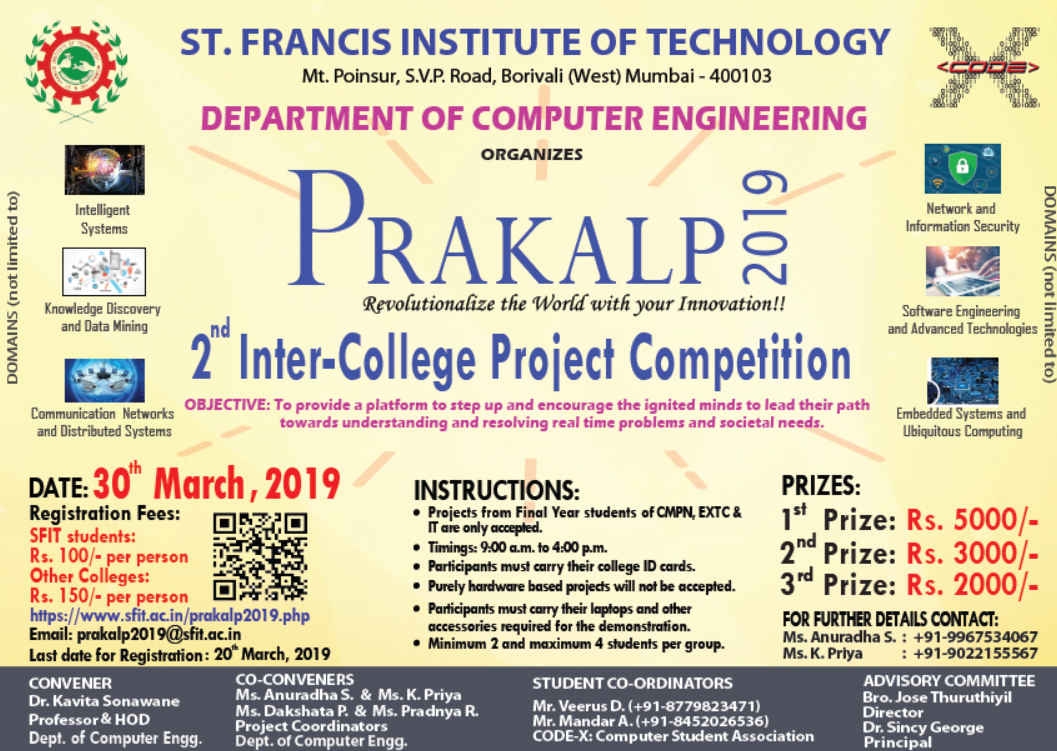
Prakalp 2019 at SFIT

Department of Computer Engineering, SFIT presents the most awaited competition of the year !!


Prakalp-2019 is an Inter-college Project Competition being held successively for the 2nd year. This competition provides a platform for final year students of Computer, Information Technology, Electronics and Telecommunication Departments to exhibit their final year projects.

REGISTRATIONS ARE NOW OPEN!!

Venue : St. Francis Institute of Technology (Borivali West), Mumbai.
Date : 30th March 2019

PRAGATI 2019 AT SFIT WINNERS

Technical Competition:

1st Winner: Complete the incomplete (Vidyavardhini's College of Engineering and Technology)
Sanchitsagar Singh
Shreyans Gosalia
Aditya Manze
Sushmita Mahajan

2nd Winner: Ground Surveillance Rover (Bharati Vidyapeeth College of Engineering)
Raj Gandhi
Aniket Jadhav
Tushar Jadhav
Shivraj Jadhav

3rd Winner: Case Link (St. Francis Institute of Technology)
Ritika Bhole
Manas Acharya
Sahil Nirkhe
Dwayne Fernandes
Sanket Dalvi


Business Plan:
1st Winner: Blue (St. Francis Institute of Technology)
Trilok Dattajirao Sawant
Aakash Ashok Salunke

2nd Winner: Besto
Sarang Jitendra Bora

(Inputs by Dr. Prachi Raut, E-Cell Convener)

Monday, March 18, 2019

PRAGATI 2019 at SFIT Photos

Entrepreneurship Cell SFIT presents the most awaited competition of the year !!
PRAGATI 2019 is a national level technical innovation and business plan Competition offering a platform for students with different innovative project to compete against each other for investment. Aspiring entrepreneurs can transform their simple ideas into a market ready business plan and present it in front of a wide range of investors.
For Details, visit  http://pragati.ecellsfit.com

Some Snapshots:


  All Photos Courtesy: Mr. Sunil Pansare (In-Charge HOD - Mechanical Department, SFIT)


Project and Research Help for Faculty and Students of Engineering

(Image created and uploaded by SFIT Library)

The word “Shodh” originates from Sanskrit and stands for “research and discovery”. “Gangotri”  is one of the largest glacier in the Himalayas and source of origination of Ganges, the holiest, longest and largest of rivers in India. The Ganges is the symbol of age-long culture, civilization, ever-aging, ever-flowing, ever-loving and loved by its people.
Under the initiative called “ShodhGangotri”, research scholars / research supervisors in universities are requested to deposit electronic version of approved synopsis submitted by research scholars to the universities for registering themselves for the Ph.D programme. The repository on one hand, would reveal the trends and directions of research being conducted in Indian universities, on the other hand it would avoid duplication of research. Synopsis in “ShodhGangotri” would later be mapped to full-text theses in "ShodhGanga". As such, once the full-text thesis is submitted for a synopsis, a link to the full-text theses would be provided from ShodhGangotri to "ShodhGanga"

Source: https://shodhgangotri.inflibnet.ac.in/# (Accessed on 18 March, 2019)

SFIT Alumni Publications - Main Post

Dear SFIT Alumni,

Please share the publication details by clicking on the form URL given below:

SFIT Alumni Publications

How startups are leveraging deep tech knowledge to power ahead

Geetha Manjunath turned entrepreneur in the backdrop of a tragedy. In 2017, a cousin she was really close to succumbed to breast cancer at a relatively young age. Breast cancer is the most commonly occurring cancer in women and the second most common worldwide. 

Manjunath, who has a PhD in computer science from the Indian Institute of Science, applied her scientific mind to the issue. Ubiquitous screening and early detection vastly reduces fatality from cancer. Manjunath had been part of  .. 

Indian IT Giant TCS Developing Multiple Blockchain Platforms

India’s largest software company, Tata Consultancy Services Limited (TCS), is actively working on a number of decentralized projects leveraging R3’s blockchain platform and Microsoft Azure blockchain workbench. Per the company, the blockchain venture was initiated to accelerate the adoption of distributed ledger technology across a wide range of industries.

TCS Delves Deep Into Blockchain

As reported by ANI, IT giant TCS is developing five blockchain architectures, each offering a different solution ranging from digital identity to tokenization. The platforms will also facilitate solutions such as track-and-trace, asset monetization, and assets in common.
The Indian IT heavyweight divulged that the platforms will leverage R3’s blockchain platform, Codra Enterprise, and be hosted on Microsoft Azure cloud.
TCS, the world’s ninth-largest IT company by market cap, intends to develop advanced cross-industry blockchain platforms that would make it easy to deploy scalable solutions on the platform. Apart from developing shared ledgers, TCS will develop a number of solutions built on these decentralized architectures.
Global head of blockchain services at TCS, Lakshminarasimhan Srinivasan, stated:
“Some of the anchor solutions that we are building on these platforms include skills marketplace, anti-counterfeiting of luxury goods, affordable mobility, shared telecom infrastructure for 5G and loyalty and rewards programmes.”
While the plan seems ambitious, the company has not announced any timeline to launch of these enterprise-level blockchain platforms. However, TCS hopes that the cross-industry blockchain platforms will increase adoption of the technology.
Tata Consultancy Services

Race to Become Blockchain Platform Leaders

With this latest development, TCS plans to work on a market position in the blockchain space. On that front, software powerhouse TCS has successfully been offering its blockchain solution dubbed Quartz. The Quartz blockchain solution allows enterprises in the financial ecosystem to use distributed ledger tech to significantly cut transaction processing cost.   
Earlier in January, Srinivasan stated that distributed ledger technology, along with artificial intelligence and Internet of Things (IoT), can lead to new income opportunities.
“The combinatorial effect of blockchain with other next-gen technologies such as artificial intelligence, Internet of Things, and virtual reality, cannot only drive hyper productivity and business transformation, but also open up new revenue streams through disruptive innovation.”
While TCS is aggressively pursuing blockchain, other Indian software firms are not behind the curve.
One such company is Tech Mahindra, which has been very bullish on distributed ledger technology. In the past, Tech Mahindra revealed plans to use DLT to register vehicle numbers. Apart from that, the IT heavyweight also signed an MoU with the state government of Telangana to build a blockchain district that will foster startups working in the space.  
Moreover, Tech Mahindra also partnered with Microsoft to develop a blockchain-powered platform that would regulate unsolicited telecom communications.
Similarly, last year India’s second-biggest software firm Infosys developed a tailor-made blockchain trade finance network. The blockchain-powered platform is aimed to eliminate any opportunities for fraud in the Indian banking system.

Source: https://bitsonline.com/indian-tcs-blockchain-platform/(Accessed on 18 March, 2019)

Colleges do their paper work, make campuses eco-friendly

MUMBAI: From online tests to reducing the use of paper to recycling answer sheets, colleges across Mumbai are doing their bit to turn their campuses into environment-friendly spaces.
At Kalyan’s BK Birla College, question papers are designed and assessed online. “Very soon, all our internal examinations too will be computer-based,” said Naresh Chandra, principal of the college.
He added that the college will soon rope in an agency to set up an online examination system. “Autonomy gives us this freedom and we want to use the power to bring about a positive change,” said Chandra.
Two years ago, St Andrew’s College in Bandra had hired an agency to help them recycle all types of paper.
“Earlier, we used to find ways of recycling paper ourselves but with the help of the agency we also found ways to reduce usage of paper and they help recycle whatever paper is generated on campus,” said Marie Fernandes, principal of the college.
In 2016, St Andrew’s College had conducted a green and energy audit to get a better idea of what changes will help the environment, following which the college introduced waste segregation on the campus and installed compost pits to produce manure for their gardens.
RA Podar College in Matunga has already replaced all their regular administrative work, which requires a lot of paper, to electronic format.
“All circulars and notices are now sent via emails and even parents are contacted via email or WhatsApp. Such small changes have brought about a significant difference to our daily functioning,” said Sobhana Vasudevan, principal.
She added that all newspapers collected in college are reused to make paper bags by students, which are then distributed to vendors in Dadar and Matunga markets.
Colleges said the reason behind bringing about these changes was to spread the importance of reducing carbon footprint.

Source: Hindustan Times dated 18 March, 2019

IT returns at city engineering colleges: More jobs, high pay

HIRING SEASON Major information technology firms offer ₹40L package a year

MUMBAI: After a two-year slump, the city’s engineering colleges are seeing a rise in offers and pay packages from information technology (IT) companies, with some even touching ₹40 lakh.
While IT firms such as Accenture, Larsen and Toubro (L&T) Infotech, Capgemini and Infosys are hiring students in bulk, Tata Consultancy Services (TCS) and Wipro opted for a pan-India centralised recruitment process.
“We are witnessing a surge in demand for IT and computer science graduates compared to last year. There has been an unusual growth in packages, which wasn’t seen in the past decade,” said Gopakumaran Thampi, principal, Thadomal Shahani Engineering College (TSEC), Bandra.
Here’s an example: Accenture made 178 offers at the KJ Somaiya College of Engineering this year, up from 130 and 140 offers in 2016-17 and 2017-18, respectively. The recruitment figure for the company was much higher – 301 – in 2015-16.
At Thakur College of Engineering and Technology (TCET), Kandivli, Accenture offered 150 jobs. Last year, the company didn’t visit the college, as it didn’t want to share the sought-after first day of placements with Infosys. MH Saboo Siddik College of Engineering (MHSSCOE), Byculla, saw L&T Infotech and Wipro, both of whom were absent last year, making offers to their students this year.
Several students received attractive international packages, especially from Japanese firms. Uniqlo, a Japanese clothing company, recruited students for software profile from at least three colleges – MHSSCOE, Vidyalankar Institute of Technology (VIT), Wadala, and Sardar Patel Institute of Technology (Andheri) – offering between ₹37.5 lakh to ₹39 lakh an annum. Works Applications, a Japanese enterprise resource management (ERP) firm, made three offers of ₹37 lakh each at TSEC.
The packages, too, have gotten better. At TSEC, the number of students receiving at least ₹5 lakh an annum doubled to around 100. At TCET, TCS and Infosys offered salaries between ₹8-10 lakh, up from the highest ₹7 lakh offered last year.
In addition to their regular job profile, which pays around ₹3.5 lakh to freshers, some of the mass-recruiting IT firms such as Infosys and Cognizant offered another job profile of ₹6.5 lakh package at Sardar Patel Institute of Technology. One of the students at the college was offered ₹40 lakh per annum, including stock options and other perks, by software giant Microsoft.
According to experts, the growth in new technologies and bagging of lucrative contracts and investments by IT services firms has contributed to the renewed boom in hiring.
“The improvement in the IT recruitment is mainly owing to development in new areas, including artificial intelligence, blockchain, cloud and data, collectively known by the acronym ABCD,” said Braj Mishra, principal, TCET.
Kamal Karanth, founder, Xpheno, a Bengaluru-based specialist staffing firm, said, “For the past two to three years, IT companies were running on a thin batch, filling only 70% of their workforce requirement. The recruitment has gone up in the past four-five months. The arrival of guaranteed investment certificates (GICs) in the country and large contracts bagged by some of the companies in the past six years are the other factors.”

Source: Hindustan Times dated 18 March, 2019

Saturday, March 16, 2019

India likely to benefit as UK lifts limit on PhD level work visas

According to the most recent UK Home Office data, Indians form the largest group of highly-skilled professionals within the Tier 2 (General) category of work visas.

London: Indians are among the largest group of professionals set to benefit from a new UK government plan to remove any limit on the number of PhD-level work visas to be granted.
UK Chancellor Philip Hammond announced on Wednesday in a Budget update, referred to as the annual Spring Statement, that from later this year all such highly-qualified roles will be exempt from any cap on the numbers that can apply and come to work in Britain.
“[A] key pillar of our plan is backing Britain to remain at the forefront of the technology revolution that is transforming our economy. And to support that ambition, from this Autumn we will completely exempt PhD-level roles from the visa caps,” Hammond said in his speech in the House of Commons.
“From Autumn 2019, PhD-level occupations will be exempt from the Tier 2 (General) cap, and at the same time the government will update the immigration rules on 180-day absences so that researchers conducting fieldwork overseas are not penalised if they apply to settle in the UK,” he added in his statement.
According to the most recent UK Home Office data, Indians form the largest chunk of highly-skilled professionals within the Tier 2 (General) category of work visas, accounting for 54 per cent of all such visas granted in 2018.


Indian nationals also marked the largest increase in the grant of Tier 2 visas last year, up by 6 per cent at 3,023 more visas compared to the previous year.
The UK government’s latest PhD-level visa exemption was welcomed by UK universities, who are key employers of international researchers.
“This is fantastic news for Indian researchers who would like to work in the UK, and for UK universities who thrive on bringing together a diversity of brilliant minds from around the world,” said Vivienne Stern, Director of Universities UK International, the main representative body for UK higher education institutions.
“Many of the UK’s leading researchers, in fields ranging from biomechanics to gender politics, come from India. Outside of Europe, India is the third-largest country of origin for academic staff in the UK,” she said.
Universities UK International said that despite making up only 0.9 per cent of the global population, the UK is responsible for 15.9 per cent of the world’s most highly-cited research articles.
“The achievements are made possibly as a result of the international community of researchers that work at and with UK institutions,” Stern said.
The new announcement comes soon after doctors and nurses were removed from the cap to address shortages in the state-funded National Health Service (NHS) last year.
Currently, only a limited number of visas are issued every year under the Tier 2 skilled worker section of the visa system. The government’s latest announcement is seen as the first step towards the complete removal of a cap on visas for skilled workers in 2021, when a new immigration system comes into force.
“We already issue more skilled worker visas to Indian nationals than to the rest of the world combined, and I am delighted to see many Indian students coming to study at our world-class universities,” UK immigration minister Caroline Nokes had said following a Migration Dialogue with Indian government officials in January this year.
“Under the new system, operating from 2021, we will always be open to the brightest and best from India, who wish to come to live and work in the UK,” she said.

The Solutions State: Why the digital needs the human

Leveraging technology for effective program delivery poses unique challenges. Technology is a tool that requires a capable state to be effective; also, it creates new power asymmetries. Three well-known economists weigh in.


Read the full article at:

Investors feel today's CInvestors feel today's CEOs not fit to handle tomorrow's tasks: StudyEOs not fit to handle tomorrow's tasks

Two-thirds of investors believe today’s private-sector is unfit to handle future challenges. That sobering statistic comes from a survey done by consulting firm Korn Ferry as part of a larger study on whether leaders have qualities that will allow them to handle challenges in coming years and decades.
“A majority of leaders can’t make decisions, take smart actions quickly enough, motivate people effectively, or build trust — all of which is needed to ensure their organization’s survival into the future,” Korn Ferry said in a statement on release of the report.
According to the survey, 67 per cent of investors believe the current stock isn’t fit for the future. At the country level, the figures were 82 per cent in China, 70 per cent in the US, with Singapore coming in at 51 per cent. “Investors are looking at, ‘Who can tell me the growth story I want to believe?’” Dennis Baltzley, Korn Ferry’s global solution leader for development, said in an interview from the US on Wednesday. 


Chart
“They care about the talent and the bench” of upcoming leaders, he said. The survey had 795 investor and analyst participants from 18 markets globally, and included people from firms with at least $1 billion in assets under  About two-thirds of the top 400 money managers by assets took part in the research, Korn Ferry said.
What can corporations do to make sure their executive maintain investor confidence and are prepared to handle future challenges? “We have to be a little more disruptive,” Baltzley said. “Energise, manage information flow. Let people have a place to be heard. There’s a theme of care, positivity and optimism that these leaders bring when they’re doing it right.”

IISc engineers take fetch to a whole new level

India's first commercial walking robot Stoch uses machine learning to move around

IISc engineers take fetch to a whole new level
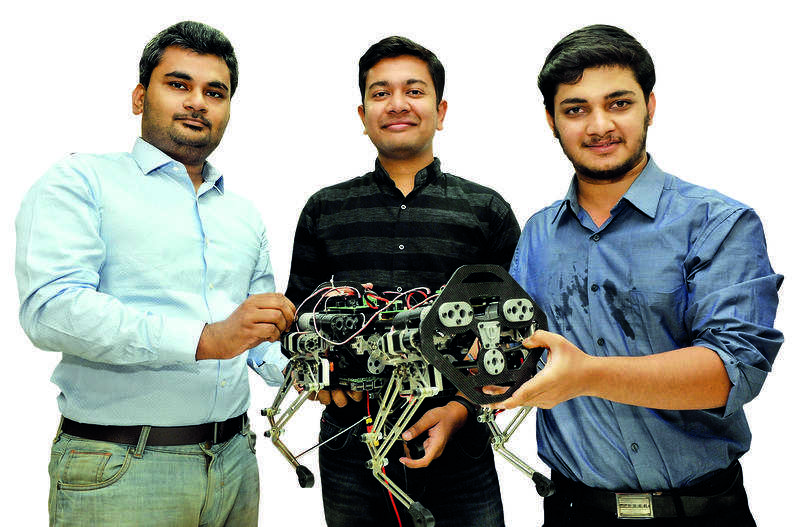
The robot is the size of a small dog with four legs and a thick but flexible spine. When connected to a battery, it starts walking on slender, articulated limbs, like a canine. 

It even has a 'face' that looks vaguely like that of a pug. The developers at the Robert Bosch Centre for Cyber-physical Systems at the Indian Institute of Science (IISc) are calling it 'Stoch' and they say it's on target to become the country's first commercial "walking" robot.

Stoch has been under development since January last year. The first version was displayed a month ago at Aero India - it was heavy-footed and clumsy. A sleeker second version was developed just two weeks ago and a third will be ready in three months. A commercial variant is about a year away. 

The robot uses machine learning to figure out how to walk by itself. Specifically, it uses reinforcement learning, where the machine learns over time to take the best possible action in return for the best reward. 

After several million attempts - performed in computer simulation - ؙthe robot learns to walk. Some Indian Institutes of Technology (IITs) and IISc have been working on such devices in the past few years. There aren't any commercial versions in the market and no institution other than IISc has a prototype that uses reinforcement learning to teach the robot to walk.

The IISc project started when a student, Shounak Bhattacharya, did a master's project in the department of mechanical engineering. After the project, the Bosch Centre at IISc took over development by bringing together professors from other departments. 

It also hired engineers and put together a development team. "We wanted to explore the field of data-driven robotics," said Bharadwaj Amrutur, professor of electrical engineering at IISc and chairman of the Robert Bosch Centre.

Data-driven robotics is a set of technologies that use data to get a robot to learn by itself. As the IISc project got off the ground, it was joined by Shishir Kolathaya from Georgia Tech University. Kolathaya, who has been working with walking robots since the undergraduate level, studied legged robots for his PhD.

When he joined, the Bosch Centre had a non-working prototype. The first real prototype - Stoch 1 - didn't carry batteries. Stoch 2 was twice as powerful, was designed to carry batteries and could walk for 15 minutes without being plugged into an electrical outlet. The third version will improve on looks and be even more powerful. The commercial prototype, when ready, will be bundled with an applica tion.

The Bosch team is mulling several applications - climbing coconut trees, doing surveys in difficult terrain, inspecting construction sites and so on. The project now has five engineers, apart from some faculty members. "We are planning to put a software development kit for people to programme," says Dhaivat Dholakiya, who is technical associate of the project.

Source: https://tech.economictimes.indiatimes.com/news/technology/iisc-engineers-take-fetch-to-a-whole-new-level/68418892 (Accessed on 16 March, 2019)

Friday, March 15, 2019

India lags behind global peers in future job skills, report says

IIT Kharagpur to design Desi Supercomputer

C-DAC already makes the PARAM series of supercomputers for strategic requirements

KOLKATA: IIT Kharagpur is building a supercomputer of a speed of 1.3 Petaflops, all the parts of which will be manufactured indigenously.

A Petaflops is a unit of computing speed equal to 1,000 million million (1015) floating-point operations per second. In three months, the institute will be ready to pull the veil off this genius, promised the computer wizards at the institute.

The supercomputer is being built at the high-performance computing (HPC) facility and data centre ecosystem that has come up at the institute under the National Super Computing Mission, which aims at building the fastest and most powerful computers in the country.

The Centre for Development of Advanced Computing (C-DAC), which is an autonomous scientific society of the ministry of electronics and information technology, scouted all the IITs before agreeing to set up the HPC at IIT Kharagpur, where the marvel is being built. An MoU between the institute and C-DAC was signed on March 12 for the project.

The department of science and technology (DST), along with experts from Niti Ayog, DRDO and IISc, will help IIT Kharagpur develop this supercomputer.

As the new computing system would revolutionise output and efficiency in complicated calculations, researches on cryptography, chemistry, molecular dynamics, drug discovery, data sciences would directly benefit, said director of IIT Kharagpur Partha Pratim Chakraborty

“Some other fields that will benefit from the project are healthcare, smart cities, geo-sciences and new materials,” he added.

The computer will be built in three phases and no imported part will be used anywhere. The first phase will involve assembling, the second will focus on assembling and manufacturing and the third phase will perfect the design and manufacturing details with all major parts and accessories to be indigenously designed and manufactured, as is C-DAC’s mandate.

After the new supercomputer is built, the HPC will be continuously building improved versions. Students will also use the facility for academic programmes at the institute, like M.Tech, doctoral programmes as well as micro-specialisations.

Wednesday, March 13, 2019

The next chartbuster by an artist called AI?

Kashaf Shaikh: the budding superlative entrepreneur in India

Kashaf Shaikh is one of the most renowned entrepreneurs in the country and all across the globe. With her innovative set of skills, mindfulness, and determination, she founded one of the most famous websites in the country which is called Dealivore. It is an authentic website which is full of various kinds of coupons which are valid and real and can be used across a lot of stores all over the country. Also, if you are a purchaser of online products from various e-commerce websites then you have to check her website because all the coupons, she puts on the website are pure deals which will surely make your experience on the shopping portals better and fascinating.
However, she is a computer engineer basically. She completed her graduation......
To read the full article, visit: