Wednesday, March 27, 2019

30 years of surfing the giant web


Source: The Times of India dated 27 March, 2019

AICTE to introduce students feedback-based assessment for the promotion of Engineering teachers

Besides research work and their overall performance, teachers in Engineering colleges will now be appraised on the basis of students' evaluation All India Council of Technical Education's (AICTE) decision to include the students' feedback to assess the teachers has been introduced to improve the educational quality of engineering colleges. But, its effectiveness remains to be seen. "Since students' feedback will be considered while granting promotion to the teachers, they will have to put their best foot forward in the classroom. This assessment pattern is followed by the IITs and NITs," says AICTE chairman Anil Sahasrabudhe.

As per the rule, students' feedback will have 25% weightage in the overall assessment of the faculty, which will be a decisive component for their promotions. Till now, the focus for promoting teachers in colleges has been on the number of research papers published by the faculty members. This was partly the reason for the publication of substandard research papers in fake journals. "Colleges in tier II and III cities, may not have the resources to conduct research. But research publications being given high priority during promotions often leads to the problem of paid journals. The new assessment will thus award good teachers," adds Sahasrabudhe. While some academicians are positive about the impact of this assessment system, others are of the view that students might not be honest with their feedbacks owing to various reasons. "Students are sometimes not objective or may be simply confused while giving feedback for teachers. Their opinions are based on peer thinking. While interacting with the students, I have come across several students who behave differently in class and during one-on-one interactions," says Govinda K, professor, School of Computer Science and Engineering, Vellore Institute of Technology (VIT). Addressing the concern, Sahasrabudhe says that the number of such students is mostly low, thus the overall score of a teacher who is good at his work is not hampered. "Some students may give poor feedback, probably because the teacher is strict or is not lenient with marks, but this is temporary. In the long run, a teacher who is passionate about teaching and thinks about students' welfare will always be valued by the majority. Also, such an assessment will also ensure better student-teacher communication," he says. This system will allow the teachers to address their weaknesses and improve teaching methods, says KK Mahapatra, dean, Academics at NIT, Rourkela. "Since students are the direct beneficiaries, this will help the teachers to analyse their skills, for instance, maybe there is an issue with communication or students might be finding the teaching method complicated," says Mahapatra.

Source: The Times of India dated 25 March, 2019

Monday, March 25, 2019

Johns Hopkins Assistant Professor Archana Venkataraman Receives NSF CAREER Award

The Indian American professor’s CAREER project, “Small Data in a Big World: Balancing Interpretability and Generalizability for Data Integration in Clinical Neuroscience,” uses the power of machine learning to address the challenges of high data dimensionality and limited sample sizes in clinical neuroscience, the university said......

To read the full article, visit https://www.indiawest.com/news/global_indian/johns-hopkins-assistant-professor-archana-venkataraman-receives-nsf-career-award/article_6b53a23c-4b45-11e9-a915-cf53b17bddf2.html (Accessed on 25 March, 2019)

Wednesday, March 20, 2019

Niranjan Karagi’s Nirnal world’s cheapest portable water filter

Sometimes, the inspiration for the most brilliant of inventions can come from the most humbling of places. Such is the case for NirNal founder Niranjan Karagi while he was playing in a schoolyard nearby his home has invented and patented the world’s cheapest water filter which costs Rs.30 and can be used for 100 times and fits any water bottle and this removes 99% of bacteria and other disease-causing water contaminants.

AAB is proud that we were the first ones to cover his project in December 2016, An Engineer Filters the Way to Success.
Niranjan now has many accolades to his name including Best Entrepreneur Award by Deshpande Foundation – Feb 2017, Best Entrepreneur Award by Visvesvaraya Technological University (VTU) – Jan 2017, Yuva Shilpi Award by Akhil Bharatiya Vidyarthi Parishad (ABVP).
It is a compatible, portable, reusable, healthy and an eco-friendly water purifier. A product that ensures ‘Safe Drinking water ’ at an affordable price. This acts as a filter when the water oozes out of Nirnal fixed to the bottles. It is easy to use, imparts taste and also adds some essential minerals to the water. It uses activated charcoal, Filter cloth.

Niranjan did his schooling from St. Mary’s school Belagavi and PUC from Govindram Seksaria Science College, Belagavi. Later completed Mechanical engineering from Angadi Institute of Technology and Management in Belagavi.
During his free time, he noticed some small children using the playground and filling up their plastic water bottles from a potentially unsafe tap. Bearing witness to the scene, Niranjan reflected sadly on this reality and felt that all children should have clean water despite their income or area of residence. It was certainly not a surprise for the young leader to think of such social issues, given his involvement in the LEAD program at AITM College Belagavi. But it was this particular case that leads him to create something that would make a significant social impact for many people.
Water filtration became the main theme for Niranjan as he began to brainstorm ideas on providing a clean, low-cost source of water. Seeing as his research revealed the relatively high prices charged by competitors for filters, the future entrepreneur settled on creating a water filter that was both very affordable and portable for bottles. His first prototype used materials that were easily accessible around the house but after some assistance from LEAD, a second prototype was created that took Niranjan 4 painstaking months to perfect. The result was a small filter that could be fitted into any standard plastic bottle with an incredibly low cost of 20 rupees.
At that point, all the hard work put into the prototype paid off. Approval was given by the Food Divisional Officer stating that the filter could purify up to 100 liters of water. Furthermore, Niranjan turned to social entrepreneurship as a means of spreading his technology by agreeing to receive tier-ii incubation support in Belagavi by the Sandbox-IMER center. Sandbox Startups was instrumental to the founding of the NirNal enterprise, officially registered with the Ministry of Micro Small and Medium Enterprises in Belagavi. Furthermore, the incubation center gave him a platform to pursue his ideas for his product while gaining business knowledge about scalability and validity for the purposes of society. Complete with networking events, partnership opportunities, mentoring, and investor meetings, Sandbox Startups was an essential springboard to Niranjan’s growth as a social entrepreneur.
The social impact of his product has been significant. With the distribution of his product to various villages, schools, and even India’s military, it is evident that NirNal has been widely acclaimed for its ingenious and inexpensive technology. But on a personal level, Niranjan is happy with the fact that children could use his filter, knowing that they would always have a reliable source of water as they grow up. Niranjan’s initial wish to provide clean water to everyone has become more and more of a reality through the means of his portable water filter. This reality was made possible for thousands of people as 12,000 units of his filter have already been sold.
Indeed, it is exciting to see how NirNal will scale with its water filters. Niranjan himself has stated that he would like to improve the unit even further while maintaining a low price, all while maintaining his goal of providing clean water to all rural people. If he were to truly succeed in his endeavors, there would be much cause for celebration for this ingenious invention.
Niranjan can be contacted at +91-888-466-0444 or +91-779-533-9714 or contact@nirnal.in

Do It Yourself Projects

Here is a list of "Do-It-Yourself" projects curated from the magazine - Electronics For You. The library shall keep on updating the list every month.

Do-It-Yourself Projects

Do have a look at the following too:

All Electronic Projects

Top 50 Projects

Latest 50

Arduino Projects

Raspberry Pi Projects

Software Projects: 

MATLAB

Image Processing

MU reschedules 76 examinations

REGULAR FINAL EXAMINATIONS OF MOST SELF-FINANCED COURSES WILL NOW BEGIN ON MAY 2
MUMBAI: The University of Mumbai (MU) has rescheduled 76 semester examinations, including final BCom tests and most self-financed commerce courses, and few papers of 27 examinations, to avoid a clash with next month’s Lok Sabha elections.
The 76 examinations, which include sixth-semester exams of BMS, BCom (Accounting and Finance) and BCom (Banking and Insurance), have been entirely pushed ahead by a few days.
Some papers of the other 27 examinations, including sixth-semester BCom examinations, will be held on different dates, which are yet to be announced.
“The university has tried to make minimal changes,” said Vinod Patil, director, examination and evaluation board.
The four phases of general elections on April 11, 18 and 23 and 29 are set to overlap with MU’s examination schedule.
With the colleges doubling up as the examination and polling centres, and teachers assigned various election duties, the university has decided to move all the major papers being held on the polling days as well as the days preceding and following them.
The regular final examinations of most of the self-financed courses, which were to start on April 22, will now begin on May 2.
“The university should have ensured that all the examinations end on April 30 — the last day of the term. The teachers will now have to be requested to work during summer vacations. The academic calendar won’t be affected if the date of commencement of the next term is not extended beyond June 11,” said Asgar Lakdawala, principal, Royal College, Bhayander.
However, Gopal Kalkolti, principal, MV Mandali’s College, Andheri, said, “The revised schedule may delay results and admissions to post-graduation courses to some extent.”

Source: Hindustan Times (Mumbai edition) e paper dated 20 March, 2019


Move IST ahead by 30 mins, save 3.5 billion units of energy: Scientists

Two time zones will create a divide between the eastern parts of India and the rest of the country. Our proposal for advancing the clock will not force people to change their schedules or habits. DP SENGUPTA, Retd professor, Indian Institute of Science

MUMBAI: The country can save 3.5 billion units of electricity every year if the Indian Standard Time (IST) is advanced by 30 minutes, two senior Indian scientists who first proposed the idea of a timezone shift a decade ago said on Monday.
At present, India is five-andhalf hours ahead of the Greenwich Mean Time (GMT), and among few nations with a fractional shift — in minutes — from GMT. Most countries add or subtract hours from GMT to create their standard time zones.
In 1884, India had two time zones – Bombay time and Calcutta time. On January 1, 1906, British India adopted IST of fiveand-half hours ahead of GMT. Only the Assam tea gardens operate one hour ahead of IST (chai bagan time).
Retired professors DP Sengupta from the Indian Institute of Science and Dilip Ahuja from the National Institute of Advanced Studies (both based in Bengaluru) in a 2009 study funded by the Bureau of Energy Efficiency had recommended advancing the IST by 30 minutes to obtain energy and non-energy gains. They estimated India would save an estimated 2.1 billion units of electricity every year or 0.3% of the annual consumption of 750 billion units.
For 2019, the duo has said if IST is made six hours ahead of GMT, India can save 3.5 billion units from the annual 1,200 billion units of electricity consumed. According to their study, there will be a saving of 17-18% during peak energy time, such as during evenings when there is a lot of power demand.
“India is investing heavily in rural electrification, and therefore energy demands will also increase in the future. With most of the electricity requirements met by thermal power plants, a one-time advancement of 30 minutes will save us from burning coal to produce 3.5 billion units every year,” said Sengupta during a talk at the Observer Research Foundation.
The scientists are opposed to the idea of implementing daylight savings twice a year as is followed in Western countries or two time zones for India as recently recommended by the National Physical Laboratory. “Two time zones will create a divide between the eastern parts of India and the rest of the country, and lead to confusion in travel schedules. Our proposal for advancing the clock will not force people to change their schedules or habits,” said Ahuja.
Five Asian countries that have implemented one-time advancement in their clocks are China, Kyrgyzstan, Malaysia, Singapore and South Korea.
Despite making several presentations to various government departments and bodies between 2010 and 2014 and getting letters of endorsement on their proposal, nothing has happened.
“Governments and policymakers have shrugged their shoulders and moved on. We need individual states on board as stakeholders,” said Sengupta.

Source: Hindustan Times (Mumbai) e-paper dated 20 March, 2019

India Innovation Growth Programme 2.0

The India Innovation Growth Programme (IIGP) 2.0 is a unique tripartite initiative of the Department of Science and Technology (DST), Government of India, Lockheed Martin and Tata Trusts.
Supporting the Government of India’s missions of “Start-up India” and “Make in India”, IIGP 2.0 enhances the Indian innovation ecosystem by enabling innovators and entrepreneurs through the stages of ideation and innovation, to develop technology-based solutions for tomorrow.
Complemented by several implementation partners, Federation of Indian Chambers of Commerce and Industry (FICCI), Indo-US Science and Technology Forum (IUSSTF), Centre for Innovation Incubation and Entrepreneurship (CIIE) at IIM Ahmedabad and Indian Institute of Technology Bombay; the programme aims to build an innovation pipeline in India through a high-impact programme focused on the social and industrial innovation ecosystem.
Launched in 2007, India Innovation Growth Programme (IIGP) has been one of India’s longest standing public-private partners. The programme has provided mentoring and handholding assistance to over 400 innovators coming from diverse sectors from across the country; generated over 350 commercial agreements and over $900 Million of economic value for India. (Source: Second Impact Analysis Report by Ernst & Young in 2015).
Through two annual parallel tracks viz. University Challenge and Open Innovation Challenge, IIGP 2.0 identifies and supports both industrial and social innovations through:
  • Phase A: Ideation
  • Phase B: Innovation

To read more and register, please visit:

The big deal

ON OFFER Students graduating from the Arts, Commerce and Science streams are being offered hefty starting salaries in campus placements. The big selling points, say companies, are their soft skills and analtyical capabilities

There’s a rapidly growing number of positions that require data crunching or analysis, for which students from maths, statistics and economics backgrounds are well-equipped. DEVASHISH SHARMA, founding member of HR consultancy PeopleStrong
It’s not just engineering, management and law. Highly paid campus placements offers are now being made in fields beyond the professional and technical courses, to students graduating in arts, science and commerce too.
ISTOCK
This year, a final-year Economics student at Delhi’s Lady Shri Ram (LSR) College received a salary offer of Rs 38 lakh (all salary figures are per annum); last year a Commerce student from Sriram College of Commerce (SRCC) got a starting offer of Rs 31 lakh. In Mumbai, arts and commerce students got offers averaging Rs 6 lakh, with the highest going up to Rs 19 lakh.
Companies are offering better packages because they would rather hire young people who are easy to train than experienced people who need to unlearn practices and come with a higher price tag, says Smita Sharma, placement advisor at SRCC.
Another big draw is the fact that these students tend to be equipped with good soft skills.
The average engineering student, for instance, is less likely to have good communication skills, says Devashish Sharma, founding member of India’s largest HR Technology and Talent Acquisition solutions company PeopleStrong. “There’s a rapidly growing number of positions that require data crunching or analysis, for which students from maths, statistics and economics backgrounds are well-equipped,” says Soni George, placement convener at St Xavier’s College, Mumbai. “Students from other departments are also eligible to apply for these. We have had students from life sciences take up analyst jobs too.”
At both Xavier’s and SRCC, campus recruitment picked up around 2004-2005 and has been growing steadily since. “This year, we added 20 more companies. Some startups have started coming to campus too. Though they don’t offer huge pay packages, they do offer a lot of exposure,” says Smita Sharma, placement advisor at SRCC.
The brighter job prospects in these subjects have now allowed more students to choose freely when it comes to picking a stream. “I chose economics because I really wanted to study the subject. I did not even know whether I wanted to do a job right after college or not,” says Yashovat Saharia, who graduated from SRCC in 2017. He received among the highest salary offers of his year, according to his college, and has worked with that company, Parthenon EY, ever since.
Saharia says he doesn’t plan to study economics further but he’s glad he picked it to begin with. “I now firmly believe that one should study the subject one likes and not look for one with ‘better job prospects’ because it gives you a strong foundation when you specialise in one field,” he says. At Parthenon EY, his job is that of a senior associate; it involves crunching data to explain to companies why a deal or acquisitions is or isn’t a good idea. “My background in economics and my grooming in presentations made me both good with numbers and capable of communicating what those numbers say, effectively,” Saharia says. Economics has been on the top of recruiters preference for a long time but now recruitments in good honours courses in both sciences and humanities have a lot of takers too, says Sharma of PeopleStrong. “Whereas campus recruitment for general science courses are increasing in fields like pharmaceuticals and chemical research, in the humanities and social sciences there is a rise in recruitment from among psychology students, by corporates and institutions like hospitals and schools. Also, the services side of new age Internet companies are employing humanities graduates with good communication skills in their customer support teams,” Sharma adds.

Source: Hindustan Times (Mumbai edition) e paper dated 20 March, 2019.

Tuesday, March 19, 2019

Usage Statistics of SFIT LIRC


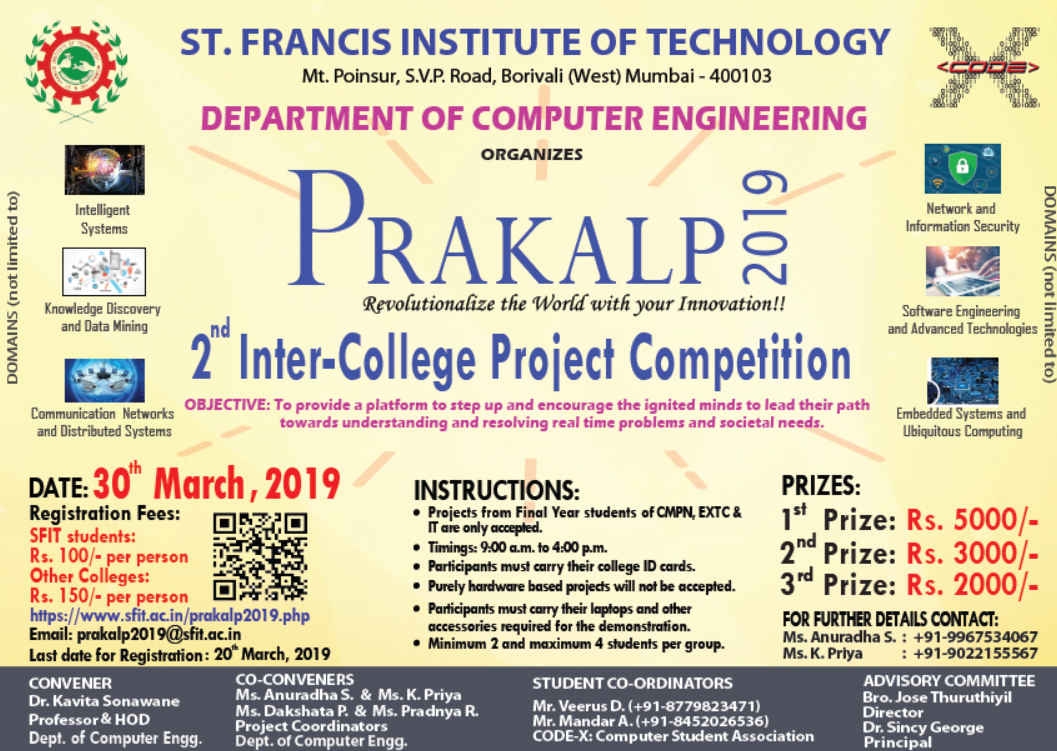
Prakalp 2019 at SFIT

Department of Computer Engineering, SFIT presents the most awaited competition of the year !!


Prakalp-2019 is an Inter-college Project Competition being held successively for the 2nd year. This competition provides a platform for final year students of Computer, Information Technology, Electronics and Telecommunication Departments to exhibit their final year projects.

REGISTRATIONS ARE NOW OPEN!!

Venue : St. Francis Institute of Technology (Borivali West), Mumbai.
Date : 30th March 2019

PRAGATI 2019 AT SFIT WINNERS

Technical Competition:

1st Winner: Complete the incomplete (Vidyavardhini's College of Engineering and Technology)
Sanchitsagar Singh
Shreyans Gosalia
Aditya Manze
Sushmita Mahajan

2nd Winner: Ground Surveillance Rover (Bharati Vidyapeeth College of Engineering)
Raj Gandhi
Aniket Jadhav
Tushar Jadhav
Shivraj Jadhav

3rd Winner: Case Link (St. Francis Institute of Technology)
Ritika Bhole
Manas Acharya
Sahil Nirkhe
Dwayne Fernandes
Sanket Dalvi


Business Plan:
1st Winner: Blue (St. Francis Institute of Technology)
Trilok Dattajirao Sawant
Aakash Ashok Salunke

2nd Winner: Besto
Sarang Jitendra Bora

(Inputs by Dr. Prachi Raut, E-Cell Convener)

Monday, March 18, 2019

PRAGATI 2019 at SFIT Photos

Entrepreneurship Cell SFIT presents the most awaited competition of the year !!
PRAGATI 2019 is a national level technical innovation and business plan Competition offering a platform for students with different innovative project to compete against each other for investment. Aspiring entrepreneurs can transform their simple ideas into a market ready business plan and present it in front of a wide range of investors.
For Details, visit  http://pragati.ecellsfit.com

Some Snapshots:


  All Photos Courtesy: Mr. Sunil Pansare (In-Charge HOD - Mechanical Department, SFIT)


Project and Research Help for Faculty and Students of Engineering

(Image created and uploaded by SFIT Library)

The word “Shodh” originates from Sanskrit and stands for “research and discovery”. “Gangotri”  is one of the largest glacier in the Himalayas and source of origination of Ganges, the holiest, longest and largest of rivers in India. The Ganges is the symbol of age-long culture, civilization, ever-aging, ever-flowing, ever-loving and loved by its people.
Under the initiative called “ShodhGangotri”, research scholars / research supervisors in universities are requested to deposit electronic version of approved synopsis submitted by research scholars to the universities for registering themselves for the Ph.D programme. The repository on one hand, would reveal the trends and directions of research being conducted in Indian universities, on the other hand it would avoid duplication of research. Synopsis in “ShodhGangotri” would later be mapped to full-text theses in "ShodhGanga". As such, once the full-text thesis is submitted for a synopsis, a link to the full-text theses would be provided from ShodhGangotri to "ShodhGanga"

Source: https://shodhgangotri.inflibnet.ac.in/# (Accessed on 18 March, 2019)

SFIT Alumni Publications - Main Post

Dear SFIT Alumni,

Please share the publication details by clicking on the form URL given below:

SFIT Alumni Publications

How startups are leveraging deep tech knowledge to power ahead

Geetha Manjunath turned entrepreneur in the backdrop of a tragedy. In 2017, a cousin she was really close to succumbed to breast cancer at a relatively young age. Breast cancer is the most commonly occurring cancer in women and the second most common worldwide. 

Manjunath, who has a PhD in computer science from the Indian Institute of Science, applied her scientific mind to the issue. Ubiquitous screening and early detection vastly reduces fatality from cancer. Manjunath had been part of  .. 

Indian IT Giant TCS Developing Multiple Blockchain Platforms

India’s largest software company, Tata Consultancy Services Limited (TCS), is actively working on a number of decentralized projects leveraging R3’s blockchain platform and Microsoft Azure blockchain workbench. Per the company, the blockchain venture was initiated to accelerate the adoption of distributed ledger technology across a wide range of industries.

TCS Delves Deep Into Blockchain

As reported by ANI, IT giant TCS is developing five blockchain architectures, each offering a different solution ranging from digital identity to tokenization. The platforms will also facilitate solutions such as track-and-trace, asset monetization, and assets in common.
The Indian IT heavyweight divulged that the platforms will leverage R3’s blockchain platform, Codra Enterprise, and be hosted on Microsoft Azure cloud.
TCS, the world’s ninth-largest IT company by market cap, intends to develop advanced cross-industry blockchain platforms that would make it easy to deploy scalable solutions on the platform. Apart from developing shared ledgers, TCS will develop a number of solutions built on these decentralized architectures.
Global head of blockchain services at TCS, Lakshminarasimhan Srinivasan, stated:
“Some of the anchor solutions that we are building on these platforms include skills marketplace, anti-counterfeiting of luxury goods, affordable mobility, shared telecom infrastructure for 5G and loyalty and rewards programmes.”
While the plan seems ambitious, the company has not announced any timeline to launch of these enterprise-level blockchain platforms. However, TCS hopes that the cross-industry blockchain platforms will increase adoption of the technology.
Tata Consultancy Services

Race to Become Blockchain Platform Leaders

With this latest development, TCS plans to work on a market position in the blockchain space. On that front, software powerhouse TCS has successfully been offering its blockchain solution dubbed Quartz. The Quartz blockchain solution allows enterprises in the financial ecosystem to use distributed ledger tech to significantly cut transaction processing cost.   
Earlier in January, Srinivasan stated that distributed ledger technology, along with artificial intelligence and Internet of Things (IoT), can lead to new income opportunities.
“The combinatorial effect of blockchain with other next-gen technologies such as artificial intelligence, Internet of Things, and virtual reality, cannot only drive hyper productivity and business transformation, but also open up new revenue streams through disruptive innovation.”
While TCS is aggressively pursuing blockchain, other Indian software firms are not behind the curve.
One such company is Tech Mahindra, which has been very bullish on distributed ledger technology. In the past, Tech Mahindra revealed plans to use DLT to register vehicle numbers. Apart from that, the IT heavyweight also signed an MoU with the state government of Telangana to build a blockchain district that will foster startups working in the space.  
Moreover, Tech Mahindra also partnered with Microsoft to develop a blockchain-powered platform that would regulate unsolicited telecom communications.
Similarly, last year India’s second-biggest software firm Infosys developed a tailor-made blockchain trade finance network. The blockchain-powered platform is aimed to eliminate any opportunities for fraud in the Indian banking system.

Source: https://bitsonline.com/indian-tcs-blockchain-platform/(Accessed on 18 March, 2019)

Colleges do their paper work, make campuses eco-friendly

MUMBAI: From online tests to reducing the use of paper to recycling answer sheets, colleges across Mumbai are doing their bit to turn their campuses into environment-friendly spaces.
At Kalyan’s BK Birla College, question papers are designed and assessed online. “Very soon, all our internal examinations too will be computer-based,” said Naresh Chandra, principal of the college.
He added that the college will soon rope in an agency to set up an online examination system. “Autonomy gives us this freedom and we want to use the power to bring about a positive change,” said Chandra.
Two years ago, St Andrew’s College in Bandra had hired an agency to help them recycle all types of paper.
“Earlier, we used to find ways of recycling paper ourselves but with the help of the agency we also found ways to reduce usage of paper and they help recycle whatever paper is generated on campus,” said Marie Fernandes, principal of the college.
In 2016, St Andrew’s College had conducted a green and energy audit to get a better idea of what changes will help the environment, following which the college introduced waste segregation on the campus and installed compost pits to produce manure for their gardens.
RA Podar College in Matunga has already replaced all their regular administrative work, which requires a lot of paper, to electronic format.
“All circulars and notices are now sent via emails and even parents are contacted via email or WhatsApp. Such small changes have brought about a significant difference to our daily functioning,” said Sobhana Vasudevan, principal.
She added that all newspapers collected in college are reused to make paper bags by students, which are then distributed to vendors in Dadar and Matunga markets.
Colleges said the reason behind bringing about these changes was to spread the importance of reducing carbon footprint.

Source: Hindustan Times dated 18 March, 2019

IT returns at city engineering colleges: More jobs, high pay

HIRING SEASON Major information technology firms offer ₹40L package a year

MUMBAI: After a two-year slump, the city’s engineering colleges are seeing a rise in offers and pay packages from information technology (IT) companies, with some even touching ₹40 lakh.
While IT firms such as Accenture, Larsen and Toubro (L&T) Infotech, Capgemini and Infosys are hiring students in bulk, Tata Consultancy Services (TCS) and Wipro opted for a pan-India centralised recruitment process.
“We are witnessing a surge in demand for IT and computer science graduates compared to last year. There has been an unusual growth in packages, which wasn’t seen in the past decade,” said Gopakumaran Thampi, principal, Thadomal Shahani Engineering College (TSEC), Bandra.
Here’s an example: Accenture made 178 offers at the KJ Somaiya College of Engineering this year, up from 130 and 140 offers in 2016-17 and 2017-18, respectively. The recruitment figure for the company was much higher – 301 – in 2015-16.
At Thakur College of Engineering and Technology (TCET), Kandivli, Accenture offered 150 jobs. Last year, the company didn’t visit the college, as it didn’t want to share the sought-after first day of placements with Infosys. MH Saboo Siddik College of Engineering (MHSSCOE), Byculla, saw L&T Infotech and Wipro, both of whom were absent last year, making offers to their students this year.
Several students received attractive international packages, especially from Japanese firms. Uniqlo, a Japanese clothing company, recruited students for software profile from at least three colleges – MHSSCOE, Vidyalankar Institute of Technology (VIT), Wadala, and Sardar Patel Institute of Technology (Andheri) – offering between ₹37.5 lakh to ₹39 lakh an annum. Works Applications, a Japanese enterprise resource management (ERP) firm, made three offers of ₹37 lakh each at TSEC.
The packages, too, have gotten better. At TSEC, the number of students receiving at least ₹5 lakh an annum doubled to around 100. At TCET, TCS and Infosys offered salaries between ₹8-10 lakh, up from the highest ₹7 lakh offered last year.
In addition to their regular job profile, which pays around ₹3.5 lakh to freshers, some of the mass-recruiting IT firms such as Infosys and Cognizant offered another job profile of ₹6.5 lakh package at Sardar Patel Institute of Technology. One of the students at the college was offered ₹40 lakh per annum, including stock options and other perks, by software giant Microsoft.
According to experts, the growth in new technologies and bagging of lucrative contracts and investments by IT services firms has contributed to the renewed boom in hiring.
“The improvement in the IT recruitment is mainly owing to development in new areas, including artificial intelligence, blockchain, cloud and data, collectively known by the acronym ABCD,” said Braj Mishra, principal, TCET.
Kamal Karanth, founder, Xpheno, a Bengaluru-based specialist staffing firm, said, “For the past two to three years, IT companies were running on a thin batch, filling only 70% of their workforce requirement. The recruitment has gone up in the past four-five months. The arrival of guaranteed investment certificates (GICs) in the country and large contracts bagged by some of the companies in the past six years are the other factors.”

Source: Hindustan Times dated 18 March, 2019