Friday, January 10, 2025

India Takes a Giant Leap in Genomics: Launch of Indian Genomic Data Set & IBDC Portals to Empower Global Research

 "India’s Genomic Revolution: 10,000 Whole Genome Samples Now Accessible Globally"
"Prime Minister Modi Congratulates Scientific Community as India Poised to Lead the Next Generation Revolution in Biotech"
Posted On: 09 JAN 2025 7:51PM by PIB Delhi

Making a vital move towards self-reliance in the field of genomics, Dr. Jitendra Singh, Union Minister of State (Independent Charge) for Science and Technology, today announced that India is no longer dependent on foreign genomic data. At the Genome India Data Conclave, held at Vigyan Bhavan, New Delhi,

Under the leadership of Prime Minister Narendra Modi the Indian Genomic Data Set unveiled and Union Minister Dr. Jitendra Singh launched the ‘Framework for Exchange of Data Protocols (FeED)’ and the Indian Biological Data Centre (IBDC) Portals, making 10,000 whole genome samples accessible to researchers across India and the globe.

Addressing the conclave, Dr. Singh proudly stated, “India has developed its own genomic data set, a monumental achievement that will fuel future medical and scientific breakthroughs. The entire collection of 10,000 whole genome samples, archived at IBDC, is now made available for research purposes not only within India but globally. This data set will serve as a critical resource for genomics research, contributing to advancements in personalized healthcare and medicine.”

The Indian Biological Data Centre (IBDC) will facilitate seamless access to valuable genetic information, enabling researchers to explore genetic variations and design more accurate genomic tools. The 10,000 whole genome sequencing (WGS) samples come from diverse Indian populations and provide a rich catalog of genetic variations. This initiative is set to position India as a leader in genomics, enabling the development of genomic chips tailored to the Indian demographic, thereby enhancing the precision of genetic studies.

Dr. Singh emphasized the significance of the 'GenomeIndia' project, spearheaded by the Department of Biotechnology (DBT), which aims to create a robust and comprehensive database of India’s genetic diversity. The data will serve as a foundation for cutting-edge research and will catalyze innovations in areas such as mRNA-based vaccines, protein manufacturing, and genetic disorder treatments. He said in India there is diversity not only in food, culture and geography but also in Genome.

The launch of the ‘Framework for Exchange of Data (FeED)’ Protocols under the Biotech-PRIDE Guidelines ensures that the high-quality, nation-specific data will be shared in a transparent, fair, and responsible manner. The Biotech-PRIDE Guidelines, introduced in 2021, are a testament to India’s commitment to ethical and secure data sharing.

Dr. Singh highlighted the impressive growth of India’s bioeconomy, which has surged from $10 billion in 2014 to over $130 billion in 2024, with projections to hit $300 billion by 2030. The Minister attributed this growth to the visionary leadership of Prime Minister Narendra Modi and the new Bioeconomy Policy, which is set to make India a global leader in biotech, positioning the country to lead the 4th industrial revolution.

India now ranks 12th globally in biotech and 3rd in the Asia-Pacific region. The Minister also pointed out that India is the largest vaccine producer in the world and the third-largest startup ecosystem. The rapid rise of biotech startups—from just 50 in 2014 to over 8,500 in 2023—demonstrates India’s growing leadership in biotechnology and its potential to revolutionize the global bioeconomy.

Dr. Jitendra Singh further announced a future target of sequencing 10 million genomes to accelerate India’s advancements in genomics and personalized medicine. He also suggested expanding the initiative by collaborating with prominent institutions such as the Tata Memorial Hospital to enhance data enrichment efforts.

Dr. Rajesh S. Gokhale, Secretary of DBT said with Genomic Data Avialble we can counter genetic and hereditary diseases.

Prof. Ajay Kumar Sood, Principal Scientific Adviser to the Government of India, spoke about the transformative potential of this data, emphasizing its role in the prevention and cure of genetic disorders. He also highlighted that the data generated from the GenomeIndia project would not only strengthen healthcare but also provide invaluable insights for agricultural, environmental, and industrial research.

Dr. Rajiv Bahl, Director General of ICMR; Dr. Y Narahari, CBR, IISc Bengaluru; Dr. Arvind Sahu, Executive Director RCB and senior officials from the concerned scientific ministries were present at the event, underscoring the collective effort behind the success of this project.

In his video message, Prime Minister Narendra Modi congratulated the scientific community on this achievement and laid out a roadmap for India’s future in genomics. He praised the initiative as a testament to India’s scientific prowess and its vision for the future of healthcare and biotechnology. This initiative will also develop an ecosystem which would act as Knowledge hub and Innovation Hub and contribute to make Viksit Bharat @2047. He also reiterated that Pro-people governance, Digital Public infrastructure development and Genomic Data Bank will empower India.

The ‘GenomeIndia’ project is poised to make India a global hub for genomic research, positioning the country at the forefront of the next scientific and medical revolution.


Source: https://pib.gov.in/PressReleasePage.aspx?PRID=2091577

Thursday, January 9, 2025

Tech jobs to see highest growth: Report

NEW DELHI: Traditional jobs such as farmworkers, delivery drivers, construction and food processing workers and salespersons are expected to see the highest growth in absolute numbers over the next five years, although in percentage terms, it will be the tech jobs with AI and machine learning (ML) being the most sought-after skills, said a new report released on Wednesday.
The World Economic Forum's (WEF) Future of Jobs report concluded that clerical and secretarial workers could see the largest decline in absolute numbers with health workers and education seeing robust rise. In India, specialists in Big Data, AI and ML, and security management are seen to be in demand.

The report said that structural factors - from broadening digital access to higher cost of living, climate change mitigation, demographic shift and geopolitical fragmentation - could displace 8% or 92 million of the current workforce, but they will also create around 170 million new jobs, which is 14% of the current workforce.
In India, increased digital access, geopolitical tensions and climate-mitigation efforts are seen to be the primary trends shaping the future of jobs. The report said that Indian companies are heavily investing in AI, robotics and autonomous systems, and energy technologies with employers looking to outpace global adoption in technologies such as semiconductors and computing technologies and quantum and encryption to transform their operations.

The WEF study said that the US and India are seeing the highest enrolment for AI skills with corporate sponsorship playing a significant role in boosting GenAI training uptake in the country.

"Analytical thinking remains the most sought-after core skill among employers, with seven out of 10 companies considering it as essential in 2025. This is followed by resilience, flexibility and agility, along with leadership and social influence," the report said on the global outlook.

While identifying skill gaps as the biggest block for businesses, the report said: "On average, workers can expect that two-fifths (39%) of their existing skill sets will be transformed or become outdated over the 2025-2030 period."

India must prioritise frontier AI research to drive innovation: Nadella

During his visit to India, Nadella announced strategic partnerships with the Government of India and industry leaders to advance cloud and AI transformation.


NEW DELHI: India must prioritise frontier research in artificial intelligence (AI) and develop foundational models to drive innovation, Microsoft Chairman and CEO Satya Nadella said on Wednesday.

However, he noted that major investment is required to overcome the entry barrier and a single groundbreaking mathematical discovery can revolutionise the entire AI landscape.

“There is no reason why India can’t do frontier work, but you can even define frontier pretty unique. For example, I don’t think the last known big breakthrough in AI frontier has happened. I always say we are one mathematical breakthrough away from that entire edifice being thrown out and being going after something else,” said Nadella

During his visit to India, Nadella announced strategic partnerships with the Government of India and industry leaders to advance cloud and AI transformation. This comes on the heels of its plan to invest $3 billion in cloud and AI infrastructure in India over next two years, including establishment of new data centres.

Microsoft has partnered with RailTel to advance digital, cloud, and AI transformation in the Indian Railways and public sector space. As part of this five-year partnership, Microsoft will support RailTel in establishing an AI center of excellence (CoE).

The company has also joined forces with the Mahindra Group to transform automotive, farm and financial services with AI. Additionally, it has partnered with Apollo Hospitals to co-innovate, jointly develop products and drive digital transformation in the healthcare sector. The partnership will also focus on research in areas such as disease progression and genomics.

Furthermore, Microsoft has entered a strategic partnership with Bajaj Finance to enhance digital transformation and deliver seamless experiences for Bajaj Finance’s customers. The company has signed a MoU with India AI, a division of Digital India Corporation, to collaborate on advancing AI and emerging technologies in India.

Cornell transfers accessible, affordable anemia detecting tech to Indian government


BATHINDA: AnemiaPhone, a technology developed by Cornell University researchers to accurately, quickly and cheaply assess iron deficiency, has been transferred to the Indian Council of Medical Research (ICMR) for integration into its programs for anemia, women’s health, and maternal and child health throughout the country.
In a press release on Wednesday Cornell University has stated that AnemiaPhone will enable access to rapid screening and diagnosis of iron deficiency at the point of need. Iron deficiency is the leading cause of anemia, a condition which can cause a range of symptoms, from fatigue and shortness of breath to multi-organ failure and death. Anemia affects 50-70% of pregnant women in India.

The technology, a test strip that can be coupled with small, portable wi-fi or Bluetooth-enabled test strip readers, was developed and tested in the laboratories of Dr Saurabh Mehta, David Erickson and Julia Finkelstein, founding director and co-directors of the Joan Klein Jacobs Center for Precision Nutrition and Health, and was formally transferred recently at no cost to India.
The technology requires a small finger stick, a drop of blood on a test strip similar to a COVID-19 home test, and a few minutes for the reader to assess. Then the information is uploaded to a clinical database via mobile phone, wireless tablet, or computer. Healthcare workers can interpret the test and provide guidance, triage and referral, or intervention on the spot.


Gold standards for biomarker assessments often have lab-intensive methodologies that much of the world cannot access or afford, said Finkelstein, whose lab in India validated the accuracy of the technology. AnemiaPhone can help bridge this gap, allowing iron deficiency to be quickly and cheaply diagnosed at home, in clinic, or during door-to-door healthcare surveys, reducing costs and speeding intervention.

“We’re not trying to replace traditional or reference laboratories, but in places where people don’t have access to laboratory and medical settings, this is a way to decentralize health care and extend the reach of central labs,” said Mehta. “It’s empowering across the whole system, enabling clinicians, community health workers and patients themselves to make real-time decisions and course corrections upon screening and diagnosis.”


AnemiaPhone has the potential to address current challenges in screening and diagnosing iron deficiency anemia within India’s Anemia Mukt Bharat programme, said Dr Bharati Kulkarni, the new Director of the Indian Council of Medical Research - National Institute of Nutrition and former head of ICMR’s Reproductive, Child Health and Nutrition Division.


“If scaled to its full capacity, it could play a pivotal role in India’s health care landscape where anemia remains a significant concern, particularly among women and children, offering new possibilities in combating this recalcitrant public health problem,” Kulkarni said.

Vaachan Sankalp Maharashtracha: 1st to 15th January 2025

आयोजक:

संट. फ्रान्सिस इन्स्टिट्यूट ऑफ टेक्नॉलॉजी (ऑटोनॉमस इंजिनिअरिंग कॉलेज), बोरीवली


महाराष्ट्र शासनाच्या वाचन संकल्पना उपक्रमांतर्गत आमच्या महाविद्यालयात विविध वाचनविषयक उपक्रमांचे आयोजन करण्यात आले. सुरुवातीच्या कालावधीत परीक्षा सुरू असल्याने परीक्षा संपल्यानंतर हे उपक्रम राबवण्यात आले. यामध्ये विद्यार्थ्यांचा आणि प्राध्यापकवर्गाचा उत्स्फूर्त सहभाग पाहायला मिळाला.


वाचन संकल्पना महाराष्ट्राच्या या उपक्रमामुळे विद्यार्थ्यांमध्ये वाचनाची आवड वाढली आणि त्यांच्यातील वाचनाची गोडी आणि सवय अधिक मजबूत झाली. विविध वाचनविषयक उपक्रमांनी विद्यार्थ्यांमध्ये विचारशक्तीला चालना दिली, चर्चा आणि संवादाचे महत्त्व समजून घेतले. यामुळे वाचन संस्कृतीला महत्त्व मिळाले आणि विद्यार्थ्यांना नवीन विषयांवर आधारित ज्ञान मिळविण्याची संधी प्राप्त झाली.
वाचन संकल्पना महाराष्ट्राच्या या उपक्रमाने विद्यार्थ्यांना वाचनाच्या महत्वाची जाणीव करून दिली आणि त्यांना आपल्या ज्ञानवर्धनासाठी वाचनाची सवय लागली.


Book Exhibition on 20th and 21st January 2025


Wednesday, January 8, 2025

Book Review Competition on 24th January 2025


SFIT LIRC invites all the students to participate in an exciting Book Review Competition on 24th January 2025.
Venue: SFIT Library, B Wing, 2nd floor
Timings: 9.45 am onward
Languages: English, Hindi and Marathi
Time for Presentation: 5 to 6 minutes
Last Date of Registration: 20th January 2025
Registration form: http://bit.ly/3DNG5B5
No Registration Fees


Congratulations on Achieving the Highest Footfalls of the Academic Year 2023-2024!


Dear Library Users,

We are thrilled to celebrate a remarkable milestone with all of you — the highest number of footfalls in the library for the academic year 2023-2024! This achievement is a testament to your unwavering commitment to learning, growth, and curiosity.

Your engagement with the library not only reflects your dedication to academic excellence but also reinforces the library as a vibrant hub of knowledge, inspiration, and community. Whether you’ve explored new resources, participated in events, or simply enjoyed the quiet space for study, your presence has made this achievement possible.

As we continue to evolve with the times, we are excited to offer even more innovative tools and services to meet your needs. Together, we are shaping the future of learning, one visit at a time.

Thank you for being a part of this success. Let’s keep the momentum going and make the coming year even more inspiring!

Congratulations once again to all the students, and we look forward to seeing you in the library!


Government panel suggests AI incident database, invites comments till January 27

The report recommends that the governance group should bring together all authorities and institutions that deal with AI governance at the national level.

A panel set up by the government in 2023 to look at AI governance has recommended an AI incident database to better understand the actual risks of artificial intelligence, stressing that an inter-ministerial, or a holistic government approach is required to govern AI, an effort that could be spearheaded by the IT ministry and the office of the principal scientific advisor (PSA).

For representational purposes only. (Getty Images/iStockphoto)


These recommendations were made in the IT ministry’s ‘Report on AI Governance Guidelines Development’, released for public consultation on Tuesday, and comments are welcome until January 27. HT had reported on the contents of this report in October 2024.

The report recommends that the governance group should bring together all authorities and institutions that deal with AI governance at the national level.

MeitY had formed the subcommittee on November 9, 2023, and it is headed by Dr Balaraman Ravindran, chief of the department of data science and AI and the Centre for Responsible AI at IIT Madras.

The report wants MeitY to house a technical advisory body and act as the coordination focal point for this governance group, which should build an AI incident database to understand the “actual incidence of AI-related risks in India”, echoing a similar recommendation by the NITI Aayog in 2021.

These AI incidents could include “cyber incidents” and “cyber security incidents” and extend to “adverse or dangerous” outcomes from the use of AI that can disadvantage or harm individuals, businesses, and societies”. They could include “malfunctions, unauthorised outcomes, discriminatory outcomes, unforeseeable outcomes and unexpected emergent behaviour, system failures, privacy violations, physical safety problems, etc.”

It said that initially, only public sector organisations using AI systems should mandatorily report to this database while private entities were “encouraged to voluntarily report AI incidents”. “The focus should be on defining reporting protocols to ensure confidentiality and to focus on harm mitigation, not fault finding,” the report said.

The technical secretariat, as per the report, should try to get “voluntary commitments on transparency across the overall AI ecosystem and on baseline commitments for high capability/widely deployed systems” from the industry. These could include regular transparency reports by AI developers and deployers, internal and external red-teaming of models or systems, peer review by third-party qualified experts, and others. The commitments could vary across sectors.


The sub-committee also recommended that the technical secretariat could examine the suitability of technology measures to address AI-related risks, such as use of watermarking, labelling and fact-checking to deal with deepfakes.

It said that the governance group should have a mix of government and non-government members to bring in “external expertise from industry and academia” and could be headed by the PSA. On the other hand, the technical secretariat located in MeitY could be staffed by MeitY officials and “lateral hires, young professionals, and consultants.

This subcommittee also noted that providers and deployers of AI systems cannot claim “safe harbour” by default as in many scenarios, they “select or modify the content”, something that intermediaries such as Google, Facebook, Cloudflare and Airtel cannot do to claim protection from liability for third party content. This, however, is not a recommendation of the subcommittee.

Bengaluru traffic police to introduce 5-second countdown timer to address unpredictability of AI-powered signals

AI-powered VAC signals adjust the length of the red/green lights based on traffic density in each area and can often catch commuters off guard.

The Bengaluru traffic police are working to address a key issue with Artificial Intelligence (AI)-powered vehicle actuated control (VAC) traffic signals by introducing a 5-second countdown timer before the light turns green. Currently, this feature is unavailable at these dynamic signals, leaving commuters unprepared for the change.

VAC signals, which adjust the length of the red/green lights based on traffic density in each area and often catch motorists off guard when they suddenly turn from one to another. This unpredictability has led to concerns among commuters.


With VAV signals, unlike the traditional countdown signals, commuters are caught off guard and stopped abruptly by a red light, with no indication of when it will turn red. This is because the AI-powered traffic signals are designed to address the unpredictable nature of Bengaluru’s traffic and adjust signalling based on different traffic scenarios.

Recognising the problem, Joint Commissioner of Police (traffic) M N Anucheth confirmed that steps were being taken to implement the countdown timer. “The timer will help commuters prepare to move, reducing confusion and improving traffic flow,” he said.

However, commuters have also raised concerns about the rapid signal changes at VAC-equipped junctions. The AI system switches from red to green and vice versa swiftly, with the amber light barely visible, making it challenging to cross signals in time.

Currently, AI-powered VAC systems are operational at 100 junctions in Bengaluru. By the end of March, 65 more junctions will adopt this technology in the first phase, with an additional 300 signals set to be converted in the next phase.

Mahakumbh to showcase power of technology, AI-powered vehicle parking system to streamline experience

Mahakumbh 2025 devotees attending the mela will benefit from an AI-based parking solution for their vehicles. This is the first time a technology-driven parking system has been introduced for the Kumbh Mela.


Image Source : FILEParking at Kumbh Mela 2025

Kumbh Mela 2025, which is starting on January 13 this year, is set to showcase the power of technology in the world’s largest religious gathering. An innovative AI-driven parking system will be introduced to facilitate the parking of vehicles for devotees traveling to the Kumbh Mela in the Sangam city of Prayagraj. Thanks to the technology-equipped services from Park+, an auto tech super app company, parking near the event will become a breeze.


AI-Powered Parking Management

This will be a historic first, as an AI-based parking management system will be implemented at such a grand scale for the Maha Kumbh. Devotees will be able to easily and efficiently manage their parking through the Park+ app, which has been appointed the official parking partner for the event. The company has publicly shared this exciting development.

In addition to this, vehicle owners attending the fair will benefit from the ability to pay for parking via FASTag through the Park+ app, drastically reducing the time spent parking. Moreover, the app will guide devotees to designated parking areas approved by the local administration, allowing them to book parking slots effortlessly.
Expected Influx of Vehicles

Amit Lakhotia, CEO of Park+ Super App, has stated that the Maha Kumbh is anticipated to attract over 40 crore devotees to the Prayagraj area. Given this massive turnout, the smart parking solution aims to eliminate the usual parking woes. More than 25 lakh cars and other vehicles are forecasted to arrive in Prayagraj during this 45-day span, ensuring that devotees have a reliable parking option through the Park+ app.

Devotees can park their vehicles at over 30 government-approved locations, with the capacity to accommodate more than 5 lakh vehicles across these sites. The parking facilities will also be equipped with 24/7 security cameras, EV charging stations, and medical support teams, ensuring a safe and convenient experience for everyone attending the event.

Source: https://www.indiatvnews.com/technology/news/mahakumbh-to-showcase-power-of-technology-ai-powered-vehicle-parking-system-to-streamline-experience-2025-01-08-970160

Microsoft to invest $3 billion in India, boost AI, cloud infra


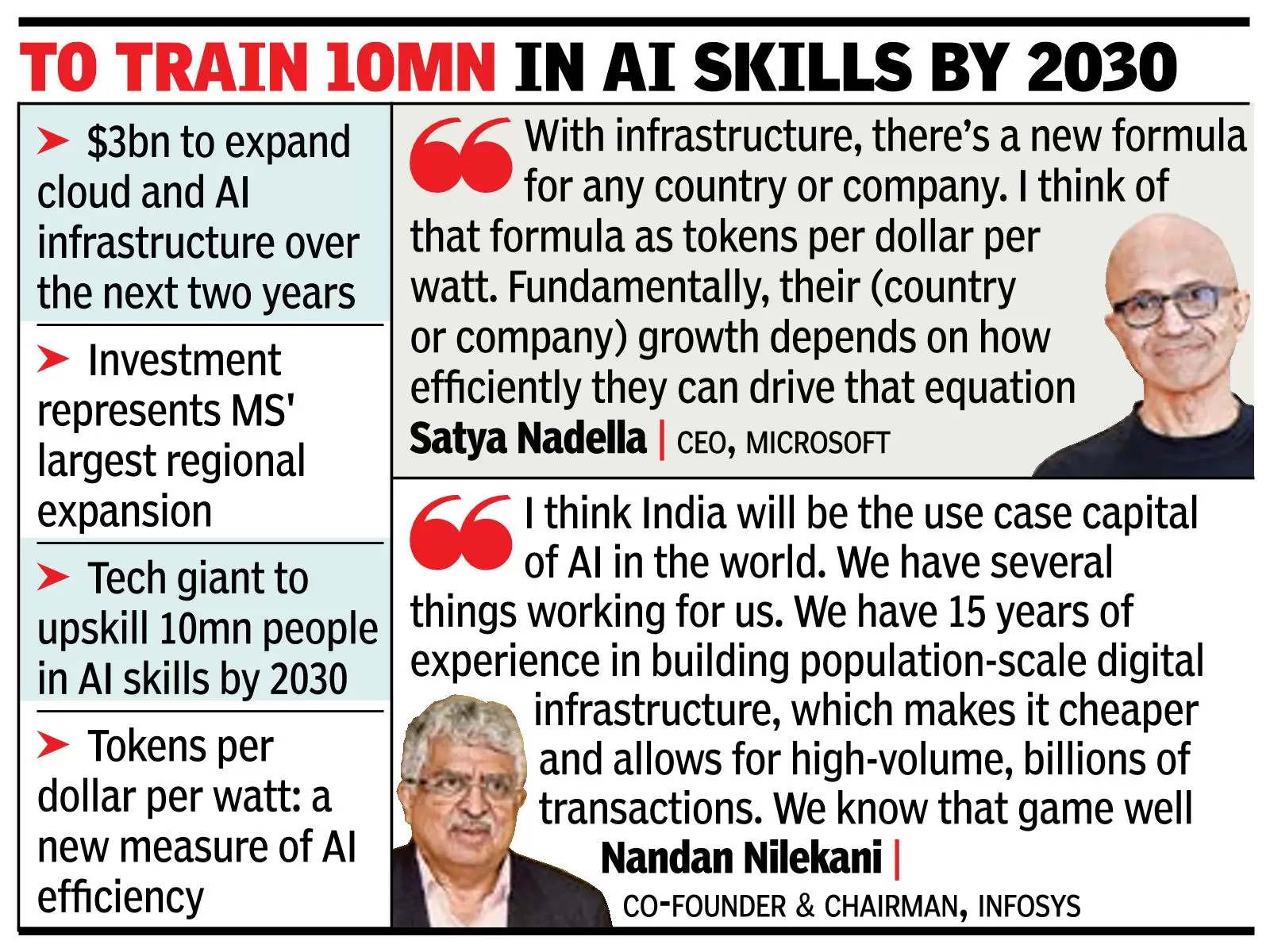
BENGALURU: Microsoft CEO Satya Nadella announced plans to invest $3 billion in India in cloud and AI infrastructure, including setting up new data centres over the next two years. He added the company is committed to training 10 million people with AI skills by 2030.
The $3-billion additional investment in India, Nadella said, would represent the single-largest expansion into the region. "The diffusion rate of AI in India is exciting. This is the golden age for systems when it comes to innovation," he told a crowd of over 3,000 developers who had gathered to listen to him in a massive exhibition centre in Bengaluru on Tuesday.

In his nearly 11 years as CEO, Nadella has transformed Microsoft with his bets on cloud computing and AI, and the infusion of a culture of collaboration, enabling the pioneering computing company to become the second in the world to touch $3 trillion in market capitalisation (the first was Apple).


A lot of Microsoft's work is today driven by its vast base of engineers in India. The company also sees India as an increasingly attractive market. "I had a chance to meet PM Modiji yesterday and it was fantastic. It's great to listen to his vision of how he wants to drive AI missions. It's the combination of the yojanas (schemes), the India Stack, the entrepreneurial energy in this country, and the demographics on both the consumer and business sides that are all coming together in a virtuous cycle," Nadella said.
Nadella said infrastructure today needs to be thought of differently from the traditional ways. "With infrastructure, there's a new formula for any country or company. I think of that formula as tokens per dollar per watt. Fundamentally, their (country or company) growth depends on how efficiently they can drive that equation," he said.


Tokens per dollar per watt is a measure of the efficiency of AI applications, essentially signifying how many tokens (units of information) can be generated per dollar spent on computing power, while also considering the energy consumption (measured in watts) required to produce those tokens. Essentially, it highlights the cost-effective and energy-efficient performance of an AI system.


This infra, Nadella said, needs to be the highest priority. And Microsoft, he said, is innovating in every layer of it. Microsoft, which counts Air India, PwC, and Biocon as customers in India, said it's copiloting South Asia's AI transformation with 800 customers and fivefold returns for every dollar the company invests in GenAI, with 70% of its clients seeing productivity benefits.

Source: https://timesofindia.indiatimes.com/business/india-business/microsoft-to-invest-3-billion-in-india-boost-ai-cloud-infra/articleshowprint/117035643.cms

Marathi to be made compulsory in all schools from next academic year: Education minister

Mumbai government mandates Marathi as a core subject in all schools from 2025-26, enforcing compliance and evaluating students on a marks-based system.

Mumbai: The state government is determined to enforce Marathi as a mandatory core subject in all schools, irrespective of board or medium, starting from the academic year 2025-26. The announcement, made on Tuesday by school education minister Dadaji Bhuse, signals the end of previous concessions that allowed schools to treat Marathi as a graded subject due to pandemic-related disruptions.

Marathi to be made compulsory in all schools from next academic year: Education minister


“Schools must ensure that Marathi is taught and evaluated as a core subject. Any reluctance to comply with this mandate will not be tolerated,” Bhuse said. To ensure strict adherence, the government clarified that the policy applies to all private, CBSE, ICSE, and other English medium schools in the state as well.

A government resolution (GR) that was issued in September had outlined a revised framework for Marathi language instruction. Under the new policy, students will be evaluated on a marks-based system, in the place of grading approach that is being used. The marks-based approach will also apply in schools across boards, reinforcing Marathi’s importance in state’s educational framework.

Bhuse also noted how schools often attempt to bypass regulations mandating Marathi instruction, particularly English medium institutions. To address this, the School Education Department will closely monitor compliance. Parents are also encouraged to report schools reluctant to implement the policy.


As it is necessary for the teachers who teach Marathi to be proficient in the language, the school education department is considering testing teachers in the Marathi language subject, including those who do not have an educational background in Marathi.

“While English proficiency is important, the significance of Marathi in Maharashtra cannot be undermined. The language has now been granted classical language status by the Centre, and we are committed to upholding its legacy through education,” Bhuse asserted.

UGC draft norms face flak from Delhi University’s Academic Council members

In terms of promotion, the AC members pointed out that in clause 3.8 of the draft guidelines, too much emphasis is given to activities which have no direct bearing on teaching and research.


NEW DELHI: A day after Union Education Minister Dharmendra Pradhan released UGC draft guidelines stating that clearing the National Eligibility Test (NET) will no longer be a mandatory qualification for appointment as an assistant professor, the academic council members of Delhi University issued a statement saying that the new recruitment criteria show a shift in focus from cutting edge research to merely reiterating existing knowledge since core competence is done away with.

In response to the draft guidelines, the AC members talked about the recruitment process, stating that there has been a massive dilution of the quality of faculty by doing away with specialisation in a core discipline while the recruitment criteria endorse the NEP’s emphasis on the common courses which are poor and substandard.

“The recruitment gives 100% weightage to the selection committee which is subjective in nature and does not give any credit to academic qualification, research publications and teaching experience. Also, the recruitment criteria shows a shift in focus from cutting-edge research to merely reiterating existing knowledge since core competence is done away with,” said Rudrashish Chakraborty, Associate Professor, Kirori Mal College.

He also mentioned how there’s no mention of the maximum hours to be put in for direct teaching in a week for teachers. “A dangerous ploy to increase workload and to reduce jobs,” the professor said.

In terms of promotion, the AC members pointed out that in clause 3.8 of the draft guidelines, too much emphasis is given to activities which have no direct bearing on teaching and research.

The academicians also highlighted that a PhD has become a mandatory qualification for promotion to level 12, which is “draconian” and will adversely affect the teachers.

“The requirement of publications for direct recruitment to Associate Professor in the University departments has increased from 7 to 8, thus adding to the already heavy requirement in the existing regulation,” a DUTA member added.

AICTE Launches ‘One Student One Mentor’ Program Under Neat 4.0 With Intercell

The All India Council for Technical Education (AICTE), under the Department of Higher Education, Ministry of Education, Government of India, has evaluated the Intercell Career Mentoring Program as a valuable initiative for students. This program aims to provide holistic education through industry mentors and AI-powered tools, offering career guidance aligned with both Indian and global standards.

Intercell, an AI-based career mentoring platform, enables students to become placement-ready. The online platform offers live one-on-one industry mentoring from senior professionals and enhances students’ skills with various AI mentoring tools, including:


* Mentor Match

* InstaResume

* Talent Finder


* Internship/Jobs Support

* Skill Assessment


* English Coach

On January 2, AICTE officially launched Phase 4 of the National Educational Alliance for Technology (NEAT 4.0) at an event held at AICTE Headquarters in Vasant Kunj, New Delhi. The launch event, which included an MoU signing ceremony, was graced by distinguished personalities such as Prof. T.G. Sitharam, Chairman of AICTE, Prof. Anil D. Sahasrabudhe, Chairman of NETF, and Buddha Chandrasekhar, Chief Coordinating Officer of NEAT AICTE.

NEAT 4.0 represents a significant stride toward bridging the gap between learners and industry-relevant skills, ensuring accessibility and inclusivity for students across the country.


Prof. T.G. Sitharam, Chairman of AICTE, remarked, “The launch of NEAT 4.0 brings renewed hope to the Indian education sector. The use of AI tools on the portal enables personalized learning, ensuring better outcomes for students. Moreover, the dynamic onboarding process allows for evaluations every 2-3 months, expediting the inclusion of innovative solutions.”


During the event, Prof. Anil D. Sahasrabudhe, Chairman of NETF, stated, “NEAT 4.0 is poised to revolutionize online learning in India by providing learners with industry-oriented skills, enhancing their employability.”

Dr. Buddha Chandrasekhar, CCO of AICTE, emphasized, “Through the Public-Private Partnership model, NEAT 4.0 makes cutting-edge EdTech solutions accessible to students from weaker sections. The inclusion of emerging domains such as Biomedical Engineering, Health & Wellness, and Space Technology highlights the portal’s versatility.”

Intercell Founder and CEO Arunabh Varma stated, “We are pleased to participate in NEAT 4.0 and fully support the Ministry of Education’s vision to deliver innovative, world-class EdTech solutions that accelerate Indian students’ career advancement.”

Source: https://theprint.in/ani-press-releases/aicte-launches-one-student-one-mentor-program-under-neat-4-0-with-intercell/2434859/

FDPs on cards as AICTE and DST take the quantum leap

Under the AICTE FDP scheme faculty will get to visit industries and get hands-on training at research labs

To train faculty, develop infrastructure for quantum technologies, and create appropriate study materials for students is on the map charted by the All India Council for Technical Education (AICTE) and the Department of Science and Technology (DST), following the launch of the Undergraduate (UG) Minor Programme in Quantum Technologies.

The regulatory bodies will ensure faculty members have a solid understanding of quantum mechanics and technologies. They will provide financial support to conduct the Faculty Development Programme (FDP) to institutions/individuals under the AICTE FDP scheme, which will facilitate faculty visits to industry/research labs for hands-on training. Meanwhile, the UG Minor course will be available starting from the 2025-26 Academic Year (AY), and students can opt for it from the fifth semester of the UG programme, that is, the third year onwards.

“The curriculum is designed to include practical projects encouraging students to collaborate directly with quantum startups. Students will have opportunities to work with startups through internships, fellowship programmes and project-based themes. AICTE will facilitate networking events, hackathons, and innovation challenges where students undergoing this course can solve the real-world problems presented by startups. Through partnerships with quantum startups supported under the National Quantum Mission (NQM), students can engage in research, co-develop solutions, and gain mentorship. Thematic Hubs established under NQM will also serve as platforms for student-startup collaboration,” says TG Sitharam, chairman, AICTE.

In the first phase, AICTE will designate the best 50 AICTE-approved institutions to run minor degree programmes and establish quantum labs.

“As per mutual collaboration with DST, the financial and technical support for creating quantum technology laboratories in the institutions will be provided by DST through their Thematic Hubs (T-Hubs) established under NQM. AICTE will assist in mapping existing resources and facilitating the procurement of essential equipment through grants and funding programs. Institutions will also receive access to shared facilities in T-Hubs,” says Sitharam.

FDPs will be initiated to upskill educators in quantum technologies, ensuring they are equipped to teach theoretical and practical components. Hands-on training sessions, recorded lectures, conferences, workshops, and online certification programmes will be conducted so faculty members can stay updated on the latest developments and trends in quantum technologies. The development of related textbooks and course materials on quantum technology for faculty and students and the creation of infrastructure and resources for quantum labs in the institutions will be prioritised.

“The curriculum supports NQM’s objectives of creating a quantum-ready workforce and fostering a robust quantum research and innovation ecosystem. By nurturing talent at the UG level, the programme lays the groundwork for research and industry-ready professionals, aligning with NQM’s workforce development goals. Plans are underway to develop specialised PG programmes in quantum technologies, for which collaborations with leading research institutions and universities will be explored to design advanced coursework and interdisciplinary modules,” says Sitharam.

“India can succeed in quantum technologies only if we have trained manpower. The biggest bottleneck in implementing this initiative is determining who will teach the courses and where the teaching materials will come from. We must ensure that all these resources are readily available. The NQM team has agreed to train faculty, and the programme will commence soon. Elite institutions such as IISc Bangalore and IITs will also participate in this initiative. We are developing MOOCs on quantum mechanics and recording lectures to support the programme. Releasing the curriculum was the first step; it will be followed by faculty training and lab establishment. Universities and colleges offering this programme will connect with these labs through a hub-and-spoke model,” says Prof Rajive Kumar, member secretary, AICTE.

Kumar adds, “We are writing to the universities to adopt the programme or some courses. But in the initial phase, access to trained faculty could be a challenge.”