Friday, January 17, 2025

Joint Entrance Examination (Main) Exam Date On: 22nd - 30th Jan 2025


JEE Main Admit Card 2025: Release Date, Download Session 1 Admit Card, Direct Link

JEE Main Admit Card 2025 - The National Testing Agency (NTA) releases the hall ticket for JEE Main exam at least 3 days before the scheduled exam date. JEE Main city slip is also released by NTA before the admit card at jeemain.nta.ac.in.

JEE Main Admit Card 2025 - The National Testing Agency is set to release the hall ticket for the JEE Main exam 2025 on its official website - jeemain.nta.nic.in. The JEE Main 2025 admit card will be released by NTA at least three days before the exam scheduled date. Therefore, candidates can expect the hall ticket to be released by January 19, 2025, considering the session 1 exam will start from 22nd January 2025. JEE Main City Intimation Slip has been released by NTA at jeemain.nta.nic.in

JEE Main session 1 admit card link will be provided to candidates on their registered email address by NTA. The same can be accessed from the official website - jeemain.nta.nic.in and in this as article as well. To download the JEE Main admit card 2025, candidates must have a valid application number and password. In case, applicants have forgotten their password, they can reset it using their application ID provided to them after the successful submission of the JEE Main application form.


Source: JEE Main Registration 2025: Date, Session 1 Application Form, Fee, Steps to Apply | Engineering & Technology | IE Education

UGC bars three Rajasthan universities from awarding Ph.D. degrees over integrity issue, asks students not to enroll | Education - Hindustan Times

UGC Secretary Manish Joshi advised prospective students and parents not to take admission in Ph.D. programme offered by the universities. 

The University Grants Commission (UGC) has barred three universities in Rajasthan from awarding Ph.D. degree after they were found to be compromising the integrity of the degree.

The three universities include:


You 2025 Fortune revealed! Read Now

1) PAS University, Churu, Rajasthan

2) Sunrise University, Alwar, Rajasthan

3) Singhania University, Jhunjhunu, Rajasthan

In an official notice signed by the UGC Secretary Manish Joshi, the commission informed that decision follows the findings of a Standing Committee which was constituted by the UGC to monitor whether universities are following the procedure and awarding Ph.D. degrees in accordance with the UGC Regulations.

“One of the mandates of this Standing Committee is to suggest corrective measures and recommend action to be taken against erring Universities,” the notice stated.

“After analysing/examining/evaluating the information/data submitted by the univiersities, the Standing Committee has found that three Universities did not follow the provisions of the UGC Ph.D. Regulations and also the academic norms for the award of Ph.D. degrees. These Universities were given an opportunity to explain why they failed to comply with the provisions of the UGC Ph.D. Regulations, however, the responses received from these Universities were not found satisfactory. The Standing Committee has, thus, recommended that the UGC may debar these Universities from enrolling Ph.D. students for the next five years,” read the notice.

Source: https://www.hindustantimes.com/education/news/three-rajasthan-universities-barred-by-ugc-from-offering-phd-courses-over-integrity-issue-says-secretary-manish-joshi-101737024531056.html


Thursday, January 16, 2025

80% Indian firms mark AI as core priority surpassing global average, but lag in workforce readiness: BCG study

The increased prioritisation and spending on AI from Indian firms will mean a significant portion of technology R&D budgets will now be dominated by something related to AI, Kalra noted.

India is emerging as a frontrunner in artificial intelligence adoption, with 80% of companies marking AI as a core strategic priority; surpassing the global average of 75%, according to Boston Consulting Group’s latest AI Radar report.

The study finds that Indian enterprises are planning significant investments, with 72% allocating up to $25 million for AI initiatives in 2025, while 16% plan to spend between $26-50 million, positioning India among the major global spenders in AI technology.

Amongst key global markets, India ranks ahead of several developed economies in planned AI investments for 2025, with only Japan (53%), US (59%), and Singapore (63%) showing lower percentages of companies planning investments up to $25 million.

The higher percentage of Indian companies in this investment bracket (72%) indicates a more widespread adoption approach across the corporate landscape, though the proportion of firms planning investments above $50 million remains relatively smaller compared to global leaders.

The report, titled “From Potential to Profit: Closing the AI Impact Gap,” which surveyed 1,803 C-level executives across 19 markets and 12 industries, also highlights the growing attention towards autonomous agents; AI systems that achieve goals with minimal human input gaining significant traction as 67% of executives globally consider them for AI transformation.

However, it reveals a concerning gap in India’s AI readiness; particularly in workforce upskilling. Only 26% of Indian companies have trained more than a quarter of their workforce on AI/GenAI tools, falling below the global average of 29% and significantly behind leaders like Singapore (44%) and Japan (38%). BCG, however, anticipates this spending to increase in 2025. Yet, assuming that global counterparts will also keep up with increased spending, this may mean that in India, where supply often outweighs demand in most functions, individual initiative in skill development may continue to play a crucial role alongside organisational efforts.

The upskilling challenge is particularly crucial as organisations grapple with the dual needs of training both users and producers of AI tools. “As learning and development agendas evolve, companies are actively working to upskill their employees on scaling use cases and enabling thinking functions to conceptualise new applications,” said Nipun Kalra, MD & Partner, BCG India, and India Leader, BCG X.

However, contrary to widespread concerns about AI-driven job losses, only 7% of executives globally anticipate a decrease in headcount due to AI automation. “Most CXOs are focused on augmenting existing workforces rather than replacement. The conversation is centred around making functions 30-50% more productive and enabling employees to do more with the same resources, Kalra added.

Meanwhile, despite the increased interest in AI, only 25% of global companies have been able to derive meaningful value from their AI initiatives, the study found, potentially signalling a lack of focused initiatives in a ever-evolving landscape. “While there’s widespread enthusiasm about AI’s intuitive interface, like what we see in ChatGPT, translating this into tangible business impact remains a challenge for many organisations,” Kalra said. “Companies that are surging ahead are the ones that approach AI as a means to an end, focusing on strategic priorities rather than just deploying tools or conducting proof of concept tests, Kalra added.

Globally, leading companies allocate more than 80% of their AI investments to reshaping core functions and inventing new offerings, while others focus 56% of their investments on smaller-scale, productivity-focused initiatives.

In India this has meant that companies in financial services, consumer retail, and manufacturing sectors with consumer facing employees are showing particularly strong adoption trends in autonomous agent adoption, with them having already deployed genAI to transform a core function. “Companies that got comfortable with generative AI in the past year are better positioned to leverage autonomous agents,” Kalra added.

Meanwhile, about 76% of Indian executives acknowledge the need for substantial improvements in AI cybersecurity measures, while 54% cite regulatory challenges as a major factor slowing AI adoption.

Notably, for Indian companies, the lack of control or understanding of AI decisions emerged as the primary concern, ahead of data privacy and regulatory compliance issues. “As companies progress from proof of concepts to full rollout, they’re finding practical solutions to privacy and security concerns,” Kalra added, noting that many scaled use cases actually only send about 20% of their data to external LLMs, with the rest handled by on-premise solutions. This de-averaging effect of scale will start to play out and reduce some of the concerns around safety, and privacy in 2025, Kalra added.

The increased prioritisation and spending on AI from Indian firms will mean a significant portion of technology R&D budgets will now be dominated by something related to AI, Kalra noted. This will also mean a significant shift for India beyond its traditional role as a cost-effective implementation hub towards being an innovative leader. “India’s tech ecosystem is increasingly pivoting towards innovation rather than just being a low-cost player. The focus is shifting towards exporting innovation from India instead of purely being an arbitrage player,” Kalra said.

US removes Bhabha Atomic Research Centre, 2 others from restrictive list to advance nuclear cooperation

The United States announced the removal of the Bhabha Atomic Research Centre (BARC) and two other Indian entities from its restricted list.

The United States' Bureau of Industry & Security on Wednesday, January 15, removed Bhabha Atomic Research Centre (BARC) and two other Indian entities from its restrictive list.

In a statement, Bureau of Industry & Security said, “The removal of Indian entities Indian Rare Earths, Indira Gandhi Atomic Research Centre (IGCAR), and Bhabha Atomic Research Centre (BARC) will support US foreign policy objectives by reducing barriers to advanced energy cooperation, including joint research and development and science and technology cooperation, towards shared energy security needs and goals.”

In a statement regarding the removal of three Indian entities, Príncipal Deputy Assistant Secretary of Commerce for Export Administration Matthew Borman said, “The removal of the three Indian entities will enable closer cooperation between the United States and India to secure more resilient critical minerals and clean energy supply chains.”

It further said that the removal of these Indian entities will help in advancement of nuclear cooperation between the two countries. “…with strengthened science and technology cooperation over the past several years that has benefitted both countries and their partner countries around the world,” it said.

The US Bureau has added 11 new entities under the People's Republic of China (PRC) for activities deemed contrary to US national security and foreign policy interests. “With these Entity List additions and removal, we have sent a clear message that there are consequences for supporting the PRC's military modernization,” it said.

“Ten entities were added due to their advancement of the PRC's military modernization through the development and integration of advanced artificial intelligence research. One entity was added for its involvement in development of lithography technology for advanced-node fabrication facilities in China. This technology will enable indigenous production in China of advanced integrated circuits for military end-use,” it said.

UGC Draft Regulation 2025: What PhD holders need to know

Assistant professor roles require a postgraduate degree with 55 per cent marks and NET/SET/SLET, except in Engineering and Technology.

Union Education Minister Dharmendra Pradhan announced the UGC (Minimum Qualifications for Appointment & Promotion of Teachers and Academic Staff in Universities and Colleges and Measures for the Maintenance of Standards in Higher Education) Regulations, 2025 on January 6, setting forth the minimum qualifications required for appointing and promoting academic staff in universities and colleges. While addressing discipline-specific criteria for faculty eligibility, these guidelines aim to uphold and enhance standards in higher education.

Qualification criteria

Candidates must hold a postgraduate degree with at least 55 per cent marks (or equivalent) and clear the National Eligibility Test (NET), State Eligibility Test (SET), or State-Level Eligibility Test (SLET), to qualify for an assistant professor role in disciplines such as Arts, Commerce, Humanities, Law, Social Sciences, Sciences, Languages, Journalism, and Management.

However, for positions in Engineering and Technology, a postgraduate degree (e.g., ME or MTech) with at least 55 per cent marks suffices, with no NET requirement, as per AICTE standards. Candidates holding a PhD in any discipline are exempt from the NET criterion, making them eligible for assistant professor roles.

Additional provisions for PhD holdersIf a candidate's PhD discipline differs from their undergraduate or postgraduate discipline (aligned with NCrF levels), the PhD discipline will determine their eligibility for academic appointments.
PhD holders who earned their postgraduate degrees before September 19, 1991, are eligible for a 5 per cent relaxation in marks.
A PhD is mandatory for promotions to Assistant Professor (Academic Level 12), Associate Professor (Academic Level 13A), and Professor (Academic Level 14).

For PhD candidates registered before July 11, 2009, the prevailing regulations of their awarding institution will apply, exempting them from NET/SLET/SET requirements for roles such as Assistant Professor, Assistant Librarian, or Assistant Director of Physical Education and Sports.

UGC NET 2024 revised schedule: New dates announced for postponed January 15 exams

UGC NET December 2024 exam schedule: The January 15 exam, postponed due to Makar Sankranti, Pongal, and other celebrations, will now be held on January 21 and 27.

The National Testing Agency (NTA) has announced the postponement of the UGC NET December 2024 examination scheduled for 15 January 2025. This decision follows numerous requests to defer the exam due to significant festivals occurring on that date, including Pongal and Makar Sankranti.

The 15 January exam, which has been postponed, will now be held on January 21 and January 27. However, the tests scheduled for 16 January remain unchanged.

In an official statement, the NTA stated, "In the interest of aspirants, the National Testing Agency (NTA) has decided to postpone the UGC-NET December 2024 Exam scheduled on 15th January 2025 only."

The UGC NET December 2024 examination cycle began on 3 January 2025 and was initially planned to conclude on 16 January 2025.
The UGC NET is a national-level examination conducted to determine the eligibility of candidates for Assistant Professorship, Junior Research Fellowship, or both, in Indian universities and colleges.

The exam covers 85 subjects and is conducted in a computer-based format across multiple shifts. Each session comprises two papers, with no break in between, and the questions are presented in both English and Hindi, except for language-specific subjects.

Candidates can contact the NTA helpdesk or refer to the frequently asked questions (FAQs) section on the official UGC NET website for further updates.

UDYAMOTSAV 2025: AICTE initiative to nurture student entrepreneurs

Coinciding with National Startup Day, the event serves as a platform for over 325 student-led startups to present their ideas, connect with investors, and access mentorship, writes TG Sitharam.

Aiming to promote innovation and entrepreneurship among students across India, the All India Council for Technical Education (AICTE) has launched UDYAMOTSAV 2025.

Organised in partnership with the Ministry of Education’s Innovation Cell (MIC), the event coincides with National Startup Day, announced by PM Narendra Modi on January 16, 2022, and aligns with the vision of the government to make India a global hub for startups. Being the government’s flagship initiative, Startup India has fostered innovation, catalysed startup culture, and built a robust and inclusive ecosystem for entrepreneurship. Over the years, the initiative has rolled out numerous programmes designed to support entrepreneurs, build a resilient startup ecosystem, and transform India into a nation of job creators. Since its inception, the startup landscape in India has witnessed exponential growth, earning its place as the third-largest startup ecosystem globally.

The AICTE has decided to elevate the celebration of National Startup Day with UDYAMOTSAV 2025, a platform for startups and entrepreneurs from higher education institutions. This first-of-its-kind event will bring together over 80 investors and showcase the innovative ideas of more than 325 startups, selected from over 10,000 student registrations across the country. These startups will present groundbreaking ideas at 14 institutions nationwide, including Apex University, Jaipur; Chandigarh Engineering College, Mohali; iHub, Ahmedabad; Mahindra University, Hyderabad; MIT World Peace University, Pune; and many others.

Pitching ideas
One of the key highlights of UDYAMOTSAV 2025 is the ‘Shark Tank’-style pitching sessions. This dynamic format provides startups with a unique opportunity to pitch their ideas to a distinguished panel of investors, securing not only funding but also invaluable feedback and exposure. This initiative aims to bridge the gap between budding entrepreneurs and the investor community, fostering a robust entrepreneurial ecosystem in the country.

The event is designed to nurture the entrepreneurial spirit of our youth. All participating startups, including those not shortlisted for the national pitching round, will receive ongoing support through AICTE Indovation Centres. These centres play a pivotal role in building a regional ecosystem that supports innovation and entrepreneurship, ensuring that our youth have the resources and mentorship they need to succeed.

AICTE’s initiatives, including UDYAMOTSAV, are in alignment with the National Education Policy (NEP) 2020, which emphasises promoting an entrepreneurial mindset and nurturing problem solvers. Through experiential learning, innovation, and creativity, AICTE is fostering a new generation of entrepreneurs who will drive India’s growing economy. Furthermore, as we celebrate the Year of Artificial Intelligence, AICTE is committed to integrating AI into our educational framework through dedicated curricula, collaborative programmes, hackathons, and projects.

To further strengthen this ecosystem, AICTE-MIC will launch a dedicated Faculty Development Programme (FDP) on Innovation and Entrepreneurship on National Startup Day. This programme aims to train 3,000 faculty members who will serve as master trainers, ensuring that innovation and entrepreneurship become integral components of our educational institutions.

By fostering a culture of innovation and entrepreneurship, we are empowering our youth to become job creators rather than job seekers. UDYAMOTSAV 2025 is not just an event but a celebration of the entrepreneurial spirit that will shape the future of our nation.

Wednesday, January 15, 2025

Elon Musk reveals Neuralink’s third human implant as Brain-Computer Interfaces expand horizons


Neuralink continues its push in the brain-computer interface space with a third implant, while competitors and researchers accelerate advancements globally.

Elon Musk, CEO of Tesla and Neuralink, has disclosed that his brain-computer interface (BCI) company has implanted devices in three human subjects, with all showing promising results. Speaking at an event in Las Vegas streamed on his platform X (formerly Twitter), Musk highlighted Neuralink’s progress and ambitions to implant the devices in 20-30 more people in 2025.

“We’ve got three humans with Neuralinks, and all are working well,” Musk stated, adding that the devices have been upgraded with more electrodes, higher bandwidth, and longer battery life since the first implant.

Musk shared updates on two previous Neuralink recipients. The second patient, who has a spinal cord injury, is using the implant to play video games and learn computer-aided design software for creating 3D objects. The first recipient, also paralysed, has used the implant for gaming and playing chess.

However, details about the third implant recipient remain undisclosed.

While Neuralink garners significant attention, over 45 clinical trials involving BCIs are currently underway worldwide, focusing on applications ranging from aiding communication in ALS patients to treating brain disorders. Rajesh Rao, co-director of the Center for Neurotechnology at the University of Washington, acknowledged Neuralink’s innovation in robotic-assisted surgery and flexible electrode threads. However, he noted that other companies, such as Synchron, Blackrock Neurotech, and Onward Medical, are advancing BCI technology through less invasive or more versatile methods.

BCIs are hailed as transformative for individuals with paralysis and neurological disorders. Marco Baptista, chief scientific officer of the Christopher & Dana Reeve Foundation, described the technology as “very exciting” but emphasised the need for more clinical data to determine the best approach. “This is clearly high-risk, high-reward. We don’t know how safe or feasible it will be,” Baptista said.

Neuralink received regulatory clearance in 2023 to begin human trials. Dr. Rita Redberg, a cardiologist and expert on medical device regulations, highlighted the rigorous oversight required for high-risk devices like BCIs. “The FDA ensures safety at every step, from recruiting patients to testing devices,” Redberg explained, noting the involvement of institutional review boards to evaluate risks and benefits for trial participants.

Despite Neuralink’s innovations, competitors have achieved significant milestones. Synchron’s BCI, for instance, uses minimally invasive techniques, while Blackrock Neurotech combines neural recording with stimulation.

Income Tax Budget 2025: Will FM Sitharaman scrap old regime as new one gains popularity? Experts weigh in

Income Tax Budget 2025: No official plans exist to abolish the old tax regime, but discussions continue. While the new tax structure offers lower rates, many taxpayers prefer the old system's deductions.

Will the old tax regime be scrapped? No official announcements indicate that the government will abolish the old tax regime. However, discussions about its future have been ongoing. The new tax regime was introduced in the 2020 Union Budget, offering lower tax rates but without the exemptions and deductions available under the old one.

Many taxpayers still like the old tax system because of its deductions and exemptions, such as those under Sections 80C, 80D, and others, even though the new tax regime has become more popular since it is more straightforward.

Section 80C of the Income Tax Act provides deductions up to ₹1.5 lakh on investments in life insurance premiums, the principal repayment of home loans, and other savings instruments like the Public Provident Fund (PPF).

Section 80D allows deductions for premiums paid on medical insurance policies for self, family, and parents, helping taxpayers reduce their taxable income.

Will Modi Govt do away with old income tax regime?

“Looking at the biased attitude of the government towards the new tax regime, the increasing number of people opting for it and the fact that the limits of various deductions available under the old regime have not been enhanced after the introduction of new tax regime, do not get shocked if the finance minister altogether scraps the old tax regime,” Mumbai-based tax and investment expert Balwant Jain said.

He noted that since the government wants you to report your actual income, which is the basis of the new tax regime, it will likely happen sooner rather than later.

However, the outright abolition of the old tax regime demands a holistic approach to how it will affect the existing investment and retirement planning patterns. “The government has to rein in simplicity and instrumentality because tax-saving instruments must work for the middle class.

Suppose the 2025 Budget were to effect a phase-out of the old regime. In that case, it should also, most critically, ensure that motivation to undertake significant financial planning is preserved through the provision of incorporating certain key deductions into the new format,” said Siddharth Maurya, Founder & Managing Director of Vibhavangal Anukulakara Private Limited.

The simpler structure of the new regime, comprising lower rates as well as minimal deductions, coincides with the government’s view of having a straightforward tax regime. On the other hand, the old regime is still of importance to the significant taxpayers who have invested in tax-saving instruments, said Gaurav Singh Parmar, Associate Director, Fincorpit Consulting.

Even though the government has not made any formal declaration regarding ending the previous tax system, continuing conversations indicate that it is not impossible, particularly given the current system's increasing popularity. According to experts, if the government decides to phase out the previous tax system, it must ensure that essential deductions are included in the new structure to keep people motivated to plan their finances, especially middle-class people.

Amazon races to transplant Alexa’s ‘brain’ with generative AI

Amazon is gearing up to relaunch its Alexa voice-powered digital assistant as an artificial intelligence “agent” that can complete practical tasks, as the tech group races to resolve the challenges that have dogged the system’s AI overhaul. The $2.4tn company has for the past two years sought to redesign Alexa, its conversational system embedded within 500mn consumer devices worldwide, so the software’s “brain” is transplanted with generative AI. 

Source: https://www.ft.com/content/de4c86b8-c744-4051-9255-d34259223160

Biden admin’s cap on GPU exports may hit India's AI ambitions

The outgoing US administration’s proposed rule to curb the import of graphics processing units (GPUs) by certain countries may hit India's ambitions. GPUs power heavy artificial intelligence (AI) models and applications.


Read more at:
https://economictimes.indiatimes.com/tech/technology/biden-admins-cap-on-gpu-exports-may-hit-indias-ai-ambitions/articleshow/117245296.cms?utm_source=contentofinterest&utm_medium=text&utm_campaign=cppst

Tuesday, January 14, 2025

Amid H-1B visa debate, some Indians lose jobs

HYDERABAD: Indian professionals are facing the heat in the wake of a raging debate over H-1B visa reforms in the US. With President-elect Donald Trump's administration expected to introduce stricter immigration policies, several professionals have already been hit by job offer withdrawals, visa delays and warnings of potential layoffs.
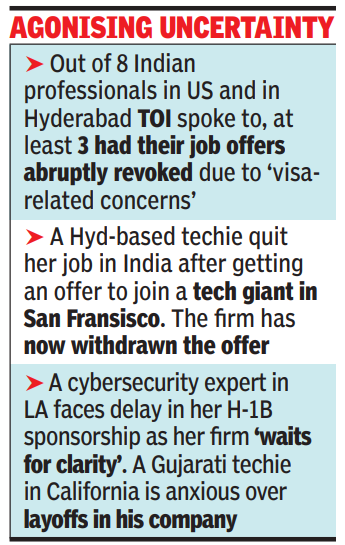
TOI spoke to eight professionals in the US and in Hyderabad, and at least three had their job offers abruptly revoked due to "visa-related concerns". Hyderabad-based software engineer V Puvvada (name changed) is one such professional. Hired by a US tech giant in Dec, she was preparing to move to San Francisco when her offer was revoked. She had, meanwhile, quit her current job.

"I was offered the job in Dec 2024 and since I had a written confirmation, I resigned from my current job," said the 28-year-old.
The company cited "changing visa dynamics" as the reason for withdrawing the offer. "I feel cheated. Why offer a role when you're not sure about sponsoring the visa? They later said that they will issue my offer letter again when the whole discussion is settled and there is a concrete decision after Donald Trump assumes office. But how long can I wait?" Vaishnavi said.


According to US Citizenship and Immigration Services, over 72% of the 380,000 H1B visas issued in 2023 went to Indians, most of whom work in STEM fields like data science, AI, machine learning, and cybersecurity. These professionals earn an average salary of $118,000 (about Rs 1.01 crore) annually.

However, Indian professionals in the US are staring at an increasingly challenging environment as Trump's administration is expected to "reform" the H1B programme by increasing salary thresholds and costs for employers, aiming to prioritise American workers. There's also a growing backlash from MAGA supporters, who have often targeted the H1B visa, claiming it undermines American jobs and wages.

The fear of unemployment is affecting those waiting for visa renewals. Samaira Haji (name changed), a cybersecurity consultant in Los Angeles, is facing delays in her H1B visa sponsorship.
"Initially, the company promised to expedite the process (of sponsoring the H1B). But now they claim they are ‘waiting for clarity' on the potential visa reforms. The wait is agonising," she said.

Saniya, who moved from Nagpur to US in 2022 for her master's degree, is unsure of her future. "I was told they would register me for the H1B lottery in March 2025. But they haven't even initiated the preliminary stages of the process. Does it mean they are going to file for my H1B later, or are they going to just fire me if there is any major reform?" she wondered.

A woman from Telangana, who recently secured a position as a data analyst after an extended job search, now faces a new challenge as her company expresses uncertainty about sponsoring her visa.

"Now that I have finally secured a position as a data analyst, the uncertainty around the H1B visa has come to haunt me. I can't even think of facing the trauma of unemployment again," she said, preferring to remain anonymous.

Similarly, a software developer from Gujarat working in California, is feeling anxious despite holding a secure visa. His company recently announced workforce reductions, adding to his worries.

"The management hasn't stated categorically if these layoffs are linked to visa issues, but the timing is suspicious," he said, choosing to remain anonymous. "If we lose our job, we have to find another within 60 days to be able to continue staying here."

With unemployment at record levels and increasing uncertainties for Indian immigrants, he said finding a new job with H1B sponsorship within such a short period would be difficult. "It is terrifying to think that I could lose my job and my legal status in the US any moment," he said.

A senior immigration lawyer based in Georgia, speaking on condition of anonymity, elaborated on the broader implications. "Employers are hesitant to commit to international hires because the rules are in flux. They fear investing resources in sponsorships that might later face rejection or scrutiny. Unfortunately, it's the employees who have to bear the brunt of this uncertainty," the lawyer said.

UGC NET December 2024 exam for January 15 postponed, new date later

NTA Postponed UGC NET December 2024 Exam: Candidates are advised to keep visiting the NTA website – nta.ac.in and ugcnet.nta.ac.in for latest updates on UGC NET December 2024 exam.

NTA Postponed UGC NET Exam Scheduled on Jan 15 2025: The National Testing Agency (NTA) has postponed the January 15 exam of the University Grants Commission National Eligibility Test (UGC NET) December 2024. The postponement comes after representations were received to postpone the exam amid Pongal, Makar Sankranti and other festivals on January 15. The new exam date will be announced later, NTA said.

UGC NET is held to award Junior Research Fellowship and appoint Assistant professor, for appointment as Assistant Professor and admission to PhD and admission to PhD only. The UGC NET December 2024 exam is conducted for 85 subjects. The UGC NET December 2024 exam which started on January 3 was supposed to continue till January 16. The exams scheduled to be held on January 16 will be conducted as per earlier schedule, NTA added.

The exams are being held online in two shifts – the first from 9 am to 12 noon and the second between 3 pm and 6 pm.

Candidates are advised to keep visiting the NTA website – nta.ac.in and ugcnet.nta.ac.in for latest updates on UGC NET December 2024 exam.

Why is Meta shutting down fact-checkers? | Explained

Is crowd-sourced fact-checking a better way of implementing content moderation? What role did fact-checkers play during the COVID-19 pandemic? How have fact-checking communities responded to Zuckerberg’s announcement? When are policy changes likely to be implemented?

The story so far: On January 7, Meta CEO Mark Zuckerberg said the company will get rid of fact-checkers and simplify content policies by removing restrictions on topics as it is “out of touch with mainstream discourse.” In a five-minute video, he said that the company will return to its roots as the fact-checkers have been “too politically biased” and “destroyed more trust than they created, especially in the U.S.”

After the 2016 U.S. presidential election results were out, Meta, then known as Facebook, faced serious backlash for amplifying political posts that helped tilt the election in favour of U.S. President-elect Donald Trump. To build back its reputation, Facebook roped in content moderators globally and developed technology to filter harmful content.

Is groundwater contamination high in India? | Explained

The story so far: An assessment of India’s groundwater by the Central Ground Water Board (CGWB) found that several States are grappling with a serious problem of nitrate contamination.


The most concerning finding was that the number of districts with excessive nitrate in their groundwater rose from 359 in 2017 to 440 in 2023. This works out to nearly 56% of India’s districts having excessive nitrate in ground water, defined as having more than 45 mg/l (milligram per litre). Of the 15,239 groundwater samples collected from across the country for testing, 19.8% samples had nitrates — nitrogenous compounds — above safe limits though it must be said that this proportion has not substantially changed since 2017. In the 13,028 samples analysed in 2017 for instance, 21.6% had excessive nitrate. There are two major concerns with excess nitrate content: one is methemoglobinemia, or a reduced ability of red blood cells to carry oxygen.

GATE 2025 Dates and Admit Card Download

GATE 2025 Examinations
1st February 2025
2nd February 2025
15th February 2025
16th February 2025

Admit Card Download: https://goaps.iitr.ac.in/login

Monday, January 13, 2025

TCS to hire 40,000 freshers from campuses this year with AI skills expected at all levels, CHRO says: Report

TCS is increasingly integrating the use of AI into various functions and that it is an important skill to have across all levels of the hierarchy

Tata Consultancy Services Ltd (TCS) plans to hire 40,000 freshers from campuses this year, the IT giant's Chief Human Resources Officer (CHRO) Milind Lakkad said.He added that despite the quarterly headcount fluctuations, TCS manages through a combination of “employees on the bench, ongoing productivity enhancements, and other operational adjustments.”(Representational Image/Mint)

This however, comes at a time when its headcount had decreased by over 5,000 employees in the third quarter of the financial year 2024-25.

“In any given quarter, changes in headcount don't always reflect growth or demand because our hiring plans are structured on an annual basis,” TCS Lakkad said in an interview with Business Standard.

He added that despite the quarterly headcount fluctuations, TCS manages through a combination of “employees on the bench, ongoing productivity enhancements, and other operational adjustments.”

Lakkad said that the company is increasingly integrating the use of artificial intelligence (AI) into various functions and that it is an important skill to have across all levels of the hierarchy such as E0, E1, E2, E3, and so on in what has been described as a “pyramid with different skill sets.”


Even for the entry-level E0 tier, TCS expects employees to have a foundational understanding of large language models (LLMs) and their applications.

At the E1 level, employees have to be able to work with LLM APIs, which is a skill set similar to that of prompt engineers.

At E2, employees have to use TCS GenAI tools.

At levels E3 and above, TCS expects by default, advanced expertise in AI and its applications across various domains.

However, Lakkad said that while AI is certain to transform jobs, it will more likely change the nature of the roles rather than eliminate them altogether.

“AI will enhance efficiency, but humans will continue to play a crucial role—especially in client-facing and knowledge-intensive roles, where the value of human insight and empathy remains irreplaceable,” he added.

He also said that degrees are a must as they provide foundational understanding necessary for the broader demands of the services industry as TCS requires “more than just coding skills.”

Friday, January 10, 2025

Prioritise growth-oriented regulations, deep tech push; invest in human capital, particularly in STEM fields

The upcoming 2025 budget presents a critical juncture for India. As global economic uncertainties and geopolitical tensions loom large, the choices we make today will determine whether India can sustain its growth trajectory and emerge as a global leader in the coming decades. While India has made significant strides, particularly in building a world-class digital public infrastructure, our policy framework needs a fundamental shift to capitalise on the opportunities before us. I outline three key expectations that should be central to the 2025 budget.

Read the full article at: https://indianexpress.com/article/business/economy/prioritise-growth-oriented-regulations-deep-tech-push-invest-in-human-capital-particularly-in-stem-fields-9770602/

Centre links Farmer ID to PM-Kisan, makes it mandatory for new applications

The Centre has set a target of creating 6 crore farmer IDs by the end of March this year.
Written by Harikishan Sharma


According to sources, all new applicants for the PM-Kisan scheme will have to get registered with the Farmers' Registry and provide their farmer ID in the application form.


The Centre has made it mandatory for new applicants to obtain a farmer ID for enrolment into the Pradhan Mantri Kisan Samman Nidhi (PM-Kisan) to get benefits under the scheme.

The move by the Union Ministry of Agriculture and Farmers’ Welfare to make farmer ID mandatory for registering new beneficiaries under the PM-Kisan is significant as it receives about 2 lakh new applications monthly. “This farmer ID guarantees that the applicant-farmer owns the land, and thus, the PM-KISAN registration process would be vastly simplified,” said a source, adding that it will ease the process for farmers to avail themselves of the benefits of the Central scheme.


According to sources, all new applicants for the PM-Kisan scheme will have to get registered with the Farmers’ Registry and provide their farmer ID in the application form. This system has come into force across 10 states for any new applicant with effect from January 1, 2025, said the sources.


The agriculture ministry has sent a communication to these 10 states, said the sources. In the remaining states, it will be made mandatory at a later date, they added.


Kisan Pehchaan Patra or farmer ID is an Aadhaar-like unique digital identity linked dynamically to the state’s land records with information like demographics, crops sown, and ownership details. The database created through the farmer ID will be known as Farmer’s Registry — one of the three registries under the Agri-Stack component of the Centre’s Digital Agriculture Mission for the creation of digital public infrastructure in the farm sector, which was approved by the Union Cabinet last year. The government has set a target of creating 6 crore farmer IDs by March end this year. Till January 7, one crore farmer IDs have been created.

The 10 states in which farmer ID has been made mandatory for registration of new beneficiaries under the PM-Kisan are Andhra Pradesh, Assam, Bihar, Chhattisgarh, Gujarat, Madhya Pradesh, Maharashtra, Odisha, Rajasthan and Uttar Pradesh. These 10 states account for about 84 per cent (9.25 crore) of 11 crore PM-Kisan beneficiaries.

Under the PM-Kisan scheme, eligible farmer families receive Rs 6,000 per annum in three equated instalments (Rs 2,000 in each instalment) through Direct Benefit Transfer (DBT) every four months. The scheme was launched on February 24, 2019, just before the 2019 Lok Sabha elections. With 100 per cent funding from the Centre, the money is directly transferred to the bank accounts of the beneficiaries.


Prime Minister Narendra Modi released the 18th instalment of the PM-KISAN scheme on October 5, 2024, in Washim, Maharashtra. In the latest round of the instalment, the PM-Kisan amount was transferred to over 9.4 crore farmers across the country.


Recently, a Parliamentary panel has recommended doubling the yearly payouts under the PM-Kisan to Rs 12,000 per annum from the present Rs 6,000.

Sixth-generation aero-engine can be developed by tying up with foreign firm: DRDO chief

India will have to invest close to $4 billion-$5 billion, says Samir V. Kamat

Defence Research and Development Organisation (DRDO) chairman Samir V. Kamat. | Photo Credit: ANI


The only way India can develop a sixth-generation aero-engine and other technologies required is by co-development with a foreign manufacturer, Samir V. Kamat, Chairman of the Defence Research and Development Organisation (DRDO), said while noting that India currently invests only 5% of its defence budget for research and development, which needs to increased to 15%.

To realise that capability, he said the country will have to invest close to $4 billion to $5 billion, that’s ₹40,000 crore to 50,000 crore.

His remarks come against the backdrop of huge delays in the development of indigenous fighter jets, while China has made rapid progress in this area. Incidentally, India is in talks with France for the co-development of a 110KN engine for the fifth-generation jet, Advanced Medium Combat Aircraft (AMCA), that is on the drawing board and at least a decade away from the roll-out of a prototype.

There are still critical issues that need to be worked out before an agreement can be reached, sources said on the status of discussions between India and France.

The decision for the co-development of a new engine was announced during Prime Minister Narendra Modi’s visit to Paris in July 2023. Since then discussions have been going on between the DRDO’s Aeronautical Development Agency (ADA), Gas Turbine Research Establishment (GTRE), and Safran to work out the specifications and other modalities.

“If we look at what we need to do in terms of technologies, the first priority is aero-engines. Today, we have demonstrated a fourth-generation aero-engine for our fighter aircraft but going ahead we will need a sixth-generation aero-engine where the thrust to weight ratios exceed 10,” Mr. Kamat said, speaking at an event two days ago.

He detailed various technologies that need to be developed such as single-crystal blade powder metallurgy discs and ceramic matrix composites for static parts to begin with.

“And if we have to do this and deliver an aero-engine the only way I can see is if we do a co-development with a foreign Original Equipment Manufacturer.”

Elaborating further, he said various facilities have to be to set up — testing facilities for each sub-system, a high-altitude test facility, flying test-bed, manufacturing facilities to make the disc which would need investing in a forge press which can press 50,000 tonnes, and so on.


In this regard, Mr. Kamat said that when it comes to platforms India had reached a “certain level of maturity” in fighter aircraft, but needs to build capacity. “Today, we are not able to deliver 16 aircraft per year. For that we should increase our capacity. Whether it should be in the public sector, private sector or joint, is a decision we all have to arrive at.”

Further, addressing an oft demand that a separate assembly line should be set up by the private sector for the LCA, Mr. Kamat noted that only U.S., and may be Russia, has two players in the fighter space. Overall, in other countries you have only one major player because the volumes are not sufficient, he stated adding, “So we have to take a call and support whatever decision we arrive at after due deliberations.”

The jet-engine technology is a closely guarded secret due to its extreme criticality in modern warfare. India made unsuccessful attempts in the past to develop an engine locally under the now shelved ‘Kaveri’ project. The Kaveri project was sanctioned by the Cabinet Committee on Security (CCS) in 1989 and over the course of 30 years, before it was shut down, saw an expenditure of ₹2035.56 crore and the development of nine full prototype engines and four core engines.


The General Electric (GE) F-414 engine deal, which Hindustan Aeronautics Ltd. bagged, is for manufacturing licence of an already operational engine. The deal gives India access to several technologies and industrial processes involved in the manufacture of jet engines and will upskill the capabilities of the Indian industry, both public and private, officials stated earlier.

The F-414 engines are meant to power the LCA-MK2, a larger and more capable variant of the LCA currently in service, and also the initial version of the under-development AMCA. The AMCA is planned in two phases — MK1 with the GE414 engine and a MK2 with an engine to be co-developed with France.

Speaking at the same event, Indian Air Force (IAF) chief Air Chief Marshal A.P. Singh said that R&D loses its relevance in case it is not able to meet timelines. “Technology delayed is technology denied. There has to be an increased aptitude for acceptance of risks involved and failures in R&D,” he stated, adding that they haven’t yet received the first 40 LCA.

Source: https://www.thehindu.com/news/national/sixth-generation-aero-engine-can-be-developed-by-tying-up-with-foreign-firm-drdo-chief/article69081772.ece