Thursday, January 9, 2025

Vaachan Sankalp Maharashtracha: 1st to 15th January 2025

आयोजक:

संट. फ्रान्सिस इन्स्टिट्यूट ऑफ टेक्नॉलॉजी (ऑटोनॉमस इंजिनिअरिंग कॉलेज), बोरीवली


महाराष्ट्र शासनाच्या वाचन संकल्पना उपक्रमांतर्गत आमच्या महाविद्यालयात विविध वाचनविषयक उपक्रमांचे आयोजन करण्यात आले. सुरुवातीच्या कालावधीत परीक्षा सुरू असल्याने परीक्षा संपल्यानंतर हे उपक्रम राबवण्यात आले. यामध्ये विद्यार्थ्यांचा आणि प्राध्यापकवर्गाचा उत्स्फूर्त सहभाग पाहायला मिळाला.


वाचन संकल्पना महाराष्ट्राच्या या उपक्रमामुळे विद्यार्थ्यांमध्ये वाचनाची आवड वाढली आणि त्यांच्यातील वाचनाची गोडी आणि सवय अधिक मजबूत झाली. विविध वाचनविषयक उपक्रमांनी विद्यार्थ्यांमध्ये विचारशक्तीला चालना दिली, चर्चा आणि संवादाचे महत्त्व समजून घेतले. यामुळे वाचन संस्कृतीला महत्त्व मिळाले आणि विद्यार्थ्यांना नवीन विषयांवर आधारित ज्ञान मिळविण्याची संधी प्राप्त झाली.
वाचन संकल्पना महाराष्ट्राच्या या उपक्रमाने विद्यार्थ्यांना वाचनाच्या महत्वाची जाणीव करून दिली आणि त्यांना आपल्या ज्ञानवर्धनासाठी वाचनाची सवय लागली.


Book Exhibition on 20th and 21st January 2025


Wednesday, January 8, 2025

Book Review Competition on 24th January 2025


SFIT LIRC invites all the students to participate in an exciting Book Review Competition on 24th January 2025.
Venue: SFIT Library, B Wing, 2nd floor
Timings: 9.45 am onward
Languages: English, Hindi and Marathi
Time for Presentation: 5 to 6 minutes
Last Date of Registration: 20th January 2025
Registration form: http://bit.ly/3DNG5B5
No Registration Fees


Congratulations on Achieving the Highest Footfalls of the Academic Year 2023-2024!


Dear Library Users,

We are thrilled to celebrate a remarkable milestone with all of you — the highest number of footfalls in the library for the academic year 2023-2024! This achievement is a testament to your unwavering commitment to learning, growth, and curiosity.

Your engagement with the library not only reflects your dedication to academic excellence but also reinforces the library as a vibrant hub of knowledge, inspiration, and community. Whether you’ve explored new resources, participated in events, or simply enjoyed the quiet space for study, your presence has made this achievement possible.

As we continue to evolve with the times, we are excited to offer even more innovative tools and services to meet your needs. Together, we are shaping the future of learning, one visit at a time.

Thank you for being a part of this success. Let’s keep the momentum going and make the coming year even more inspiring!

Congratulations once again to all the students, and we look forward to seeing you in the library!


Government panel suggests AI incident database, invites comments till January 27

The report recommends that the governance group should bring together all authorities and institutions that deal with AI governance at the national level.

A panel set up by the government in 2023 to look at AI governance has recommended an AI incident database to better understand the actual risks of artificial intelligence, stressing that an inter-ministerial, or a holistic government approach is required to govern AI, an effort that could be spearheaded by the IT ministry and the office of the principal scientific advisor (PSA).

For representational purposes only. (Getty Images/iStockphoto)


These recommendations were made in the IT ministry’s ‘Report on AI Governance Guidelines Development’, released for public consultation on Tuesday, and comments are welcome until January 27. HT had reported on the contents of this report in October 2024.

The report recommends that the governance group should bring together all authorities and institutions that deal with AI governance at the national level.

MeitY had formed the subcommittee on November 9, 2023, and it is headed by Dr Balaraman Ravindran, chief of the department of data science and AI and the Centre for Responsible AI at IIT Madras.

The report wants MeitY to house a technical advisory body and act as the coordination focal point for this governance group, which should build an AI incident database to understand the “actual incidence of AI-related risks in India”, echoing a similar recommendation by the NITI Aayog in 2021.

These AI incidents could include “cyber incidents” and “cyber security incidents” and extend to “adverse or dangerous” outcomes from the use of AI that can disadvantage or harm individuals, businesses, and societies”. They could include “malfunctions, unauthorised outcomes, discriminatory outcomes, unforeseeable outcomes and unexpected emergent behaviour, system failures, privacy violations, physical safety problems, etc.”

It said that initially, only public sector organisations using AI systems should mandatorily report to this database while private entities were “encouraged to voluntarily report AI incidents”. “The focus should be on defining reporting protocols to ensure confidentiality and to focus on harm mitigation, not fault finding,” the report said.

The technical secretariat, as per the report, should try to get “voluntary commitments on transparency across the overall AI ecosystem and on baseline commitments for high capability/widely deployed systems” from the industry. These could include regular transparency reports by AI developers and deployers, internal and external red-teaming of models or systems, peer review by third-party qualified experts, and others. The commitments could vary across sectors.


The sub-committee also recommended that the technical secretariat could examine the suitability of technology measures to address AI-related risks, such as use of watermarking, labelling and fact-checking to deal with deepfakes.

It said that the governance group should have a mix of government and non-government members to bring in “external expertise from industry and academia” and could be headed by the PSA. On the other hand, the technical secretariat located in MeitY could be staffed by MeitY officials and “lateral hires, young professionals, and consultants.

This subcommittee also noted that providers and deployers of AI systems cannot claim “safe harbour” by default as in many scenarios, they “select or modify the content”, something that intermediaries such as Google, Facebook, Cloudflare and Airtel cannot do to claim protection from liability for third party content. This, however, is not a recommendation of the subcommittee.

Bengaluru traffic police to introduce 5-second countdown timer to address unpredictability of AI-powered signals

AI-powered VAC signals adjust the length of the red/green lights based on traffic density in each area and can often catch commuters off guard.

The Bengaluru traffic police are working to address a key issue with Artificial Intelligence (AI)-powered vehicle actuated control (VAC) traffic signals by introducing a 5-second countdown timer before the light turns green. Currently, this feature is unavailable at these dynamic signals, leaving commuters unprepared for the change.

VAC signals, which adjust the length of the red/green lights based on traffic density in each area and often catch motorists off guard when they suddenly turn from one to another. This unpredictability has led to concerns among commuters.


With VAV signals, unlike the traditional countdown signals, commuters are caught off guard and stopped abruptly by a red light, with no indication of when it will turn red. This is because the AI-powered traffic signals are designed to address the unpredictable nature of Bengaluru’s traffic and adjust signalling based on different traffic scenarios.

Recognising the problem, Joint Commissioner of Police (traffic) M N Anucheth confirmed that steps were being taken to implement the countdown timer. “The timer will help commuters prepare to move, reducing confusion and improving traffic flow,” he said.

However, commuters have also raised concerns about the rapid signal changes at VAC-equipped junctions. The AI system switches from red to green and vice versa swiftly, with the amber light barely visible, making it challenging to cross signals in time.

Currently, AI-powered VAC systems are operational at 100 junctions in Bengaluru. By the end of March, 65 more junctions will adopt this technology in the first phase, with an additional 300 signals set to be converted in the next phase.

Mahakumbh to showcase power of technology, AI-powered vehicle parking system to streamline experience

Mahakumbh 2025 devotees attending the mela will benefit from an AI-based parking solution for their vehicles. This is the first time a technology-driven parking system has been introduced for the Kumbh Mela.


Image Source : FILEParking at Kumbh Mela 2025

Kumbh Mela 2025, which is starting on January 13 this year, is set to showcase the power of technology in the world’s largest religious gathering. An innovative AI-driven parking system will be introduced to facilitate the parking of vehicles for devotees traveling to the Kumbh Mela in the Sangam city of Prayagraj. Thanks to the technology-equipped services from Park+, an auto tech super app company, parking near the event will become a breeze.


AI-Powered Parking Management

This will be a historic first, as an AI-based parking management system will be implemented at such a grand scale for the Maha Kumbh. Devotees will be able to easily and efficiently manage their parking through the Park+ app, which has been appointed the official parking partner for the event. The company has publicly shared this exciting development.

In addition to this, vehicle owners attending the fair will benefit from the ability to pay for parking via FASTag through the Park+ app, drastically reducing the time spent parking. Moreover, the app will guide devotees to designated parking areas approved by the local administration, allowing them to book parking slots effortlessly.
Expected Influx of Vehicles

Amit Lakhotia, CEO of Park+ Super App, has stated that the Maha Kumbh is anticipated to attract over 40 crore devotees to the Prayagraj area. Given this massive turnout, the smart parking solution aims to eliminate the usual parking woes. More than 25 lakh cars and other vehicles are forecasted to arrive in Prayagraj during this 45-day span, ensuring that devotees have a reliable parking option through the Park+ app.

Devotees can park their vehicles at over 30 government-approved locations, with the capacity to accommodate more than 5 lakh vehicles across these sites. The parking facilities will also be equipped with 24/7 security cameras, EV charging stations, and medical support teams, ensuring a safe and convenient experience for everyone attending the event.

Source: https://www.indiatvnews.com/technology/news/mahakumbh-to-showcase-power-of-technology-ai-powered-vehicle-parking-system-to-streamline-experience-2025-01-08-970160

Microsoft to invest $3 billion in India, boost AI, cloud infra


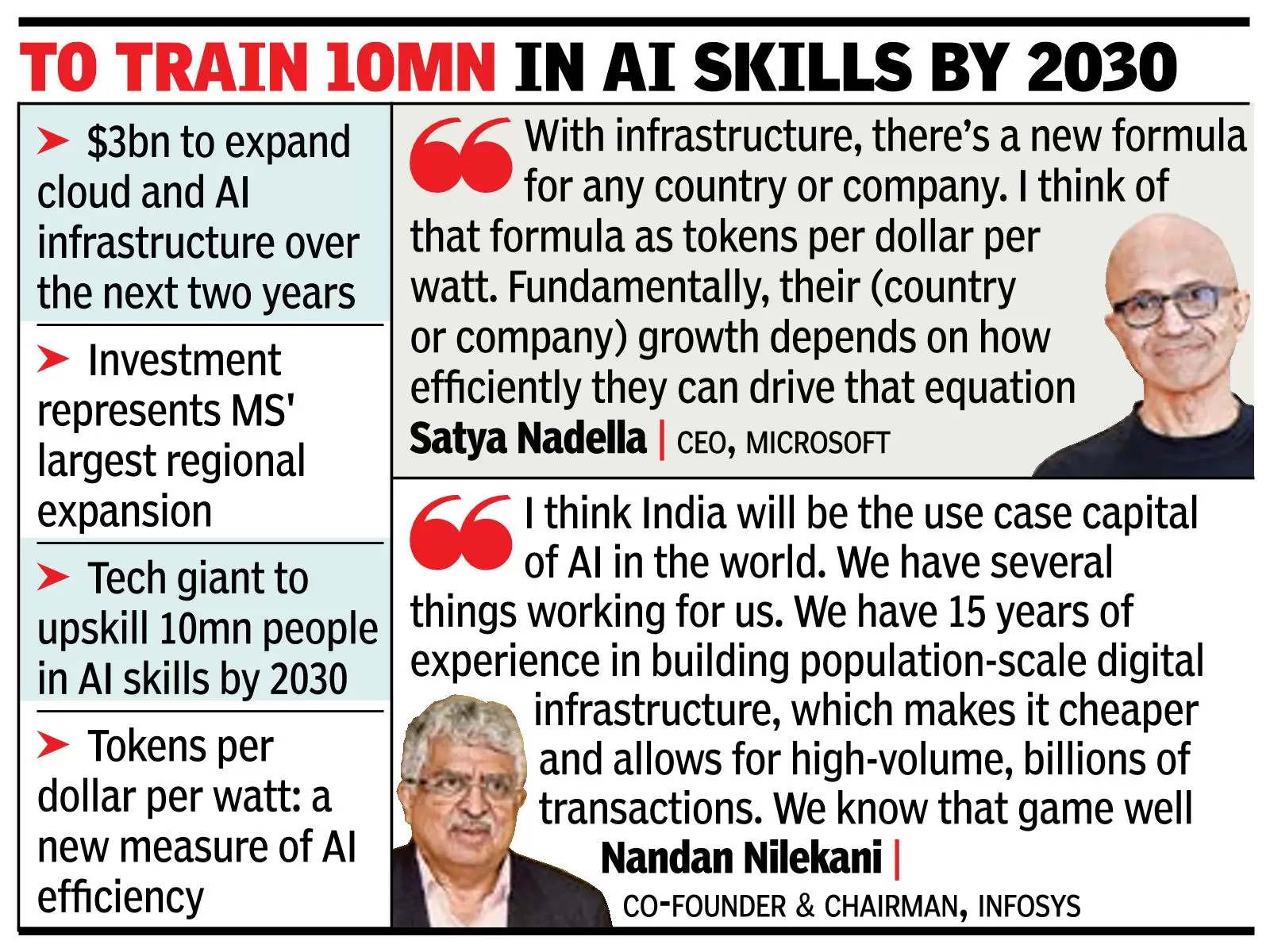
BENGALURU: Microsoft CEO Satya Nadella announced plans to invest $3 billion in India in cloud and AI infrastructure, including setting up new data centres over the next two years. He added the company is committed to training 10 million people with AI skills by 2030.
The $3-billion additional investment in India, Nadella said, would represent the single-largest expansion into the region. "The diffusion rate of AI in India is exciting. This is the golden age for systems when it comes to innovation," he told a crowd of over 3,000 developers who had gathered to listen to him in a massive exhibition centre in Bengaluru on Tuesday.

In his nearly 11 years as CEO, Nadella has transformed Microsoft with his bets on cloud computing and AI, and the infusion of a culture of collaboration, enabling the pioneering computing company to become the second in the world to touch $3 trillion in market capitalisation (the first was Apple).


A lot of Microsoft's work is today driven by its vast base of engineers in India. The company also sees India as an increasingly attractive market. "I had a chance to meet PM Modiji yesterday and it was fantastic. It's great to listen to his vision of how he wants to drive AI missions. It's the combination of the yojanas (schemes), the India Stack, the entrepreneurial energy in this country, and the demographics on both the consumer and business sides that are all coming together in a virtuous cycle," Nadella said.
Nadella said infrastructure today needs to be thought of differently from the traditional ways. "With infrastructure, there's a new formula for any country or company. I think of that formula as tokens per dollar per watt. Fundamentally, their (country or company) growth depends on how efficiently they can drive that equation," he said.


Tokens per dollar per watt is a measure of the efficiency of AI applications, essentially signifying how many tokens (units of information) can be generated per dollar spent on computing power, while also considering the energy consumption (measured in watts) required to produce those tokens. Essentially, it highlights the cost-effective and energy-efficient performance of an AI system.


This infra, Nadella said, needs to be the highest priority. And Microsoft, he said, is innovating in every layer of it. Microsoft, which counts Air India, PwC, and Biocon as customers in India, said it's copiloting South Asia's AI transformation with 800 customers and fivefold returns for every dollar the company invests in GenAI, with 70% of its clients seeing productivity benefits.

Source: https://timesofindia.indiatimes.com/business/india-business/microsoft-to-invest-3-billion-in-india-boost-ai-cloud-infra/articleshowprint/117035643.cms

Marathi to be made compulsory in all schools from next academic year: Education minister

Mumbai government mandates Marathi as a core subject in all schools from 2025-26, enforcing compliance and evaluating students on a marks-based system.

Mumbai: The state government is determined to enforce Marathi as a mandatory core subject in all schools, irrespective of board or medium, starting from the academic year 2025-26. The announcement, made on Tuesday by school education minister Dadaji Bhuse, signals the end of previous concessions that allowed schools to treat Marathi as a graded subject due to pandemic-related disruptions.

Marathi to be made compulsory in all schools from next academic year: Education minister


“Schools must ensure that Marathi is taught and evaluated as a core subject. Any reluctance to comply with this mandate will not be tolerated,” Bhuse said. To ensure strict adherence, the government clarified that the policy applies to all private, CBSE, ICSE, and other English medium schools in the state as well.

A government resolution (GR) that was issued in September had outlined a revised framework for Marathi language instruction. Under the new policy, students will be evaluated on a marks-based system, in the place of grading approach that is being used. The marks-based approach will also apply in schools across boards, reinforcing Marathi’s importance in state’s educational framework.

Bhuse also noted how schools often attempt to bypass regulations mandating Marathi instruction, particularly English medium institutions. To address this, the School Education Department will closely monitor compliance. Parents are also encouraged to report schools reluctant to implement the policy.


As it is necessary for the teachers who teach Marathi to be proficient in the language, the school education department is considering testing teachers in the Marathi language subject, including those who do not have an educational background in Marathi.

“While English proficiency is important, the significance of Marathi in Maharashtra cannot be undermined. The language has now been granted classical language status by the Centre, and we are committed to upholding its legacy through education,” Bhuse asserted.

UGC draft norms face flak from Delhi University’s Academic Council members

In terms of promotion, the AC members pointed out that in clause 3.8 of the draft guidelines, too much emphasis is given to activities which have no direct bearing on teaching and research.


NEW DELHI: A day after Union Education Minister Dharmendra Pradhan released UGC draft guidelines stating that clearing the National Eligibility Test (NET) will no longer be a mandatory qualification for appointment as an assistant professor, the academic council members of Delhi University issued a statement saying that the new recruitment criteria show a shift in focus from cutting edge research to merely reiterating existing knowledge since core competence is done away with.

In response to the draft guidelines, the AC members talked about the recruitment process, stating that there has been a massive dilution of the quality of faculty by doing away with specialisation in a core discipline while the recruitment criteria endorse the NEP’s emphasis on the common courses which are poor and substandard.

“The recruitment gives 100% weightage to the selection committee which is subjective in nature and does not give any credit to academic qualification, research publications and teaching experience. Also, the recruitment criteria shows a shift in focus from cutting-edge research to merely reiterating existing knowledge since core competence is done away with,” said Rudrashish Chakraborty, Associate Professor, Kirori Mal College.

He also mentioned how there’s no mention of the maximum hours to be put in for direct teaching in a week for teachers. “A dangerous ploy to increase workload and to reduce jobs,” the professor said.

In terms of promotion, the AC members pointed out that in clause 3.8 of the draft guidelines, too much emphasis is given to activities which have no direct bearing on teaching and research.

The academicians also highlighted that a PhD has become a mandatory qualification for promotion to level 12, which is “draconian” and will adversely affect the teachers.

“The requirement of publications for direct recruitment to Associate Professor in the University departments has increased from 7 to 8, thus adding to the already heavy requirement in the existing regulation,” a DUTA member added.

AICTE Launches ‘One Student One Mentor’ Program Under Neat 4.0 With Intercell

The All India Council for Technical Education (AICTE), under the Department of Higher Education, Ministry of Education, Government of India, has evaluated the Intercell Career Mentoring Program as a valuable initiative for students. This program aims to provide holistic education through industry mentors and AI-powered tools, offering career guidance aligned with both Indian and global standards.

Intercell, an AI-based career mentoring platform, enables students to become placement-ready. The online platform offers live one-on-one industry mentoring from senior professionals and enhances students’ skills with various AI mentoring tools, including:


* Mentor Match

* InstaResume

* Talent Finder


* Internship/Jobs Support

* Skill Assessment


* English Coach

On January 2, AICTE officially launched Phase 4 of the National Educational Alliance for Technology (NEAT 4.0) at an event held at AICTE Headquarters in Vasant Kunj, New Delhi. The launch event, which included an MoU signing ceremony, was graced by distinguished personalities such as Prof. T.G. Sitharam, Chairman of AICTE, Prof. Anil D. Sahasrabudhe, Chairman of NETF, and Buddha Chandrasekhar, Chief Coordinating Officer of NEAT AICTE.

NEAT 4.0 represents a significant stride toward bridging the gap between learners and industry-relevant skills, ensuring accessibility and inclusivity for students across the country.


Prof. T.G. Sitharam, Chairman of AICTE, remarked, “The launch of NEAT 4.0 brings renewed hope to the Indian education sector. The use of AI tools on the portal enables personalized learning, ensuring better outcomes for students. Moreover, the dynamic onboarding process allows for evaluations every 2-3 months, expediting the inclusion of innovative solutions.”


During the event, Prof. Anil D. Sahasrabudhe, Chairman of NETF, stated, “NEAT 4.0 is poised to revolutionize online learning in India by providing learners with industry-oriented skills, enhancing their employability.”

Dr. Buddha Chandrasekhar, CCO of AICTE, emphasized, “Through the Public-Private Partnership model, NEAT 4.0 makes cutting-edge EdTech solutions accessible to students from weaker sections. The inclusion of emerging domains such as Biomedical Engineering, Health & Wellness, and Space Technology highlights the portal’s versatility.”

Intercell Founder and CEO Arunabh Varma stated, “We are pleased to participate in NEAT 4.0 and fully support the Ministry of Education’s vision to deliver innovative, world-class EdTech solutions that accelerate Indian students’ career advancement.”

Source: https://theprint.in/ani-press-releases/aicte-launches-one-student-one-mentor-program-under-neat-4-0-with-intercell/2434859/

FDPs on cards as AICTE and DST take the quantum leap

Under the AICTE FDP scheme faculty will get to visit industries and get hands-on training at research labs

To train faculty, develop infrastructure for quantum technologies, and create appropriate study materials for students is on the map charted by the All India Council for Technical Education (AICTE) and the Department of Science and Technology (DST), following the launch of the Undergraduate (UG) Minor Programme in Quantum Technologies.

The regulatory bodies will ensure faculty members have a solid understanding of quantum mechanics and technologies. They will provide financial support to conduct the Faculty Development Programme (FDP) to institutions/individuals under the AICTE FDP scheme, which will facilitate faculty visits to industry/research labs for hands-on training. Meanwhile, the UG Minor course will be available starting from the 2025-26 Academic Year (AY), and students can opt for it from the fifth semester of the UG programme, that is, the third year onwards.

“The curriculum is designed to include practical projects encouraging students to collaborate directly with quantum startups. Students will have opportunities to work with startups through internships, fellowship programmes and project-based themes. AICTE will facilitate networking events, hackathons, and innovation challenges where students undergoing this course can solve the real-world problems presented by startups. Through partnerships with quantum startups supported under the National Quantum Mission (NQM), students can engage in research, co-develop solutions, and gain mentorship. Thematic Hubs established under NQM will also serve as platforms for student-startup collaboration,” says TG Sitharam, chairman, AICTE.

In the first phase, AICTE will designate the best 50 AICTE-approved institutions to run minor degree programmes and establish quantum labs.

“As per mutual collaboration with DST, the financial and technical support for creating quantum technology laboratories in the institutions will be provided by DST through their Thematic Hubs (T-Hubs) established under NQM. AICTE will assist in mapping existing resources and facilitating the procurement of essential equipment through grants and funding programs. Institutions will also receive access to shared facilities in T-Hubs,” says Sitharam.

FDPs will be initiated to upskill educators in quantum technologies, ensuring they are equipped to teach theoretical and practical components. Hands-on training sessions, recorded lectures, conferences, workshops, and online certification programmes will be conducted so faculty members can stay updated on the latest developments and trends in quantum technologies. The development of related textbooks and course materials on quantum technology for faculty and students and the creation of infrastructure and resources for quantum labs in the institutions will be prioritised.

“The curriculum supports NQM’s objectives of creating a quantum-ready workforce and fostering a robust quantum research and innovation ecosystem. By nurturing talent at the UG level, the programme lays the groundwork for research and industry-ready professionals, aligning with NQM’s workforce development goals. Plans are underway to develop specialised PG programmes in quantum technologies, for which collaborations with leading research institutions and universities will be explored to design advanced coursework and interdisciplinary modules,” says Sitharam.

“India can succeed in quantum technologies only if we have trained manpower. The biggest bottleneck in implementing this initiative is determining who will teach the courses and where the teaching materials will come from. We must ensure that all these resources are readily available. The NQM team has agreed to train faculty, and the programme will commence soon. Elite institutions such as IISc Bangalore and IITs will also participate in this initiative. We are developing MOOCs on quantum mechanics and recording lectures to support the programme. Releasing the curriculum was the first step; it will be followed by faculty training and lab establishment. Universities and colleges offering this programme will connect with these labs through a hub-and-spoke model,” says Prof Rajive Kumar, member secretary, AICTE.

Kumar adds, “We are writing to the universities to adopt the programme or some courses. But in the initial phase, access to trained faculty could be a challenge.”

Tuesday, January 7, 2025

UGC draft norms remove NET as must for assistant prof post


Source: The Times of India dated 07/01/2025.

नेट सेटशिवायही सहाय्यक प्राध्यापक होणे शक्य?


IIT: As placements dip, students look beyond campus

The trends, based on data obtained by The Indian Express, come against the backdrop of a shifting tech landscape, global economic uncertainties, and an increasing number of Indian Institute of Technology graduates competing in a dynamic job market.


IIT Delhi is the only institution that bucked the trend, maintaining a consistent placement percentage of 84 per cent to 85 per cent since 2018-19, except for fluctuations during the pandemic years of 2020-21.

In an indication of the changing hiring trends from the Indian Institutes of Technology, at least four older IITs have seen a decline in their campus placement percentages in recent years, even as surveys indicate the number of students getting jobs independently may be on the rise.

The trends, based on data obtained by The Indian Express, come against the backdrop of a shifting tech landscape, global economic uncertainties, and an increasing number of IIT graduates competing in a dynamic job market.


Five of the seven first-generation IITs responded to The Indian Express’s request under the RTI Act for placement data spanning six years, from 2018-19 to 2023-24. IIT Madras and IIT Guwahati did not share details and instead referred to their annual reports.
Advertisement

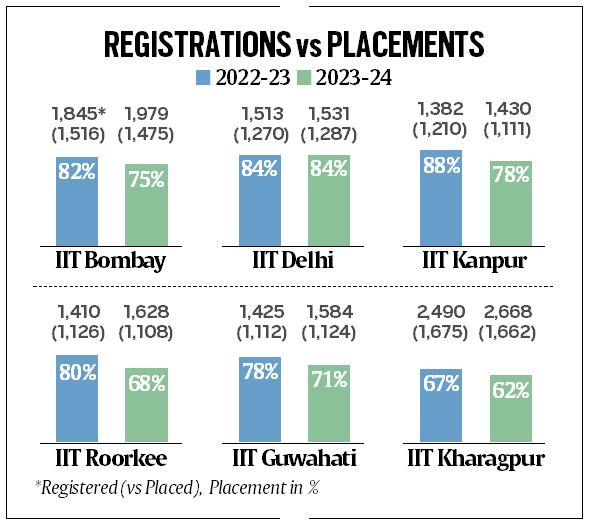
Among the institutes that disclosed placement rates (the percentage of students receiving job offers) across undergraduate, postgraduate, and research programs, IIT Kanpur, IIT Kharagpur, and IIT Roorkee recorded declines ranging from 5 to 16 percentage points (see chart).


IIT Bombay provided data only for 2022-23 and 2023-24, showing a drop from 82 per cent to 75 per cent. While IIT Guwahati’s placement percentage for 2023-24 (71 per cent) is higher than the pre-pandemic level of 2018-19 (67 per cent), it is seven percentage points lower than the previous year, 2022-23 (78 per cent).

IIT Delhi is the only institution that bucked the trend, maintaining a consistent placement percentage of 84 per cent to 85 per cent since 2018-19, except for fluctuations during the pandemic years of 2020-21 (80 per cent) and 2021-22 (75 per cent).


The factors — and some riders

While the IITs refused to comment on the record, students and teachers associated with the campus hiring process attributed the drop to a combination of factors: the aftereffects of post–Covid mass hiring in 2022, a slowdown in key sectors like tech and software, and increasing batch sizes.


“In 2022, there was a spike in placement percentages as the market recovered after Covid, with rates exceeding 85 per cent. This spike followed a two-year hiring freeze. Hiring in 2023 was more conservative, with fewer top MNCs coming in and a decline in software and tech recruitment. Placements this year might improve over last year, but are unlikely to match 2022 levels. The numbers may normalise by 2025,” said a source from IIT Kanpur.

Another person associated with placements at IIT Kharagpur pointed to growing batch sizes as a factor. At IIT Kharagpur, the number of students registering for placement has increased from 1,757 in 2018–19 to 2,668 in 2023–24, while those placed grew from 1,375 to 1,662 during the same period.

“Placements in 2022-23 were among the best for the institute, but there hasn’t been much improvement in the market since then, and the companies coming for placements this year haven’t met expectations,” the source said.

“The intake of students has been increasing gradually, with nearly 3,000 students sitting for placements this year, making it a challenging task to place everyone. While most JEE entrants are placed, companies have fewer roles for PG students,” the person said.


IIT Guwahati too said that placement outcomes are better for B.Tech graduates. “Most IIT placement data focuses on B.Tech students. In 2022, the B.Tech placement percentage was 83 per cent, and in 2023, it was 80 per cent,” an official from IIT Guwahati told The Indian Express. “PG students often prefer higher studies – they register for placements but do not pursue them further. The actual placement scenario is best reflected in undergraduate placements, where close to 80 per cent of students secure jobs, while 10 per cent go for higher studies, 5 per cent opt for civil services, and others pursue MBA programs.”

The official said that around 600 and 650 BTech students were placed in 2022 and 2023, respectively.

Though the placement percentage at IIT Bombay dropped from 82.16 per cent in 2022-23 to 74.53 per cent in 2023-24, an official said it would be misleading to draw conclusions solely from this data as it only reflects on-campus placements and not other career paths. “Many students shown as ‘not placed’ take routes like higher education or off-campus placements or entrepreneurship. The dip does not offer a true reflection unless compared with the exit survey,” the official said.

A newly introduced exit survey revealed that from 2018 to 2022, 57.1 per cent of students were placed through campus placements, 10.3 per cent found jobs independently, 1.6 per cent initiated start-ups, 8.3 per cent entered public services, 6.1 per cent were still seeking jobs, and 12 per cent pursued higher education in India or abroad.

Of the six IITs, only three shared data pertaining to the average salary package offered to placed students. IIT Kanpur’s average salary rose from Rs 22.1 lakh per annum (LPA) in 2020–21 to Rs 25.9 LPA in 2022–23, but dropped to Rs 23.7 LPA in 2023–24.

At IIT Kharagpur, the average salary increased from Rs 14 LPA in 2020–21 to Rs 18 LPA in 2022–23, before declining to Rs 17 LPA in 2023–24.

IIT Bombay recorded an average salary of Rs 21.50 LPA in 2021–22, slightly rising to Rs 21.82 LPA in 2022–23.

Why IIT Delhi stood out

The increase in students availing themselves of IIT Delhi’s placement services rose from 1,471 in 2021-2022 to 1,531 in 2023-2024, largely due to a significant rise in participation from PhD scholars.


Nearly 190 PhD candidates, a sixfold increase, sought placements for the first time, affecting the overall placement percentage since regular job profiles for B.Tech and M.Tech graduates are not suitable for PhD scholars.

To address this, IIT Delhi conducted a special recruitment drive for PhD students in June 2024, resulting in a sevenfold increase in offers as compared to the previous year. An official said: “If you notice, the number of offers received in 2022-2023 (1,287) and 2023-24 (1,222) are comparable and only about 5 per cent less than the previous year. Despite difficult market conditions and placements across the institutions in the country during 2023-2024, IIT Delhi managed to do reasonably well last year. We are striving to get our PhD and other students jobs to achieve a very good overall placement this year. We have a number of profiles lined up for this year and are hoping to cater to all aspiring students.”

In an exit survey conducted by IIT Delhi this year, 1411 (53.1 per cent) students confirmed that they had received a job offer. On the other hand, 224 (8.4 per cent) students responded that they were self-employed, whereas 45 (1.7 per cent) students informed that they are working for a start-up and 66 (2.5 per cent) students were involved in entrepreneurship.

UGC eases hiring contract teachers, opens V-C post to non-academics too

The 2018 University Grants Commission regulations had limited contract teacher appointments to 10 per cent of an institution’s total faculty positions. The new draft regulations have also removed the cap on such appointments.

UGC eases hiring contract teachers, opens V-C post to non-academics too, ugc hiring procedure, non academic, The new rules will be finalised after the higher education regulator receives public feedback on the draft. 

In a major overhaul of the process of appointment of leaders in higher education, the University Grants Commission (UGC) issued new rules Monday which effectively give Governors in states broader powers in appointing Vice-Chancellors and opened the position to industry experts and public sector veterans, thus breaking from the tradition of selecting only academicians.

According to government sources, if approved as is, the new regulations will give Chancellors greater control over Vice-Chancellor selection. This will likely have significant ramifications for Opposition-ruled states such as Tamil Nadu, West Bengal, and Kerala, where the government and Governor (who serves as Chancellor of state universities) are currently locked in disputes over the top academic appointment process.

The new draft regulations — titled ‘University Grants Commission (Minimum Qualifications for Appointment and Promotion of Teachers and Academic Staff in Universities and Colleges and Measures for Maintenance of Standards in Higher Education) Regulations, 2025’ — have also removed the cap on contract teacher appointments.

The 2018 regulations had limited such appointments to 10 per cent of an institution’s total faculty positions.

The new rules will be finalised after the higher education regulator receives public feedback on the draft.

“The Chancellor/Visitor shall constitute the Search-cum-Selection Committee comprising three experts,” the new regulations state. Earlier, the regulations mentioned that the selection for the post of Vice-Chancellor should be through proper identification by a panel of 3–5 persons formed by a Search-cum-Selection Committee but did not specify who would constitute the committee.

According to a senior government official, there are at least two Supreme Court judgments that make the UGC regulations, especially those pertaining to academic appointments, applicable to state universities as well.

In other words, Governors in states who are Chancellors of state universities now have more control over the selection process and also have the final say on the V-C appointment. The draft guidelines also warn that non-implementation may result in debarring an institution from participating in UGC schemes or from offering degree programmes.

“Every time we revise UGC regulations, we try to make changes based on past experiences. As far as Vice-Chancellor appointments are concerned, we have tried to make the selection process as clear as possible, leaving no room for ambiguity,” said a senior government official. When asked if the change was influenced by the tussle between the Government and Governors in some states, the official said, “The regulation doesn’t mention the Governor anywhere. Whoever is the Chancellor will appoint the selection committee.”

Another key change in the draft regulations is that university Vice-Chancellors need not be professors, but can be individuals at senior levels in industry, public policy, public administration, or public sector undertakings, going by the University Grants Commission’s (UGC) new draft regulations on appointment and promotion of teachers and academic staff in universities and colleges.

Another key change in the draft regulations is that it does away with the Academic Performance Indicators (API) system– a score that determines the recruitment and promotion of teachers based on parameters such as publication in journals. Instead, “notable contributions” across nine categories are to be considered for recruitment and promotion of teachers, including “teaching contributions in Indian languages” and “teaching-learning and research in Indian Knowledge Systems.”

According to UGC Chairman M Jagadesh Kumar, the API system in the 2018 regulations “heavily relied on quantitative metrics, reducing academic performance to numerical scores.”

“In the previous regulations, candidates were often judged primarily on numerical criteria, such as journal or conference publication counts. The 2025 regulations discontinue the API-based shortlisting and adopt a more qualitative approach, allowing selection committees to assess candidates holistically based on their notable contributions and broader academic impact…,” he said.

Other notable contributions that will be considered are innovative teaching contribution, research or teaching lab development, consultancy or sponsored research funding as a principal investigator or co-principal investigator, student internship or project supervision, digital content creation for massive open online courses (MOOCs), community engagement and service, and a “startup”, registered with the Registrar of Companies as “a founding promoter, successfully raising funding through government, angel or venture funds to support the startup.”

Kumar said the subject experts in the selection committee for these hirings will evaluate the notable contributions “in a transparent way as decided by the selection committee.”

“The draft regulations expand the scope to identify leaders who can navigate complex systems, foster innovation, and build meaningful collaborations between academia, industry, and society in alignment with the vision of NEP 2020,” he said.

Earlier regulations issued in 2018 had said that the V-C should be a “distinguished academician”, with a minimum of ten years of experience as a Professor in a University or ten years of experience “in a reputed research and/or academic administrative organisation with proof of having demonstrated academic leadership.”

The new draft regulations say that the V-C candidate is to be a “distinguished person possessing high academic qualifications and demonstrated administrative and leadership capabilities”, with a minimum of ten years of experience as a professor in a higher educational institutions, or at a senior level in reputed research or academic administrative organisations, or at a senior level in industry, public administration, public policy and or public sector undertakings, with a “proven track record of significant academic or scholarly contributions.”

On doing away with the cap on appointments of contract teacher, Kumar said that it was done away with “to give some flexibility to higher educational institutions considering the fact that in many state universities, there are many faculty vacancies and they are making efforts to fill them up.”

“Once the state governments fill up the vacancies, contract basis appointments are expected to be less,” he said.

The general conditions for appointment of teachers in the new draft regulations also say that if the candidate’s subject at the undergraduate or postgraduate level is different from the PhD subject, the candidate will be considered eligible for appointment as a teacher in the subject in which they obtained the PhD. Additionally, if the candidate’s subject at the undergraduate or postgraduate level is different from their subject in qualifying exams like the NET or SET, the candidate will be eligible for appointment as a teacher in the subject in which they qualified in these exams. The 2018 regulations did not make such specifications.

“This is an important flexibility to remove rigid subject boundaries and allow faculty applicants to transition across disciplines, creating a more multi-disciplinary eco-system within university campuses as envisaged in NEP 2020,” Kumar said.


Source: https://indianexpress.com/article/education/ugc-eases-hiring-contract-teachers-opens-v-c-post-to-non-academics-too-9763765/

IIT Bombay and IISER Pune to be mentors to promote research in higher education institutions

"The idea is to promote and improve research work at central and state universities under the mentorship from hub institutions which are already excelling in research,” said Prof Karandikar“Total of 31 institutions across the country having stellar research records have been identified to become hubs (File)

The Indian Institute of Technology (IIT) Bombay from Mumbai and Indian Institute of Science Education and Research (IISER) from Pune are the two institutions from Maharashtra identified as mentors under the Partnerships for Accelerated Innovation and Research (PAIR)–a flagship initiative by the Anusandhan National Research Foundation (ANRF) to promote research in higher education institutions in the country, secretary of Department of Science and Technology, Prof Abhay Karandikar said on Monday.

The ANRF, which aims to foster culture of research in India’s universities, colleges and other research institutions, launched the PAIR initiative a couple of months ago wherein higher educational institutions in the country having excellent research record will mentor other institutions such as central universities and public universities through pairing under ‘hub and spoke’ model.

“Total of 31 institutions across the country having stellar research records have been identified to become hubs. Now they will have to apply for PAIR along with their spoke institutions for a period of five years, on various themes listed for research with focus on multidisciplinary approach. The idea is to promote and improve research work at central and state universities under the mentorship from hub institutions which are already excelling in research,” said Prof Karandikar while adding that the mentorship parameters will have a range of activities from finalising on research topics depending on strengths, guidance on publishing of research papers in high quality journals and also co-supervising PhD students among others.

Each hub and spoke pairing will receive financial support of Rs 100 crore coming from the government through ANRF for a period of five years. “Out of the funding, 70 percent will have to be used for research activities at spoke institutions whereas a hub institution will get to use the remaining 30 percent of the grant. In order to expand the reach of the scheme, each hub institution is required to have one of the spoke institutions which is located outside of the state,” said Prof Karandikar who currently also holds charge on ANRF as CEO.

Prof Karandikar, who will be the chief guest for Mumbai University’s convocation ceremony to be held on Tuesday, delivered a talk at varsity’s Kalina campus a day before on how ANRF is transforming the science and technology landscape in the country. The talk which entailed information on various new schemes under ANRF to enhance research output was attended by several researchers from Mumbai University–faculty as well as students.

In his talk, Prof Karandikar highlighted that research output in the country is concentrated in few institutions with lowest number of (18) institutions having average publication per institute at 7,620 research papers and highest number (115) institutions have average publication per institute of 1,121 research papers while underlining how ANRF is devoted to enhance research and development outputs in institutions across the country.

Source: https://indianexpress.com/article/cities/mumbai/iit-bombay-and-iiser-pune-to-be-mentors-to-promote-research-in-higher-education-institutions-9763583/lite/

Monday, January 6, 2025

Tamil Nadu CM Stalin announces USD 1 million prize for decoding Indus valley script

Synopsis
Tamil Nadu Chief Minister M K Stalin offers a $1 million prize for deciphering the Indus valley script, emphasizing its Dravidian roots and historical significance. Further, he announced a grant for a research chair and annual awards for scholars to boost the study of Indus culture.