Wednesday, August 21, 2019

Call to include on-trend topics

AICTE has identified nine areas — artificial intelligence, internet of things, machine learning, data science, robotics — for inclusion in BTech programmes

Artificial intelligence, robotics and data science should be included in BTech programmes to draw students to conventional courses, the vice-chairman of the technical education regulator said.
“An engineering institute can mention in the certificate that the student has graduated in mechanical engineering with specialisation in artificial intelligence or robotics. The institutes should offer the new topics as electives,” M.P. Poonia, the vice-chairman of the All India Council for Technical Education (AICTE), said on the sidelines of a conclave on “Impact of disruptive technologies on higher education” on Saturday.
Asked about the increase in number of vacant seats over the past couple of years, Poonia said colleges must revamp their curriculum in keeping with the demands of the job market.
“A student takes admission to a private college paying a huge sum. He hopes to get a job. But the students are remaining unemployed because of programmes that do not include topics potential recruiters are looking for,” Poonia said.
AICTE has identified nine areas — artificial intelligence, Internet of things, machine learning, data science, robotics — for inclusion in BTech programmes.
“This is the requirement of the industry. These days disciplines such as mechanical engineering and electrical engineering cannot be taught without artificial intelligence, machine learning or robotics. So I would advise colleges to make their curriculum industry-ready. They should get teachers who are competent to teach the advanced topics,” Poonia said.
sOURCE: 

Tuesday, August 20, 2019

Marathi: Fakta Post navhe, ComPost


Source: Maharashtra Times (Mumbai) dated August 20, 2019

Analytics, chatbots: The new frontiers in HR transformation


More Indian companies are using smart technology to manage human resources, but with impact hard to quantify, budgets remain low

Fifty eight per cent of Indian organizations will invest in technology to enable employees and managers to self-manage people processes this year, according to a new report by People Matters, a HR media platform founded in 2009. Based on the digital agendas of India Inc organizations titled State of HR Technology India 2019-20, the study highlights the understanding of automation levels in different aspects of talent management and also entails companies’ investment plans in HR technologies and how can they future-proof HR teams for digital transformation.ISTOCK

According to the report, there has been a ubiquitous increase in the adoption of HR technology, which testifies the progression of Indian companies towards the age of digital disruption in the HR space as well. Communication & collaboration, employer branding observed a surge in HR technology adoption by 21 percent and 17 percent respectively. However, strategic functions like Hipo (high potential employee) identification and management, succession planning, and strategic workforce planning are least mature in terms of technology

adoption. Even with investments ‘going up’ in HR technology for the year 2019-20, only 20 percent companies have allocated a budget of more than Rs 1 crore to this. About 45 percent plan to invest less than Rs 25 lacs in the next 12 months.

To increase effectiveness of HR execution emerges as the key objective of investment in HR technology. To empower employees and managers to self-manage people workflows and processes (59 percent) and to increase efficiency of HR execution (59 percent) completes the suite of top three core objectives of investment in HR technology.

When asked while shortlisting HR technology, which attributes do they look out for, ability to integrate (74 percent) was the top choice. However, it was found that only 37 percent companies have mainly an integrated system either from one partner (21 percent), multiple partners (8 percent) and in some cases, an integrated in-house technology (8 percent).

Cost still remains the prime factor in making HR technology investment decisions. As mentioned above, cost reduction was one of the objectives of investment in HR technology. The study also found that cost saving measures (49 per cent) is one of the top three metrics that companies track to measure the ROI of HR Technology. The other metrics include time-saving measures (54 percent) and HR operational metrics across functions (52 percent).

NEW-AGE HR TECHNOLOGY


The study shows that analytics, artificial intelligence (AI) & chatbots and cognitive technologies were ranked as the top three newage technologies that can create an impact on talent and workplace. Among the various technologies, blockchain emerged as the least mature technology because 39 percent of the respondents are not well-versed with it. While India Inc. organisations are highly optimistic about the opportunities that new-age technologies can bring to talent management and HR, the journey to adopting these technologies is not easy.

Organisations face challenges in adopting these technologies due to budget constraints, leadership buy-in, and lack of skills and capabilities in the HR team.

The limited budgets for HR technology (46 percent), leadership buy-in to experiment (43 percent), ability to measure return on investment (42 percent) are some of the challenges when it comes to adopting new-age technologies in their organization. Highlighting the HR involvement in adopting and executing technologies, the research reveals that in more than half of the participating organisations, the execution project is jointly owned by the HR team and the IT team.

As the world of work evolves, it is critical for organisations to leverage technology that enhances the speed of the overall people processes, empower employees, and build a team of better, more productive workers.

This study provided key insights into the current landscape of technology adoption rate, the approach towards building a digital HR function, and the challenges in adopting niche technologies in HR.

While organizations have kickstarted their HR digital journey, only three processes namely, HR operations, performance management, and communication & collaboration are automated more than 50 percent. The digitisation level has improved but still needs a lot of effort in the context of: investments, leadership buy-in, and skills and competencies of HR teams.

Limited budgets, leadership buy-in, and skills and competencies constitute the top three challenges in adopting the advanced technologies in HR. Currently, the efforts or investments in future-proofing HR teams are largely sporadic or in the planning phase.

From the study, it was evident that the HR service providers should focus more on integration, a strong analytics layer, and accessibility and mobility of technology as these form the suite of attributes that organisations are looking forward to while investing in any technology. Further, the investments in HR technology in 2019-20 have significantly increased by 35 percent as compared to the study done in 2016.

Source: Hindustan Times (Mumbai) dated August 20, 2019.

Scientists find 1st evidence of high altitude pollution

TIFR Balloon Facility has developed sophisticated plastic balloons to float at the coldest part of atmosphere at edge of stratosphere. DEVENDRA OJHA, chairperson, TIFR-BF committee

Read the full article at:
https://www.hindustantimes.com/mumbai-news/scientists-find-1st-evidence-of-high-altitude-pollution/story-H1AdEWbWBFflkUWTA71yxM.html (Accessed on August 20, 2019)

A Review Of Google's Colab And CoCalc for Collaborative Data Science

As part of my on-going series on learning data science and reviewing the latest tools, I ended up needing to work on data analysis with people in different countries. While big companies have their own internal tools for sharing code among teams, there were less available for students and freelancers. Fortunately, two such tools, Google Colab and CoCalc, are emerging to help data scientists collaborate online (Disclosure, I am a contractor with the tech policy nonprofit, Tech4America). 
Google's Colaboratory (Colab, for short) began as a research project with makers of the popular online programming notebook, Jupyter. The features have recently ramped up, as machine learning and other data science needs have become more commonplace.
Read the full article at:

US economists expect recession in the next 2 years

  • The survey came out after Donald Trump pushed back against talk of a looming recession as a raft of US data reports last week showed a mixed picture on the economy
  • The survey showed 38% economists expect a contraction of growth next year, while 34% don't see it until the following year

To read the full article, please visit:

HCL signs MoU with MADC to expand its Nagpur campus

IT services major to add 90 acres to its 50-acre MIHAN campus

HCL Technologies (HCL) has signed a memorandum of understanding (MoU) with the Maharashtra Airport Development Company (MADC) for expansion of its campus at the Multi-Model International Passenger and Cargo Hub Airport at Nagpur (MIHAN), in line with its plan for Tier-II cities.
As part of the MoU, HCL will acquire 90 acres of land to add to its existing 50-acre MIHAN campus.
HCL started its business operations in Nagpur in April 2018 and already has more than 800 employees servicing global accounts. The MIHAN centre delivers a spectrum of services, including infrastructure management, application development, product engineering, BPO, IT services management and HCL’s internal enabling functions. The campus, when fully operational, will employ over 8,000 personnel, an HCL statement said.
To read the full article, please visit:

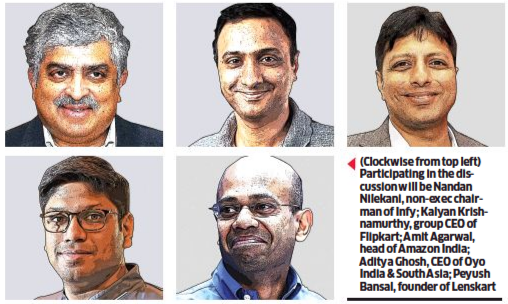
Digitising Bharat on agenda at ET Startup Awards 2019

Top industry leaders to deliberate on 'Building Digital Businesses for Bharat' at panel discussion
Digitising Bharat on agenda at ET Startup Awards 2019

To read the full article, please visit:
https://tech.economictimes.indiatimes.com/news/startups/et-startup-awards-2019-a-high-powered-panel-to-deliberate-on-building-digital-biz-for-bharat/70746026 (Accessed on August 20, 2019)

UGC releases fake universities list running in India

The eight educational institutions from Uttar Pradesh are labelled as fake, while seven are from Delhi. Every year, UGC releases a list of fake universities ahead of the college admissions


To read the full article, please visit:

UGC recognises 113 HEIs for ODL

Now, there is a price for engineering internships in Bengaluru

Many have alleged that college managements are asking students to cough up a ‘fee’ for getting internships in companies.

The All-India Council for Technical Education (AICTE) made internships mandatory recently. While students have welcomed the move, many have alleged that college managements are asking them to cough up a ‘fee’ for getting internships in companies.
To read the full article, please visit:

NASA's Hubble Space Telescope Captures Two Galaxies Interacting, Distorting

NASA's Hubble Space Telescope has captured two luminescent galaxies at play. Catalogued as the UGC 2369, the galactic duo has been caught in an interaction resulting from the mutual gravitational attraction between them. Galaxies interacting is not uncommon, but two similarly sized ones merging is a momentous event - the image shows the galaxies distorting as they pulled closer and closer together. A thin bridge of gas, dust, and stars connecting the duo can be observed. The bridge was developed when the galaxies pulled their material out into space across the diminishing divide between them.

To read the full article, please visit:
https://gadgets.ndtv.com/science/news/nasa-hubble-space-telescope-ugc-2369-galaxies-at-play-esa-2086503 (Accessed on August 20, 2019)

Just days away from entering Moon orbit, here’s what lies ahead of Chandrayaan-2

The Chandrayaan-2 is presently in the Lunar Transfer Trajectory and in this Tuesday, the liquid engine of the spacecraft will be powered so as to get it inside the orbit of the Moon.


To read the full article, please visit:

Scientists made a stable cyclocarbon ring of 18 carbon atoms: Here’s why it matters

A team of scientists from Oxford University and IBM Research has managed to make and image a ring of 18 carbon atoms for the first time, which is a carbon allotrope-- cyclocarbon (C18).


To read the full article, please visit:

Friday, August 16, 2019

New Arrivals: August 1-16, 2019

BRANCH: MECHANICAL

27213-27216 DATABASE MANAGEMENT SYSTEMS (AS PER NEW SYLLABUS OF MUMBAI UNIVERSITY)  
By GUPTA, G.K.
CHENNAI/McGRAW-HILL/2018
005.74 GUP


27217-27218 KINEMATICS AND DYNAMICS OF MACHINERY  
By NORTON, ROBERT L.
CHENNAI/McGRAW-HILL EDUCATION/2009
621.8 NOR


27219 INDUSTRIAL ELECTRONICS AND CONTROL  
By BHATTACHARYA, S.K/CHATTERJEE, S.
CHENNAI/McGRAW-HILL INDIA/1995
621.3815287 BHA/CHA


27227 ENGINEERING FLUID MECHANICS  
By KUMAR, K.L.
NEW DELHI/EURASIA/2016
620.106 KUM


27228 MECHANICS OF FLUIDS-3rd. ed.  
By SHAMES, IRVING H.
NEW DELHI/MCGRAW HILL/2014
620.106 SHA


27229-27230 THEORY OF MACHINES AND MECHANISMS-25th. ed.  
By BALLANEY, P.L.
NEW DELHI/KHANNA/2018
621.8 BAL


27238-27239 MECHANICS OF MATERIALS-2nd. ed.  
By GERE, JAMES M./TIMOSHENKO, STEPHEN P.
NEW DELHI/CBS/2004
620.1123 GER/TIM


27240 ELEMENTS OF STRENGTH OF MATERIALS-5th. ed.  
By TIMOSHENKO, S.P./YOUNG, D.H.
NEW DELHI/AFFILIATED EAST-WEST PRESS/2019
620.112 TIM/YOU


2724127245 ELEMENTS OF WORKSHOP TECHNOLOGY: MACHINE TOOLS-15th. ed.Vol.No.2  
By CHOUDHURY, S.K. HAJRA/BOSE, S.K./CHOUDHURY, A.K.HAJRA/ROY, NIRJHAR
MUMBAI/MEDIA/1964
621.9 CHO/BOS


2724627247 MANUFACTURING TECHNOLOGY: FOUNDRY, FORMING AND WELDING-5th. ed.Vol.No.1  
By RAO, P.N.
CHENNAI/McGRAW-HILL EDUCATION/2019
670 RAO


BRANCH: ELECTRONICS AND TELECOMMUNICATIONS

27220 MICROWAVES-2nd. ed.  
By GUPTA, K.C.
NEW DELHI/NEW AGE/2012
621.3813 GUP


27221 MICROWAVE ENGINEERING-3rd. ed.  
By DAS, ANNAPURNA/DAS, SISIR K.
NEW DELHI/McGRAW-HILL EDUCATION/2015
621.3813 DAS/DAS


BRANCH: ELECTRICAL

27222-27226 FUNDAMENTALS OF DIGITAL CIRCUITS-4th. ed.  
By ANANDKUMAR, A.
DELHI/PHI LEARNING/2018 [Issued]
621.395 ANA


27231-27232 NETWORK ANALYSIS  
By VALKENBURG, M.E.
UTTAR PRADESH/PEARSON INDIA/2019
621.3192 VAL


BRANCH: INFORMATION TECHNOLOGY


27233-27237 COGNITIVE COMPUTING AND BIG DATA ANALYSIS  
By HURWITZ, JUDITH S./KAUFMAN, MARCIA/BOWLES, ADRIAN
INDIANAPOLIS/JOHN WILEY/2015
006.3 HUR/KAU


BRANCH: COMPUTERS

27248-27267 DIGITAL SIGNAL PROCESSING-2nd. ed.  
By ANAND KUMAR, A.
DELHI/PHI LEARNING/2016
621.3822 ANA

Laboratories in engineering colleges, technical institutions in rural areas to get makeover: AICTE

New Delhi, Aug 11 Laboratories in engineering colleges and other technical institutions operational in rural areas are all set to get a makeover, with the All India Council of Technical Education (AICTE) deciding to providing grants to institutions for procuring modern equipment.
The technical education regulator under the HRD Ministry will be providing grants under the Modernisation and Removal of Obsolescence (MODROBS) scheme.
"A special drive is being undertaken by AICTE under MODROB scheme for modernising laboratories in technical institutions operating in rural areas and approved by AICTE by providing grants for procuring modern equipments. The institutions can apply under the scheme till August 28," a senior AICTE official said.
The MODROB scheme aims to modernise and remove obsolescence in laboratories, workshops, computing facilities excluding libraries, so as to enhance the functional efficiency of technical institutions for teaching, training and research purpose.
"It also supports new innovations in class room and laboratory, teaching technology, development of lab instructional material and appropriate technology to ensure that practical work and project work to be carried out by students is contemporary and suited to the needs of the industry.
"The equipment financed under the scheme could be ideally used for up-gradation of equipment in existing laboratories, enhancement of performance parameter specification of existing equipment, incorporation of latest development in the field and replacement of old depreciated equipment by modern equipment," the official said.
The equipment installed through MODROBS can also be used for indirect benefit to faculty or students through continuing education programmes, training programmes for local industry and consultancy work.
Only institutions that have been in existence for at least 10 years can apply for the scheme and get funding up to Rs 20 lakh. Duration of the project will be two years from the date of receipt of funds in the institute''s account.
"100 per cent grant of sanctioned amount will be released to government and government aided institutes. To private institutions, grants will be sanctioned in the form of per cent of the sanctioned amount as advance followed by 20 per cent as reimbursement on submission of the utilisation certificate and other supporting documents as specified in terms and conditions of MODROB," the official said. GJS GJS DV DV

VIKRAM SARABHAI'S 100TH: WORDS FROM THE AWARD-WINNING LEADER'S 1971 SPEECH REMAIN IMPORTANT FOR INDIA TODAY

Editor's Note: On 10 April 1971, at the Silver Jubilee Celebration of the Tata Institute of Fundamental Research, the father of India's Space program Dr Vikram Sarabhai was invited to take the stage and share a few words as the Guest of honor. He spoke of the role Tata Institute of Fundamental Research plays in the country's biggest atomic energy program  (the Atomic Energy Commission, of which Sarabhai was the President 1966–1971) and the importance of institutes of national import to freely-interact in clusters with others important institutions to address the needs of a developing nation like India. 
Your Excellency, Mr Tata, Prof Menon and friends,
I speak here on behalf of the Atomic Energy Commission of India with admiration, gratitude, pride, and expectation as Panditji said, "This Institution has been the cradle of Atomic Energy in India", and it is through the agency of one single person: Homi Bhabha, that we saw during the early part of the fifties and right to the middle of the sixties a creation and the development of 3 major institutions — not only the Atomic Energy Commission itself but the Tata Institute of Fundamental Research and the Atomic Energy Establishment, of all three of which Bhabha was the guiding spirit.
But when in 1966 Bhabha met his tragic death, it was considered appropriate to separate the directing responsibility of each one of these three units, and we have in Professor Menon a most distinguished successor to Bhabha in the role of the Director of the Tata Institute of Fundamental Research. It is necessary for creative work to be able to see squirrels and birds. It is not a physicist's remark and I feel that Professor Menon has not only maintained the excellence of this Institute but has kept up the core 0f the culture which was created so admirably by Bhabha for the type of creative work which was to be done here.
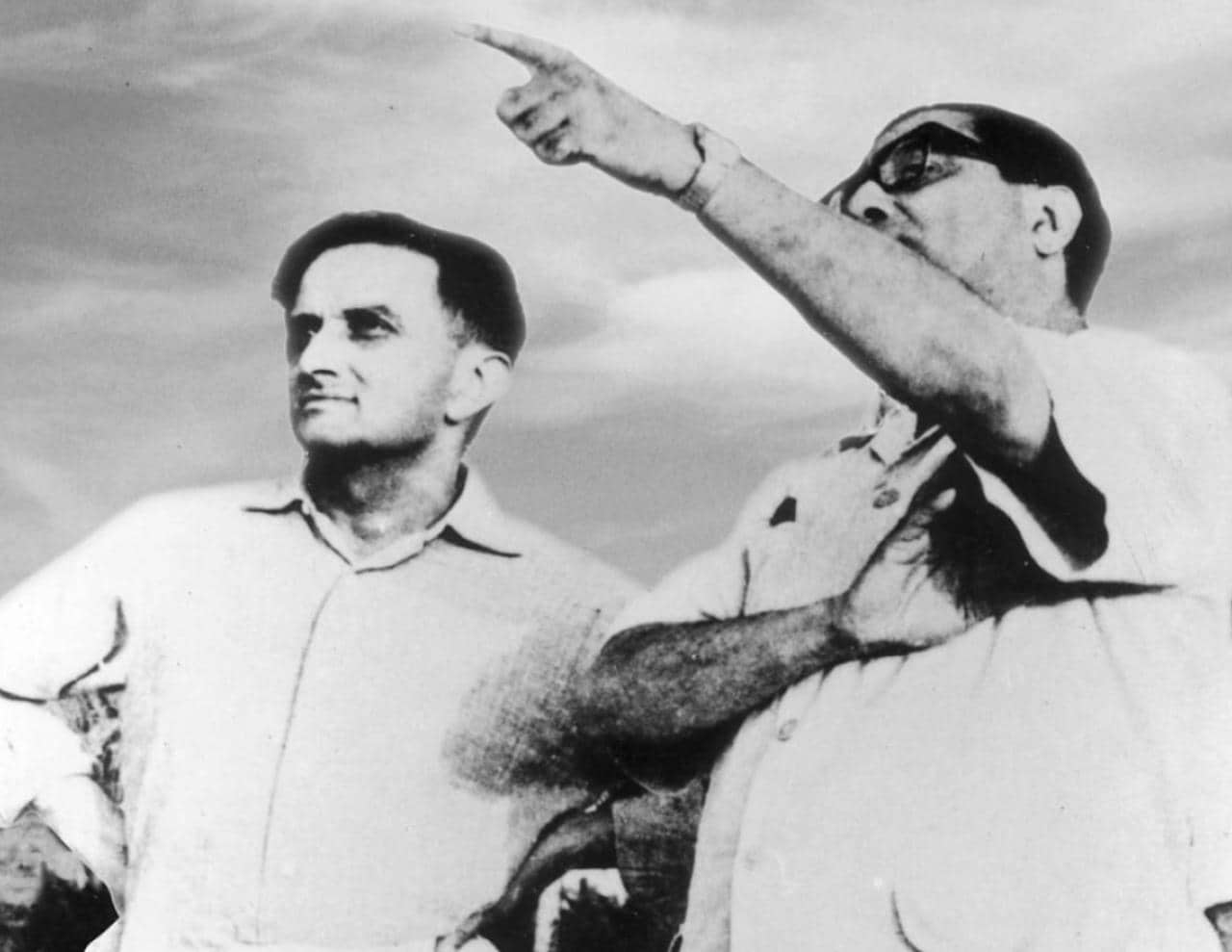
Vikram Sarabhai (left), Chairman of ISRO, and NASA administrator Thomas Paine sign an agreement in September 1969. Image: NASA
But one of the most important aspects which I would like to deal with you here is this aspect of the relationship of the culture of fundamental research, the culture of research and development and the culture of industry; for the main task of Atomic Energy Commission in this county is to provide the benefits of Atomic Energy for the development of the nation. And I think it is necessary to understand that the main task is related to the completion of this entire innovative change from fundamental research to the industry, if we are to succeed.
I would suggest that the primary task of fundamental research is to discover; of research and development is to optimise, and of the industry to produce. One of the main problems that are faced in the organisation of innovative institutions or establishments is to make the link between these three cultures and to provide for a basis by which transfer of knowledge, of men, of technology can proceed from one step to another interacting freely and also benefitting one from the other. Margarate Mead has talked of the interacting clusters which are necessary if development and change are to take place. The clusters which are in each one of these three cultures require their transfer men who shared each other's trust above all and who share a common commitment to a profession, to science, to excellence, to certain common ideals. In electrical engineering, it is well known that energy from one loop to another can only be transferred if there are matched impedances.
Dr Vikram Sarabhai with Dr Homi Bhabha. Image courtesy: Darpana Archives
It is these common matching transformers at which the point of transfer takes place and it is through the men who are occupying positions of trust in these different clusters that it is possible to make the most important transfers which are involved in the innovative change. I would like to suggest that one of Bhabha's greatest accomplishments was that when he died suddenly, he left the state of affairs in the hands of people who shared a common trust and a common culture and could manage to develop these institutions further as a joint group or a family.

Dr Menon has already remarked about the role that the Tata Institute of Fundamental Research is playing in transferring electronics technology to the Electronics Corporation of India, of the big role that today they will be playing in the development of the computer industry in this country, and in the development of radars for the Space Research or the Variable Energy Cyclotron. There are a number of projects which TIFR continues to share with the other members of the family of Atomic Energy. In the years to come, we have a very challenging task before us. The 10-year profile of Atomic Energy and Space Research requires the best from our bright and talented scholars.

Why AIoT Is Emerging As The Future Of Industry 4.0

Two trends that are dominating the technology industry are the Internet of Things (IoT) and Artificial Intelligence (AI). But for industrial automation, these two technologies are much more than the buzzwords or trending topics. The convergence of AI and IoT will redefine the future of industrial automation. It is set to lead the Industry 4.0 revolution.

To read the full article, please visit:

Featured Posts

St. Francis Institute of Technology Designated as a Potential Nodal Centre for Universal Human Values

St. Francis Institute of Technology, Mumbai, marks a significant milestone with its designation as a Potential Nodal Centre for Universal Hu...