Thursday, March 7, 2019

Coming soon: the Indian museum of natural history

Jurassic find: An excavated ichthyosaur fossil found near Lodai village in Kutch district of Gujarat in 2017.   | Photo Credit: HANDOUT

It will house the country’s geological wealth in one location

From dinosaur fossils to pre-human skulls, India is home to a vast treasury of geological and palaeontological specimens that contain a wealth of scientific information about the planet and its history. But these rare specimens are scattered in different labs all over the country. So, to better conserve this prehistoric heritage, the government is planning to house them in one place — an ‘Earth Museum’.
This museum will be modelled on the American Museum of Natural History, or the Smithsonian museum in the U.S. The museum, which will be set up as a public-private partnership, would be located somewhere in Delhi, Noida or Gurugram, said G.V.R Prasad, head of the Department of Geology, University of Delhi.
K. VijayRaghavan, Principal Scientific Adviser (PSA) to the Prime Minister, said at a press conference on Wednesday that such a repository was necessary to make people aware of India’s palaeontological and geological wealth. “There is a lot of history here, but somehow it hasn’t been communicated well,” he said. Another concern, he added, was that several collections of fossils and important geological specimens weren’t properly organised, and they survived only due to the efforts of individual researchers who maintained them within their labs. A single site, accessible to the public as well as researchers wanting to investigate rare and important finds, was necessary, Mr. VijayRaghavan said.
The PSA led a meeting of the Prime Minister’s Science, Technology and Innovation Advisory Council (PM-STIAC) last November, where the need for such a museum was endorsed. A meeting of experts from the U.S., the U.K, and South Korea is scheduled to be held in Delhi in early April, Mr. Prasad told The Hindu.

ISRO space education programme for school students


The selection will be based on the academic performance and extracurricular activities.
Indian Space Research Organisation (ISRO) has launched from this year a ‘Young Scientist Programme’.
Called ‘YUva VIgyani KAryakram’, the Programme aims to impart basic knowledge on space technology, space science and space applications to youngsters to arouse their interest in this emerging area.
ISRO has chalked out this programme to “Catch them young”. The residential training programme will run for two weeks during the summer holidays. Three students from each State/Union Territory will be selected to participate in this programme every year. Those who have finished VIII standard and are in IX standard will be eligible.
The selection will be based on the academic performance and extracurricular activities. Students belonging to the rural area will get a special weightage. ISRO is in touch with Chief Secretaries of States/UTs, and the list of selected candidates is expected by the March end.

Source: https://www.thehindubusinessline.com/news/education/isro-space-education-programme-for-school-students/article26431523.ece (Accessed on 7 March, 2019)

A-list hires of India’s B-schools


Another year, and further proof that India's leading B-schools are almost immune to the business cycle. Job markets are up or down in various ...

To read the full article, visit:
https://economictimes.indiatimes.com/jobs/a-list-hires-of-indias-b-schools/printarticle/68263315.cms (Accessed on 7 March, 2019)



Google launches 'Bolo' to tutor children to read Hindi, English

Google's Bolo app, which is being launched in India first, uses speech recognition and text-to-speech technology.
Bolo will be available on Google Play Store in India for all smartphones running Android 4.4 (Kit Kat) and higher

NEW DELHI: Tech giant Google Wednesday unveiled a new app 'Bolo' that aims to help children in primary school learn to read in Hindi and English.

The free app, which is being launched in India first, uses Google's speech recognition and text-to-speech technology.

The app features an animated character 'Diya', who encourages children to read stories aloud and helps if the child is unable to pronounce a word. It also lauds the reader when he/she completes the reading.

"We have designed the app to work offline, so users need to just download the under 50MB app once and then they have access to close to 100 stories in Hindi and English that the children can read out loud and improve their reading skills," Google India Product Manager Nitin Kashyap told PTI.

Bolo will be available on Google Play Store in India for all smartphones running Android 4.4 (Kit Kat) and higher, he added.

Citing the annual ASER 2018 report, Kashyap said, it was found that only half of students enrolled in grade 5 in rural India can confidently read a grade 2 level textbook.

"Lack of reading ability can significantly impact further education, and ultimately children's ability to realise their full potential. Limited access to quality material, under-resourced infrastructure, and barriers to learning outside the classroom are some of the challenges that children often face," he added.

Google piloted the 'Bolo' app in about 200 villages in Uttar Pradesh and the early results are very encouraging with 64 per cent of children showing an improvement in reading proficiency in just three months, Kashyap said.

"We are now actively working with a number of non-profit partners to take the app to more people across the country who could benefit from it," he said.

Kashyap said the company is also looking at expanding the app to other Indic languages like Bengali, soon.

To ensure safety of the child, all personal information always stays on device. The users are also not asked for details like email ID and gender for logging into the app.

Source: https://www.livemint.com/ (Accessed on March 7, 2019)

Wednesday, March 6, 2019

Mehak Mirza Prabhu: I am no one to select my story, the story selects me

Mehak Mirza Prabhu is a Mumbai based storyteller, full-time writer, voice-over artist, performer, mentor, blogger, scriptwriter and social enthusiast. She creates fictional stories in multiple languages. She also runs an online story telling school, ‘Jhumritaliaya’. She has a huge fan following both online and offline. Her TEDx talk, “How Story Telling Saved Me,” is a true account of her life experiences. It has been highly appreciated online. Many of her stories are widely accessed on YouTube.
Open Interview features Mehak Mirza Prabhu’s interview with Satish Bendre and Santosh C Hulagabali. In this interview, you will notice how natural, honest and gifted storyteller she is. Her answers are not studded with academic theories of art of storytelling but are full of wisdom and commonsense replete with deep understanding of what she does and how she does. You will also feel how different, simple and clear she is in her thoughts and actions.

List of Best BE Project Reports: Update 1

The list of Best B.E. Project Reports of the years 2016, 2017 and 2018 has now been updated with the abstracts and names of the respective project guides.

Please scan the QR Code below to view the list:

Rainmakers of engg services boost biz: Indian Tech’s Fastest Growing Segment Runs On Execs Whom Customers Trust

When former chief digital officer at Rolls-Royce Neil Crockett wanted to identify a service provider to accelerate its IoT (internet-of-things) capabilities three years ago, he floated a request for proposal (RFP). The company wanted to use IoT to get a lot more data from customers and use that to provide long-term service contracts.


Ayyaswamy presented TCS’s IoT platform, called Connected Universe Platform (TCUP), that helps develop and deploy IoT applications. Having worked with Rolls-Royce, TCS had a deep knowledge of its engines, blades, compressors and exhaust. “We were able to characterise what we could do for them. Our strength was contextual knowledge, digital platforms, information security, core engineering, capability around services. We were able to bring the might of TCS into making their business goal a reality,” Ayyaswamy says.Reguraman Ayyaswamy, global head of IoT & engineering and industrial services at TCS, saw it as a great opportunity for the company, and he knew he had his task cut out. Roll-Royce specialises in highperformance power systems engineering and aircraft engines. It was a decade-old-customer for TCS. But this was a different kind of engagement, one that impacted the core operations of Rolls-Royce, and TCS would really have to prove its capabilities. Other IT players too were participating in the RFP.


TCS won the deal. Ayyaswamy declined to mention the deal value, but independent sources estimate it is around $20 million annually. The platform today captures and analyses data to reduce the cycle time for Rolls-Royce to develop new products and services.
Getting customers to outsource core engineering work is very difficult, but Indian IT companies today have built significant expertise in the field, and it has become the fastest growing business for them. Deals above $10 million are considered large in this space. It is also a high-margin business. Industry body Nasscom in its 2018 strategic review called out engineering and R&D and product development as the fastest growing segment in IT services, growing at 12.8%, led by demand for connected cars, mobility and connectivity.
Pareekh Jain, founder of Pareekh Consulting, says the growth in engineering services is not a demand problem, as much as a supply problem. “Of the over $1-trillion R&D spend, only $60 billion or 6% is currently outsourced. There is a huge market but someone needs to go out and make it happen. That’s why the role of key executives and rainmakers are important,” he says.
L&T Technology Services, Persistent and HCL each won an over $50-million deal in the last two years, signalling a psychological threshold that would open up upstream, high-end engineering opportunities.

Now, just 1-day gap between engg papers at Mumbai University

MUMBAI: A month before the engineering exam is set to commence, Mumbai University has decided to reduce the gap of four to seven days given between each paper for preparation.

After a meeting held recently, a university official issued directives to all colleges, informing them about the need for creating a slot of 45 days for internship post exams. The decision has caused panic among students who plan their studies taking those leaves into account. An online petition, started a day ago, already has close to 20,000 supporters.

A message forwarded by the university’s dean of science and technology, SK Ukrande on Sunday, read, “Examinations will be conducted in two slots. Regular examinations will be held in the first slot and the ATKT (allowed to keep term) exams in the second. There will be only a day’s gap between two successive papers of the semester.” The regular exams are likely to be held from May 7 to May 22, and repeaters’ exams from May 23 to June 7. Students have been instructed to prepare themselves for the change in schedule and accordingly plan their studies. They have also been asked to plan for their internship in any industry from May 25 to July 7.


The All India Council of Technical Education (AICTE) recently stated students should mandatorily undergo internship for 600 hours during their BE/B Tech programme. Mumbai University, therefore, wanted colleges to facilitate a 45-day period during every vacation in the four-year programme – for first, second, third and final year students.


But the practice of giving preparation time before each paper is being followed for several years. Students claim the decision has come at the end of semester and can make it difficult for them to prepare. Students are worried some papers may clash. A student who signed the petition said there was no point in condensing the time-table as it would affect passing percentage of engineering students, which is already poor. “It is not possible to revise conceptual subjects in one day,” said a student. Another said the university should have announced this decision at the start of semester. The petition on change.org states students are overloaded with assignments and experiments for most of the year and there is enough pressure on students having ATKT.


A senior teacher claimed the decision was ad hoc and taken without discussion in the academic council meeting. “Also, there is a huge mismatch between number of students available and number of industries willing to take them for training,” said the teacher.


While the dean was unavailable for comment, Vinod Malale, spokesperson for the exam section, said the decision is not yet officially declared. “The university will take feedback from stakeholders,” he said. Another official said there was no point in dragging the engineering exam for a month when study leave is not given to students from any other programme. He added the university had recently shortened the timetable for TYBA exams too.
Source:
https://timesofindia.indiatimes.com/city/mumbai/now-just-1-day-gap-between-engg-papers-at-mumbai-university/articleshow/68263857.cms (Accessed on March 6, 2019)

Tata Consultancy Services recognised as Top Employer in Middle East

Capital Market March 05, 2019 Last Updated at 11:39 IST
By Top Employers Institute

Tata Consultancy Services has been recognised as a Top Employer in the Middle East for the fourth consecutive year by the Top Employers lnstitute, which independently assesses and certifies companies across the world. TCS was also recognized as the Number One Top Employer in the United Arab Emirates, and achieved Top Employer status in SaudiArabia and Qatar. This recognition was achieved due to TCS' exceptional workplace policies, culture and continued investments in its employees across all regions. Powered by Capital Market - Live News
Source: Business Standard dated March 5, 2019

Tuesday, March 5, 2019

Smart India Hackathon 2019

Innovation and entrepreneurship are at the peak in India. In order to make development a comprehensive mass movement and innovate on all fronts, MHRD, AICTE, i4c and Persistent Systems have come together to organise Smart India Hackathon (SIH) 2019 - a unique Open Innovation Model for identifying new and disruptive technology innovations to solve the challenges faced in our country. It's a non-stop product development competition, where problem statements are posed to technology students for innovative solutions. It can help to:
  • Harness creativity & expertise of students
  • Spark institute-level hackathons
  • Build funnel for 'Startup India' campaign
  • Crowdsource solutions for improving governance and quality of life
  • Provide opportunity to citizens to provide innovative solutions to India's daunting problems
To read more about the Smart India Hackathon 2019, visit the following URL:

From AI to cyber security, Cisco nurturing innovations by hi-tech start-ups

Quantum cryptography that could propel India to the forefront of hack-proof communication. Li-Fi that uses light as a medium to transfer data at high speed.
Internet of Things (IoT) devices that are helping airlines for faster turnaround of aircraft. These are some of the innovations by start-ups that are being nurtured by Cisco as part of its ‘accelerator’ programme. The US-based maker of computer networking gear is engaging with Indian start-ups through a Cisco LaunchPad programme, to get feedback and understand the innovations in areas such as IoT, artificial ..

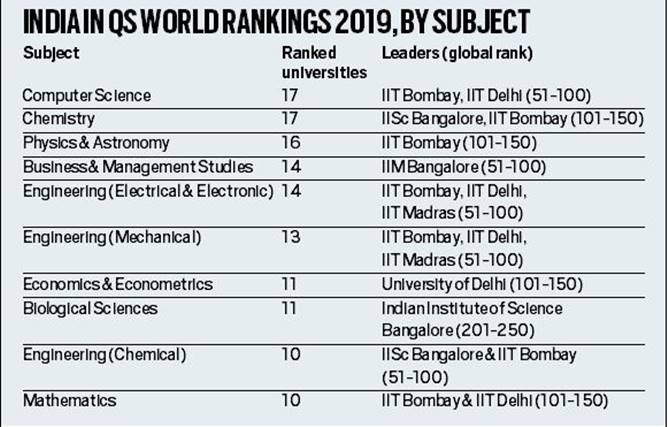
Telling Numbers: Computer Science, Chemistry power India in QS Rankings

No university has experienced a drop in rank. India’s eight IITs and IIScs are ranked 104 times, with 33 improvements in rank and only 7 drops in rank.


To read the full article, please visit:

YourStory features PRAGATI 2019

Thanks to YourStory for featuring our event PRAGATI 

2019 on their page! 

Source: https://events.yourstory.com/partners/pragati-2019


The YourStory Team brings you stories of entrepreneurs and change-makers, funding analyses, resource pieces and the first glimpse of emerging trends from India’s entrepreneurial ecosystem, as well as profiles of great businesses and entrepreneurs from all over the world.

Univs should be at least 20 years old to get deemed status: UGC

Main Edition Mumbai (Pg 8) : Univs should be at least 20 years old to get deemed status: UGC
Source: Daily News and Analysis dated 5 March, 2019

PRAGATI 2019: The National Technical Innovation and Business Plan Competition at SFIT

No photo description available.


How Does the Blockchain Work? Blockchain technology explained in simple words

Blockchain technology is probably the best invention since the internet itself. It allows value exchange without the need for trust or a central authority. Imagine you and I bet $50 on tomorrow’s weather in San Francisco. I bet it will be sunny, you that it will rain. Today we have three options to manage this transaction:
  1. We can trust each other. Rainy or sunny, the loser will give $50 to the winner. If we are friends, this could be a good way of managing it. However, friends or strangers, one can easily not pay the other.
  1. We can turn the bet into a contract. With a contract in place both parties will be more prone to pay. However, should either of the two decide not to pay, the winner will have to pay additional money to cover legal expenses and the court case might take a long time. Especially for a small amount of cash, this doesn’t seem like the optimal way to manage the transaction.
  1. We can involve a neutral third party. Each of us gives $50 to a third party, who will give the total amount to the winner. But hey, she could also run away with all our money. So we end up with one of the first two options:trust or contract.


Neither trust nor contract is an optimal solution: We can’t trust strangers, and enforcing a contract requires time and money. The blockchain technology is interesting because it offers us a third option which is secure, quick, and cheap.
To read the full article, please visit:

Monday, March 4, 2019

Legends of Artificial Intelligence (Marathi)

clip

Source: Loksatta dated 4 March 2019

Skills needed for future job market

India finds itself at a unique advantage when compared to other nations due to its young population. However, a young population is both an opportunity as well as a problem depending on how the advantage is utilised to boost the economy. The rapidly growing population indicates the urgent need for skill development in order to enable the growing population to have meaningful employment. An education that places an emphasis on imparting skills over rote learning and memorisation is necessary to ensure that the youth are gainfully employed.
For India to maintain its stature of being the largest provider of skilled programmers and technologists, we will have to ensure that its populace is skilled accordingly so as to remain competitive in the global arena. What follows are five important skills that will continue to be in high demand in the Indian job market in the years to come.

CODING
Coding or programming in languages such as Javascript or Python has consistently been a skill that is in high demand. Many companies in the past few years have produced both hardware and software that feature augmented reality and machine learning. Individuals who possess the skills required to create, design and refine applications that make the most of these technologies and application programming interfaces, will be able to consistently secure rewarding employment.


MACHINE LEARNING
Machine learning (ML) being a branch of Artificial Intelligence (AI), has proved itself to be one of the most important technological developments in the last few years as it facilitates algorithms and programes to continually learn and improve their efficiency with time. Individuals possessing a sound understanding of machine learning will ensure that they become integral components of both emerging and established corporations.

MOBILE DEVELOPMENT
Companies are constantly in need of mobile applications that make their product or service accessible to the growing target audience. An exciting direction in which mobile applications are currently headed in is integrating technologies such as augmented reality like Pokémon Go. Applications such as these blend elements from the environment around users making the content appearing on screen more engaging.

SEO/SEM
Companies are constantly on the lookout for individuals with digital marketing skills in order to be able to better their presence and visibility across the internet. This skill has an obvious advantage as greater exposure to users across the internet would result in more customers and thus revenue.

CYBER-SECURITY SPECIALISTS
It is no surprise that cybersecurity and information security are one of the highest paying and most wanted skillsets. Ransomware attacks such as WannaCry along with hardware vulnerabilities that were exhibited in MeltdownandSpectrehave become the new norm in modern society. As the world continues its reliance on outsourcing services such as cloud computing providers, coupled with internal networks that are vulnerable, the need for businesses to staff a skilled security team is of utmost importance.
These emerging skillsets will be evolving at an exponential pace and wrapping one’s head around them to stay ahead of the curve is essential. A young population can only become an asset if sufficient job opportunities are created and the youth is skilled enough to meet the aspirations of the populace.
The government has struck the right cords with ‘Skill India’ and ‘Make in India’ as well as providing the policy framework under ‘Ease of Doing Business’. However, a lot more needs to be done if we are to fully utilise youth potential. With focus on acquiring the required skillsets, the possibilities that lie before a youthful India are unlimited.
(The author is founder of Indian Institute of Digital Education)

Source: The Time of India dated March 4, 2019

Centre plans to colour code generic medicines

In a move to promote low-cost generic medicines, the government plans to colour code such drugs to enable consumers to differentiate between generic medicines and other drugs and take an informed decision while purchasing them from chemists. Apart from colour coding, the government is also considering use of symbols to make generic medicines easily identifiable.

The proposal to colour code generic medicines was discussed at a recent Drugs Consultative Committee meeting. The coding system is likely to be similar to that used in food products to differentiate between vegetarian and non-vegetarian food. The government is expected to soon draw a detailed proposal on the matter, which will be put out for stakeholder consultations.Of late, the health ministry has taken various measures to encourage the sale of generic medicines over branded ones. For instance, it has made it mandatory for pharmacies to have separate shelves for displaying generic drugs and asked doctors to prescribe drugs by generic names in legible handwriting. The drug regulator has also asked companies to print generic names on their labels in a font which is two font sizes larger than the brand name. The government is also strengthening the backend supply chain to promote Jan Aushadhi stores, which sells only generic drugs. At present, there are over 3,000 such stores across the country.

Estimates show that more than 70% of the Rs 1 lakh crore local pharmaceutical market is dominated by branded generics, whereas patented medicines constitute around 9%.
Last year, the Competition Commission of India (CCI) had raised concern about the high trade margins included in prices of branded medicines. Highlighting the role of intermediaries in increasing prices, the anti-trust regulator had asked the government to find mechanisms to promote generic medicines.
In a policy note, the CCI said high margins were a form of incentive and an indirect marketing tool employed by pharma companies.
Even international agencies like the WHO has said increased use of generics can reduce the burden of out of pocket expenditure on healthcare. Currently, essential medicines constitute over 60% of out of pocket expenditure on healthcare in India.
In addition to colour coding, the government is also considering the use of symbols to make generic medicines easily identifiable

Indian dress for Degree Distribution Ceremony